🃏 Hearthstone Battlegrounds Win Rate Calculator
Estimate Battlegrounds top-four rate, first-place rate, average placement, rating change per game, and games needed to reach a target MMR.
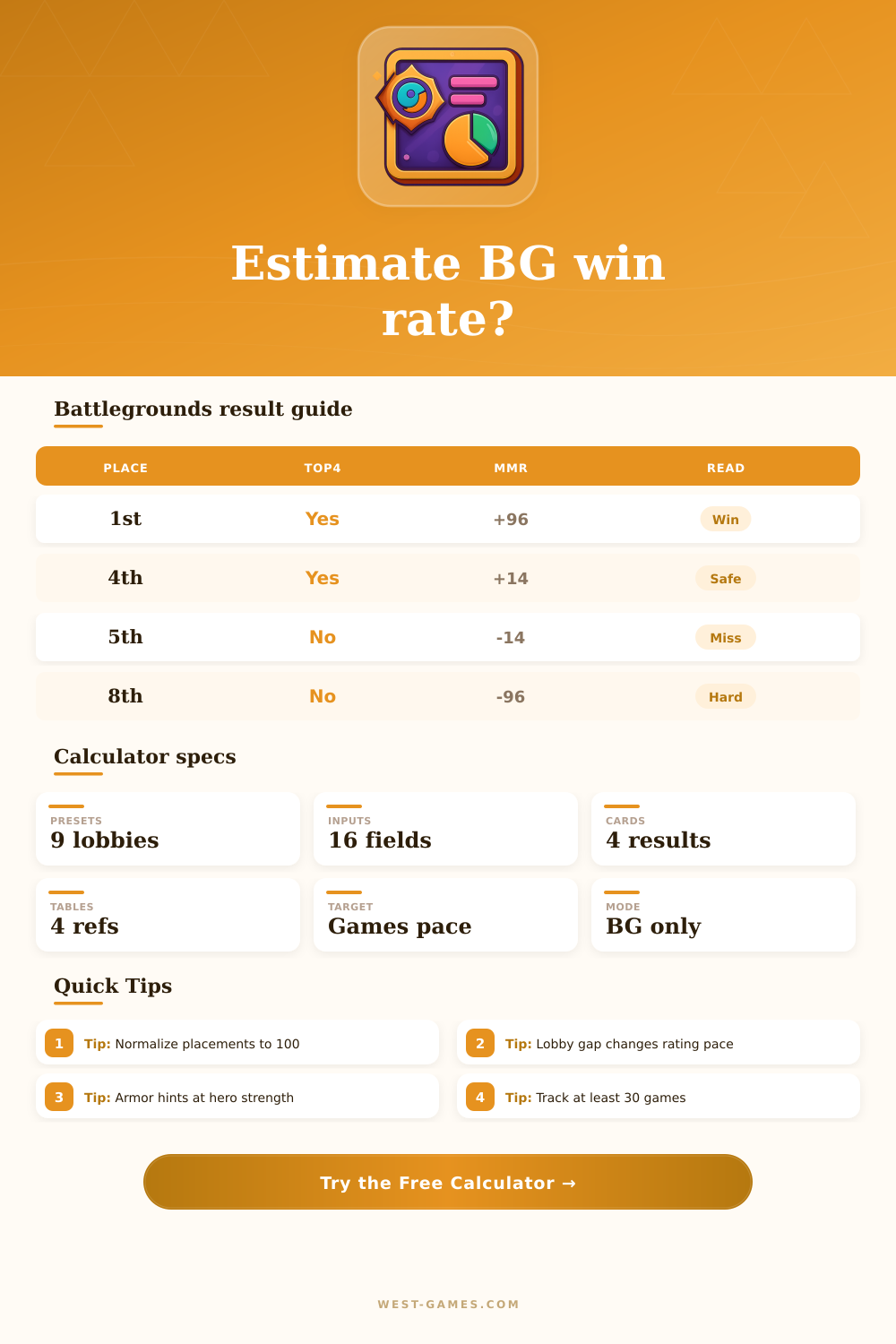
| Place | Base rating | Top-4? | Calculator meaning |
|---|---|---|---|
| 1st | +96 | Yes | Lobby win and largest MMR push |
| 2nd | +68 | Yes | Strong finish with reliable climb value |
| 3rd | +40 | Yes | Clean positive placement |
| 4th | +14 | Yes | Small gain or loss prevention result |
| 5th | -14 | No | Narrow miss with manageable damage |
| 6th | -40 | No | Clear losing finish |
| 7th | -68 | No | Heavy loss and review signal |
| 8th | -96 | No | Largest single-game rating hit |
Real Battlegrounds rating can vary by lobby composition and account state. The table is a transparent planning model.
| Signal | Adjustment | What it means | Best use |
|---|---|---|---|
| S tier | +8 EV | Premium tempo or direction | Push sessions |
| A tier | +4 EV | Strong average hero | Default laddering |
| B tier | 0 EV | Fair lobby baseline | Neutral comparison |
| C tier | -5 EV | Needs good shops or matchup | Cautious targets |
| D tier | -10 EV | Narrow or underpowered profile | Recovery planning |
| Low armor | Strength cue | Often means stronger hero kit | Rating EV |
| High armor | Buffer cue | Softens early damage risk | Top-four play |
Armor changes over time, so the input is manual. Use the current in-game armor value when comparing heroes.
| Lobby gap | Rating pressure | Top-four read | Target pace |
|---|---|---|---|
| -800 or less | Favored | Needs clean top fours | Low reward |
| -300 to -799 | Slightly favored | 5th hurts more | Slow climb |
| -299 to +299 | Fair lobby | Placement EV leads | Normal |
| +300 to +799 | Underdog value | Top four pays better | Faster if stable |
| +800 or more | Hard lobby | Even 4th has value | High swing |
A stronger lobby increases upside for good finishes, while easier lobbies demand stronger average placement to climb.
| Metric band | Strong | Neutral | Warning |
|---|---|---|---|
| Top-4 rate | 56%+ | 49-55% | Under 49% |
| First-place rate | 14%+ | 10-13% | Under 10% |
| Average place | 4.10 or less | 4.11-4.55 | Above 4.55 |
| Rating EV | +20/game | -5 to +19 | Below -5 |
| Sample size | 80+ games | 30-79 games | Under 30 |
Top-four rate measures stability, first-place rate measures ceiling, and average placement keeps both signals honest.
| Place | Normalized share | Base rating | EV contribution |
|---|---|---|---|
| Calculate to populate placement contribution rows. | |||
Percentages are normalized if they do not add to exactly 100%, so the calculator can still return a usable estimate.
At some point playing Battlegrounds, you’re going to realize that your rating stays flat or even drops. You might even nail down several fourth place spots and feel good about yourself, but you’re still not improving overally. That’s because each game alone doesn’t paint an accurat picture of how well (or poorly) you are performing.
The score don’t just highlight one result; you can use a calculator to see your full distribution of results. It takes away the emotion of poor hands and reveals if your plan is valid.
Why You Should Use a Calculator to Improve Your Rating
Winning is good! And so most people focus on winning percentage. But Hearthstone Battlegrounds is not a first-place game, it’s a top-four game. Even if both third and fifth feel like close calls to you, there’s a big difference in your ratings between those two spot. Seeing your entire distribution of placements, a tool will force you to consider expected value. Maybe you win ten percent of the time but also miss out on the top four forty percent of the time. You’re losing rating much more quickley than you think. So many people chase highlight reels instead of controlling their baseline performance.
However, it’s important to know that your inputs will matter more different than you think. You set the baseline difficulty by inputting your own MMR and the lobby’s average. That means a first place finish against players who are 100 points below you will not be as valuable as a first place finish when you play with people whose ratings is 200 points higher than yours. Because they’re rewarding beating stronger players, a fourth place finish in an elite lobby can mean even more rating than a second place finish in a lower-rating lobby. The calculator factors that difference into account. It corrects for how much better you did than the other people playing which helps you know whether your results were lucky compared to weaker fields, or strong compared to those around you.
Tier profiles and armor also add another level of detail that people tend to overlook. The lower-armor heroes are generally the ones with stronger kits. This imply that they are trying to win early engagements and scale up over time, conserving their health. Meanwhile, the higher-armor heroes provide a buffer for bad luck but they often demand perfect late-game performance.
That’s where risk profile comes into play. Are you willing to play it safe-and-steady? Doing so will help you get into the top four, but perhaps limit your first-place ceiling. Or do you want to take risks to maximize your chance at first place? The tool reveals the tradeoff, showing you how various placement mixes impact your long-term climb. It doesn’t tell you what hero to pick; rather, it demonstrates the cost in terms of variance when you choose that hero.
The silent killer is sample size. Do you know what ten games means? No. It doesn’t mean jack squat in terms of your skill. All it means is that you’ve been lucky on a Tuesday night. At minimum, we need thirty to fifty games before the data levels out and the placement average begin to have meaning.
Below 4.1 on average means you’re beating the median player consistently. Above 4.5 means you’re losing most of the time, even if you get some first place wins here and there. The norm tables included with the calc make this all clear so that you can gauge your own stats against established norms.
This isn’t about win/loss; it’s about audit time. It’s not like you’re watching a sports game; we want to see the big picture here: Are you seeing an expense trend? Are you seeing a revenue trend? You input all your numbers, then let it spit out the results. How many more games until your desired rating? Too high? Time to adjust course, not grind it out even harder.
You should of realized this sooner. Perhaps you missed the upside by being too conservative. Perhaps you’re going balls-to-the-wall in pursuit of first-place, but dying in fifth. Knowing the price of each wrong move lets you adjust the controls. It’s not about being perfect. It’s about making forward progress while keeping one eye open.
You’ll continue to get stomped by worse players and bad RNG. However, understanding precisely how your rating will change enables you to stop pointing fingers at the universe and focus on refining the strategy.
The rules hold true whether you’re trying to climb from Bronze into Diamond or push for Master rank. Respect the strength of the lobby. Manage the top-four floor. Record enough information to have confidence in the signal rather than the noise. That clarity is far more valuable than a single victory.