🎯 Dota 2 MMR Calibration Calculator
Estimate a calibrated Dota 2 MMR range from calibration games played, starting uncertainty, prior MMR estimate, win/loss sequence, role performance, and solo or party mix.
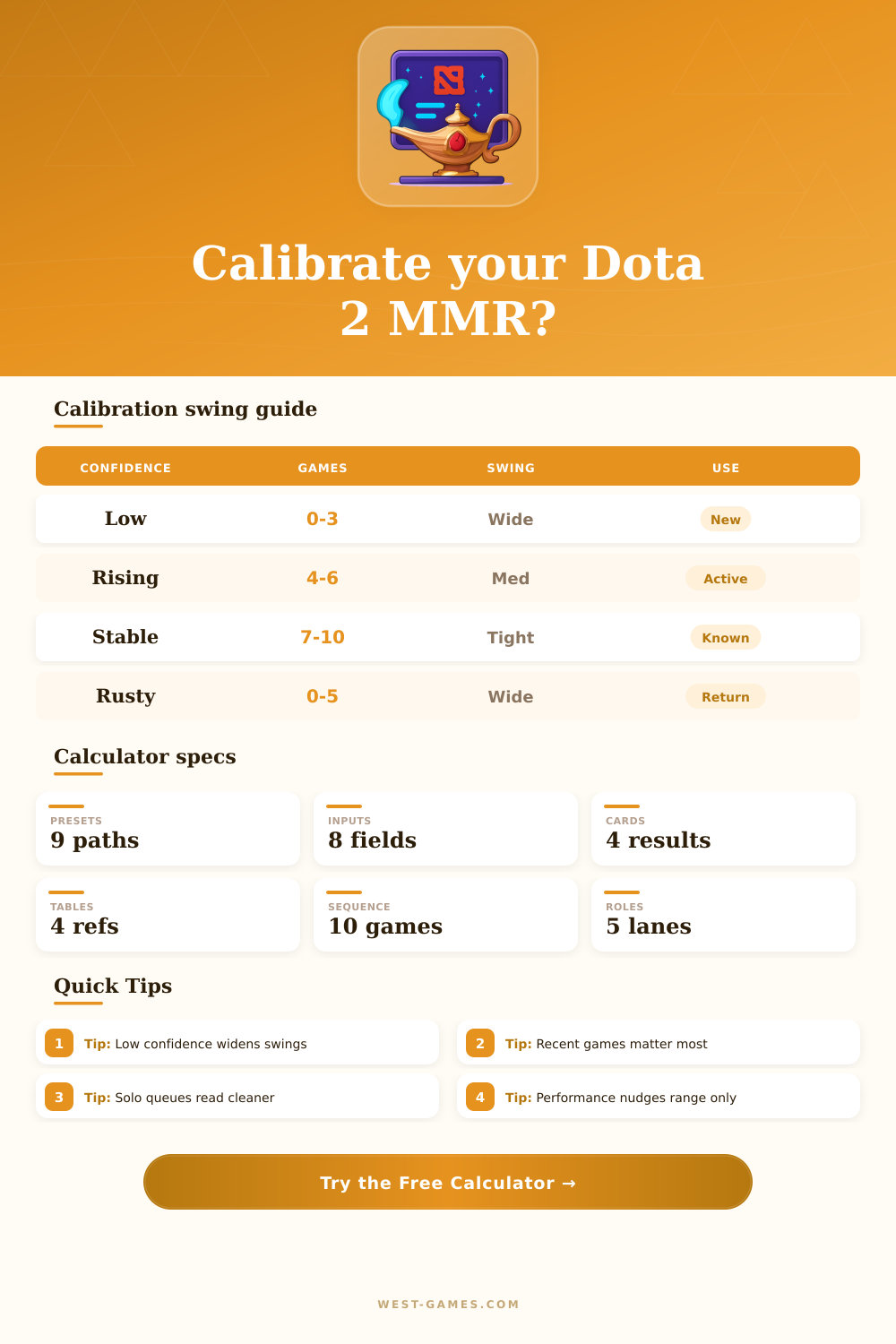
| Setting | Result pull | Base range | Use case |
|---|---|---|---|
| Very low | Small | 160 | Recently ranked |
| Normal | Medium | 230 | Active account |
| High | Strong | 320 | Returning player |
| Very high | Sharp | 430 | New or long break |
Public Dota explanations describe rank as paired with rank confidence; this calculator models lower confidence as wider movement.
| Record | 10-game rate | Typical pull | Signal |
|---|---|---|---|
| 8-2 or better | 80%+ | Large gain | Strong climb |
| 6-4 to 7-3 | 60-70% | Gain | Positive |
| 5-5 | 50% | Small | Prior holds |
| 3-7 to 4-6 | 30-40% | Drop | Negative |
| 2-8 or worse | 0-20% | Large drop | Reset lower |
Later games are weighted slightly more because they are closer to the final visible calibration result.
| Rating | Core nudge | Support nudge | Read |
|---|---|---|---|
| Poor | -70 | -50 | Low impact |
| Below avg | -35 | -25 | Rough games |
| Average | 0 | 0 | Neutral |
| Above avg | 40 | 30 | Helpful |
| Excellent | 85 | 65 | High signal |
The calculator keeps performance secondary so one good KDA does not overpower actual wins and losses.
| Bracket | Anchor | Low | High |
|---|---|---|---|
| Herald-Guardian | 650 | 0 | 1385 |
| Crusader | 1850 | 1540 | 2310 |
| Archon | 2620 | 2310 | 3080 |
| Legend | 3390 | 3080 | 3850 |
| Ancient | 4160 | 3850 | 4620 |
| Divine+ | 5120 | 4620 | 6000+ |
Medal anchors are approximate planning bands and can lag behind the hidden rank estimate during calibration.
After a long time away from clicking that matchmaking button, you’re quietly anxious. You remember that you used to have a high rank, but Valve won’t reveal your actual MMR, they keeps it hidden behind a medal icon. What if you lose your first few games? Did you fall down a rank? Or did you catch some noise? There’s a word for that sensation within the community. It’s the chasm between how you see yourself and how the system sees you.
That’s where this tool fills the gap: it takes what we normally think of as intuition and makes it into a range. Instead of guessing based off 10 matches, you input how you played the roles. You also input your win/loss string and your previous guess for MMR. Then, it do the math for you.
How the Calculator Helps You Understand Your Rank
After plugging those numbers into the calculator above, you’re no longer trying to reverse engineer Valve’s secret variables. For us, calibration is not a number but a band of probabilities that shrinks with every match. Rank confidence only become apparent when something bad happens and most people don’t consider it. The system doesn’t know what your skill level are if you’re new or haven’t played for a while. And if it’s uncertain of your skill level, then any given outcome is going to shift your rank more substantialy. Every win isn’t a point added, it’s an event that removes some degree of doubt from the system.
So if you go into the system with your initial uncertainty set to something super high because you’ve been gone for a year, that means the model think it will need to see you play a lot before it stops treating every game like a big swing. That’s intentional. Valve want to know what to expect before they stop taking every game seriously. It doesn’t hurt that your win-loss ratio isn’t in a vacuum. Recent matches is given greater weight, as they’re closer to your present skill. Four victories near the end of calibration contain more information than four victories early on. It’s similar to how real-life matchmaking algorithms changes their certainty levels. You don’t need to show that you know how to win, you need to show that you can win right now.
But there’s another detail pure win rate fails to capture: how players choose their roles. If you play perfectly in a game you lost while carrying as position one, that sends a different message than playing perfectly in a game you lost but supported as position five. To compensate for this, the calculator require a performance rating. This is meant to be a small nudge, not a substitute for looking at the scoreboard. You can have a perfect KDA and still lose ten games, and the system will drop your rank regardless of your personal brilliance. They conflate team results with individual stats. Because the tool values wins above all things, it use role performance as a way to fine tune the range only when the results become unclear.
Solo vs. Parties: When you calibrate alone, there’s little room for the kind of noise introduced by playing in a big group whose members has wildly different skill levels. In these cases, it’s hard to know which person was responsible for whatever happened so the system expands its estimate range to account for that uncertainty. Solo queues offer a purer reading, since they’re both uncontested (no teammates to hide behind) and binary (you’re good enough or not). Play solo if you care about precision. If you would rather hang out with some pals, embrace the fact that your rank will bounce around a bit as the system learns who did what.
The reference tables below shows what happens when you change settings. They show that a 50 percent win rate doesn’t always mean staying in the same place. In some cases, breaking even might widen or narrow your range based off your previous MMR and how confident you were. It’s a bit complex but it changes the mindset for the in-between games. Don’t be conservative when calibrating to maintain rank. Go all-in to demonstrate skill and reduce variance.
In conclusion, calibration isn’t so much an uphill struggle as it is getting a clear view. You’re aiming to reduce the range so that each match will feel like a logical continuation. Rather than a sudden swing, you want small, controllable increases/decreases in your MMR where you’ll have confident stability. Before queuing, use the calculator to set your expectations. Will you be satisfied with a large band? Or do you need to grind for something tighter? What information can you use to turn your nervous guessing into patient understanding?
You’ve still gotta win those games. But now you’ll know why the rank appears how it does after the fact.