🎮 Heroes of the Storm MMR Calculator
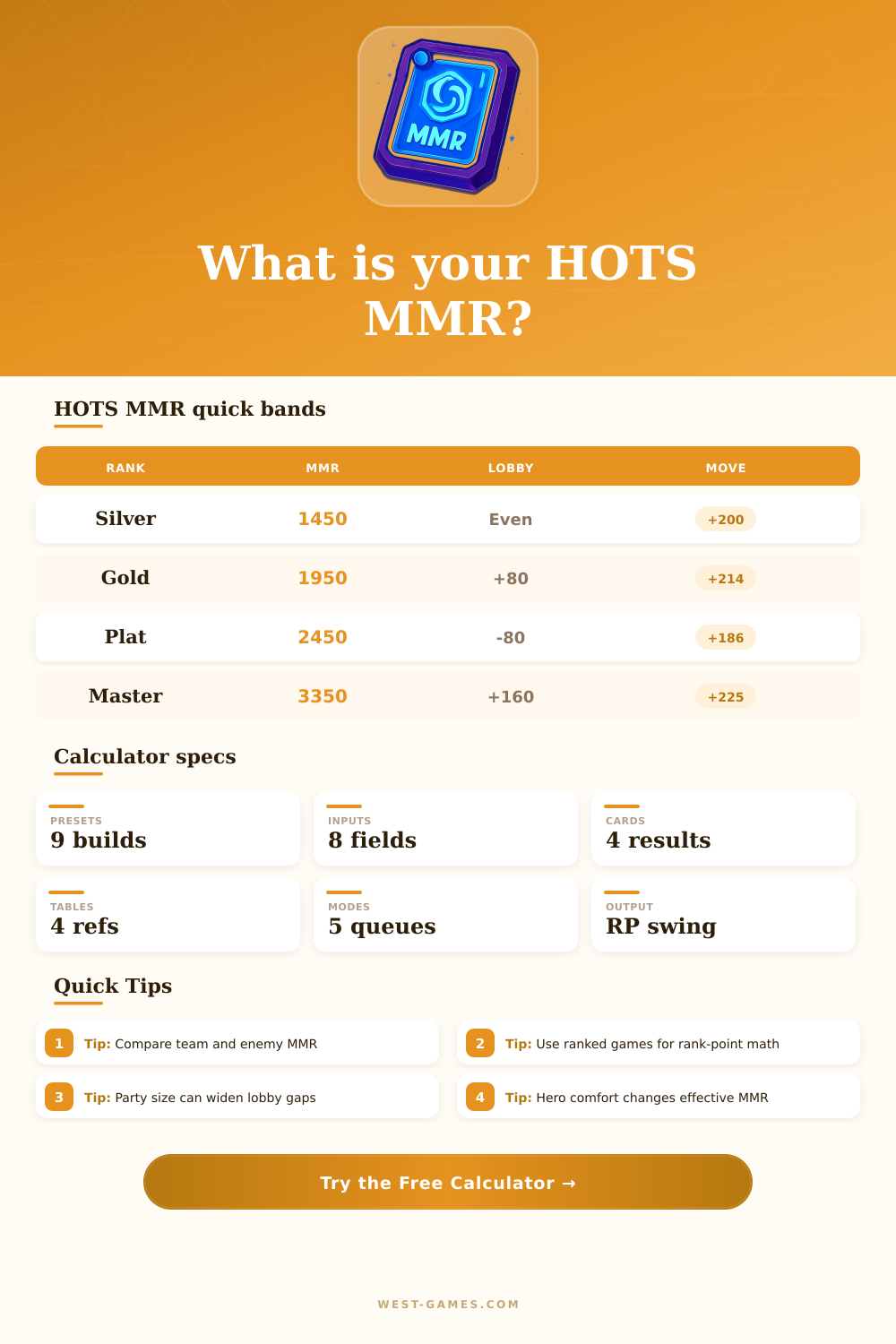
Estimate hidden MMR, lobby strength, role comfort, party pressure, streak effect, and expected Storm League rank-point movement.
| Rank band | Baseline MMR | Division step | Use |
|---|---|---|---|
| Bronze | 800-1200 | 100 | Repair climb |
| Silver | 1300-1700 | 100 | Queue steady |
| Gold | 1800-2200 | 100 | Average ladder |
| Platinum | 2300-2700 | 100 | Strong games |
| Diamond+ | 2800+ | 125+ | High lobby |
These are modeling bands for calculator consistency, not official Blizzard hidden MMR values.
| Mode | RP model | Volatility | Reading |
|---|---|---|---|
| Storm League | Full | 1.00 | Rank climb |
| Unranked | Hidden only | 0.92 | Draft read |
| Quick Match | Hidden only | 1.12 | Hero queues |
| ARAM | Hidden only | 1.18 | Mode MMR |
| Custom | Practice | 0.70 | Scrim balance |
Non-ranked modes show expected hidden strength direction; Storm League is the only rank-point output.
| Role profile | MMR effect | Risk | Why it matters |
|---|---|---|---|
| Tank | +70 | Medium | Engage control |
| Bruiser | +60 | Medium | Map pressure |
| Healer | +55 | Low | Team stability |
| Ranged | +45 | Medium | Damage uptime |
| Flex fill | -45 | High | Comfort loss |
Hero comfort changes effective next-game strength more than it changes your permanent MMR estimate.
| Signal | Effect | Range | Interpretation |
|---|---|---|---|
| Solo | 0 | Stable | Cleanest read |
| Duo | +25 | Small | Coordination bump |
| Three | +45 | Medium | Wider lobbies |
| Five-stack | +85 | Wide | Team synergy |
| Streak | +/-15 | Per game | Momentum read |
Party coordination can improve expected odds while also making matchmaker comparisons less clean.
Have you ever been annoyed at not seeing your true rank in Heroes of the Storm? You dominate; you get wins; yet you climb ranks at a snails pace. You play what feels like a fluke loss, and penalty is far too steep. Why? Because your displayed rank is just a label. Underneath layer of leaderboards is where we’re actualy measured, by our hidden Matchmaking Rating (MMR).
Because your displayed rank is meaningless. Underneath the layer of leaderboards is where we’re actually measured. By our hidden Matchmaking Rating (MMR). This is our true skill level. MMR is typically treated by most player as an absolute value. While it can be described as such, a better way to understand it is as a probability distribution that becomes tighter with each match played.
Understanding Hidden MMR
At the beginning of season (or when entering new queue), the system knows very little about you. It puts you into a wide band and then applies big jumps in rank points to rapidly identify where you belong. As it gains confidence in your position, that variance decreases.
The calculator above estimates this hidden rating by blending what we see with contextual information like current streaks and party size. It doesn’t pull numbers out of thin air. Rather, it attempts to model which factors Blizzard’s matchmaking thinks is important; and thus how heavily they weigh those values when deciding who should be your next opponent.
These inputs are important because they impact your lobby’s effective MMR. Consider party size for instance. Solo queue provide clean data on your personal performance. Stacking up in fives adds a coordination boost… But it also significantly increases the range of possible performance differences between teams. A high average rank five-stack might find itself matched against enemies with lower MMR to balance out the math of the lobby, or vice versa. The tool looks at the spread and adjusts the expected win chance accordingly.
It’s not just about winning. It’s about who you’re winning against. You’ll earn fewer points beating an underdog team compared to beating a stronger one, despite the two looking identical on scoreboard. Additionally, most people don’t consider how role selection can further complicate things. Flex fill players picking new heroes will have different effect on the game’s outcome compared to a tank main controlling the engagement. To account for this, the calculator changes effective strength measure. Playing a comfort pick like a ranged assassin is far more predictable to the system than filling a role you rarely play. This accounts for why it can sometimes seem like even when you’re doing your absolute best in a game, it contribute very little to your climb. It’s measuring consistency, not merely victory.
The other thing about streaks: they’re mechanical and psychological. If you’re on winning streak, it’s more likely that the system thinks your MMR estimate is lower than it actualy is, so it tries you against tougher competition. And if you’re on a losing streak, it might mean you’re placed higher than your true level. You’ll match up with people who shouldn’t of been as hard to beat. But then you go into the match expecting an easy win and get tilted because things didn’t go as expected.
Your streaks serve as one type of input to help predict how you’re going to do in the next several games; maybe you’re “on fire” and should expect wins, or maybe you’re slumping and should expect losses. It sounds like a little thing but it goes toward helping plan out a climb.
The precise coefficients that support these formulas don’t matter, it doesn’t require that level of mastery to apply them well. Simply knowing that rank points are a function of some sort of secret MMR, and knowing that your lobby’s strength depends on its composition will make you think differently about queuing up. The reference table at the bottom of the page shows variance by mode: Quick Match/ARAM tend to be more volatile than Ranked Storm League since they are used for different types of matchmaking. If you go into those thinking “this is my shot to climb ranks” instead of “this is practice getting comfortable with heroes,” you won’t get so bummed out when your points don’t behave like you expect.
To that end, how do you climb up? Basically, Heroes of the Storm isn’t so much a game of grinding as it is one of feeding data into the matchmaker. Each game is a data point. If you play consistently, choose roles in which you’re comfortable, and let the math happen behind-the-scenes, that’s when you start making headway on the ladder.
Don’t worry about winning matches, well, worry about winning matches. Worry about proving to the system that you deserve to be ranked higher then it thinks. When you get an idea for what they’re measuring (that isn’t reflected in the visible rank), the ladder stops feeling like such a mysterious thing and becomes a puzzle you can finally crack.