🎮 ARAM MMR Calculator
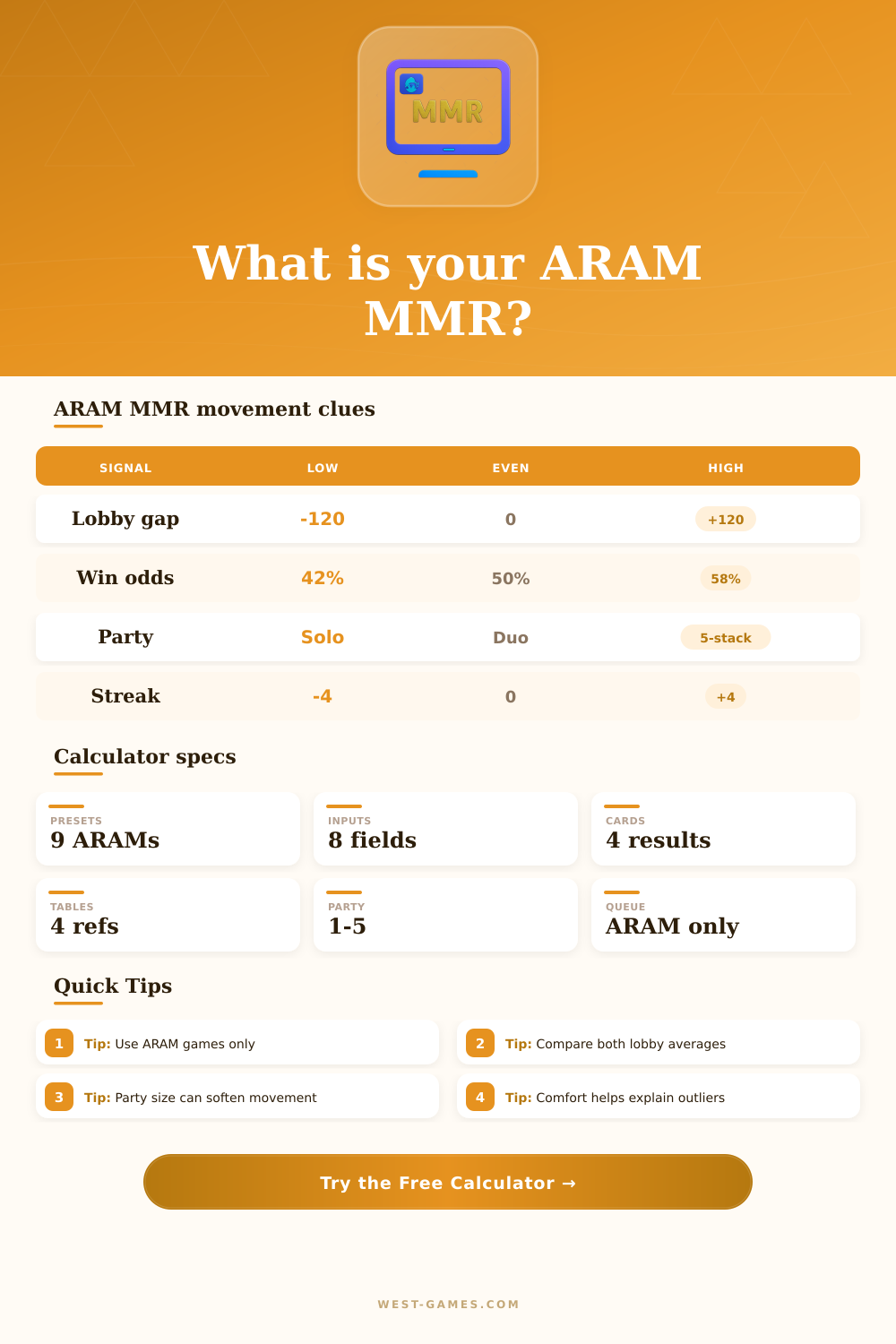
Estimate ARAM-only hidden MMR, lobby expectation, champion comfort pressure, party effects, streak state, and expected movement after one match.
Best when you have a large ARAM match history. It ignores ranked LP and focuses on Howling Abyss lobby strength.
Useful when normal or ranked skill clearly explains your ARAM opponents, especially on accounts with few ARAM games.
Uses team average, opponent average, result, party size, champion comfort, and streak to project the next hidden shift.
| Band | MMR Range | Lobby Feel |
|---|---|---|
| Entry ARAM | 400-899 | Learning queue pace |
| Casual ARAM | 900-1299 | Mixed builds and snowballs |
| Mid ARAM | 1300-1699 | Average teamfight awareness |
| Strong ARAM | 1700-2099 | Clean poke and engage timing |
| Elite ARAM | 2100+ | Draft pressure and fast punish |
| Opponent Gap | Expected Odds | Movement Note |
|---|---|---|
| -200 | 76% win | Small win gain, larger loss hit |
| -100 | 64% win | Favored side movement |
| 0 | 50% win | Normal movement |
| +100 | 36% win | Upset win pays more |
| +200 | 24% win | High reward, low loss penalty |
| Party | Confidence | Typical Effect |
|---|---|---|
| Solo | High | Cleanest personal signal |
| Duo | Medium-high | Small coordination lift |
| Three stack | Medium | Shared outcome signal |
| Four stack | Medium-low | Movement is softened |
| Five stack | Low | Team signal dominates |
| Comfort | Input Adj. | Interpretation |
|---|---|---|
| Reroll panic | -60 | Result may underrate skill |
| Low comfort | -25 | Small performance drag |
| Average | 0 | Neutral context |
| Comfort pick | +25 | Expected output improves |
| Signature | +55 | Result may overstate baseline |
Comfort adjusts the estimate context, not official matchmaking rules.
Your ARAM rank feels like some sort of secret value that fluctuates without notice. One minute you could be losing to inferior players but maintaining your rank, and suddenly you are on a winning streak and dropping down. It’s frustrating until you learn the inner workings. What most people don’t realize is they have an expectation for Matchmaking Rating that doesn’t align with reality. Understanding those processes helps avoid frustration. Instead of just pressing buttons, read what the inputs are and understand them.
For “MMR” input, check out your last few lobbies’ average MMR and use that as a guess. Don’t use win percentage. Don’t use the LP you see on screen. Use the actual skill level of the people you’re playing against. If they’re better, then your “true” rating is lower than you assume.
How Your ARAM Rank Actually Works
This is where the tool comes into play. It compares the average MMR of both teams and adjusts based on how much better or worse they are than you. The bigger the difference, the bigger the upset. And the greater the upset, the more your rating will move up or down afterward.
Comfort picks also plays a surprisingly large role in your performance context. While it doesn’t alter the match-making algorithm, knowing a champion helps stabilize your performance. Whether you play a random pick or a signature hero will impact what the model expects of you. A loss on an unfamiliar champion might undervalue your actual skill. A victory going hard on your main champ isn’t surprising to the system. Consistency offers more meaningful information then variance, and the system is skeptical of outliers.
The problem is that party size introduces a layer of complexity that solo queue players often ignore. In particular, big stack matches is harder for the matchmaking system to judge. The win/loss of your 5-stack isn’t necessarily indicative of how well you played. Whether it was a good team win or a bad team loss, it’s a reflection of the team as a whole. This makes matches less volatile. Playing with friends results in smaller differences in hidden MMR than queuing solo. That is not a bug. That’s a feature intended to lessen wild swings from coordinated play styles which are different than the typical solo player experience.
Finally, most players underestimate the importance of winning and losing streaks. It’s tempting to think you’re being punished for a run of bad games, but more likely the system is adjusting back to your real skill following an outlier (good or bad). Because it accounts for your recent momentum, it projects where you’d be at if you continued queuing up. If you’re on a losing streak and are playing people of much lower quality, it won’t raise your MMR nearly as high as a win would of early in your matchmaking session. The tables has turned.
Your account history can also be skewed due to spillover from other game modes. If you have a short account history, spillover from other queues can temporarily cause your ranked skill to influence ARAM matchmaking. However, the longer you play on Howling Abyss, the more independent the queue gets. This way it doesn’t reward/penalize you for your skills from other places.
It’s all about bridge fighting. The reference table on this page details how lobby gaps impact both your rating movement and win probability. However, keep in mind that ARAM is more about allocating resources and managing waves than it is about aim. Making good decisions when there’s not a teamfight going on is often where people improve their MMR. Losing lanes happens most frequently from chasing down kills over the bridge. Winning games comes from holding position.
When you’ve got those things down, you’ll find your secret rating catches up to your true ability. Don’t worry so much about the number, just play the lane. After that, the points come comfortabley enough.