🎯 CS2 Elo Calculator
Estimate CS2 Premier rating change from current rating, result, opponent gap, round margin, streak pressure, calibration uncertainty, impact, and target rating.
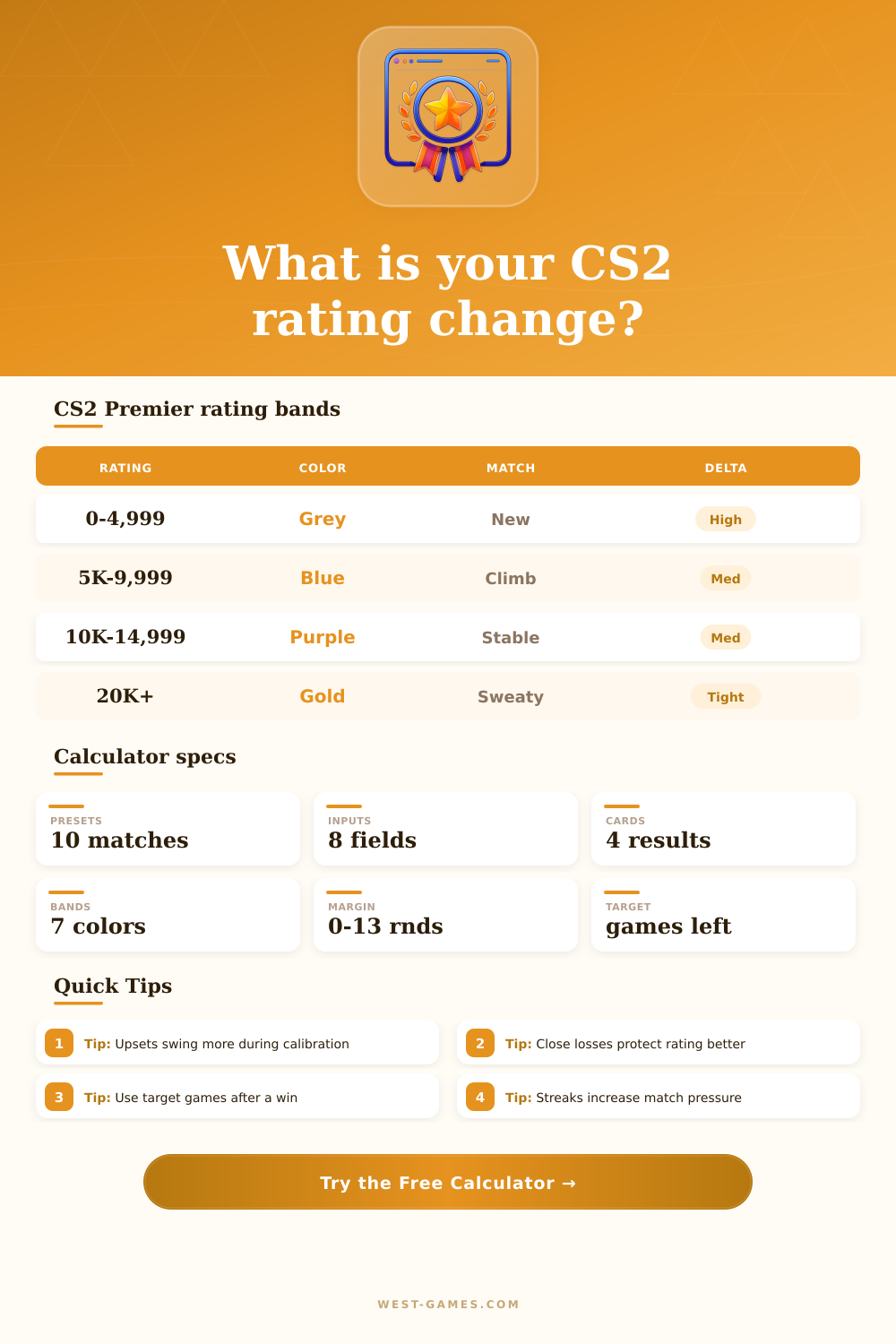
| Rating | Band | Match feel |
|---|---|---|
| 0 to 4,999 | Grey | New Premier, wide skill spread |
| 5,000 to 9,999 | Blue | Basic utility and aim checks |
| 10,000 to 14,999 | Purple | More structured defaults |
| 15,000 to 19,999 | Pink / Red | Trading and mid-round calls matter |
| 20,000 to 24,999 | Gold | Small mistakes create big swings |
| 25,000 to 29,999 | Yellow | High confidence queues |
| 30,000+ | Elite | Very tight expectation gaps |
| Setting | Base | Use case |
|---|---|---|
| Settled account | 165 | Many recent Premier matches |
| Normal account | 215 | Typical active account |
| Returning account | 285 | Confidence loosened after inactivity |
| Calibration | 390 | Rating still being placed |
| Fresh placement | 520 | Widest early swings |
The base value is the calculator's planning swing before expectation, margin, streak, and impact adjustments.
| Score type | Margin | Delta effect |
|---|---|---|
| Overtime or tie | 0 to 1 | Smallest margin adjustment |
| Close regulation | 2 to 3 | Normal confirmation |
| Controlled win | 4 to 6 | Moderate confidence bump |
| Blowout | 7 to 10 | Large but capped adjustment |
| One-sided map | 11 to 13 | Maximum margin pressure |
| Opponent gap | Expectation | Win value |
|---|---|---|
| -3,000 or lower | You are favored | Win pays less, loss hurts more |
| -1,000 to -2,999 | Slight favorite | Clean result expected |
| -999 to +999 | Even queue | Baseline rating movement |
| +1,000 to +2,999 | Slight underdog | Win gains extra value |
| +3,000 or higher | Heavy underdog | Upset gains are strongest |
| Preset | Rating | Result | Why it matters |
|---|---|---|---|
| Fresh 4K Calibration Win | 4,200 | Win by 5 | Shows early placement volatility with a positive result |
| Blue 9K Close Loss | 9,350 | Loss by 2 | Tests a protected close loss during normal uncertainty |
| Purple 12K Underdog Upset | 12,800 | Win by 4 | Rewards beating a noticeably stronger lobby |
| Pink 15K Standard Win | 15,250 | Win by 3 | Baseline settled-account climbing estimate |
| Red 18K Blowout Win | 18,650 | Win by 9 | Measures margin confirmation without uncapped inflation |
| Gold 20K Tie Stabilizer | 20,400 | Tie | Shows how expectation can still move a draw slightly |
| Gold 22K Favorite Loss | 22,300 | Loss by 5 | Highlights harsh losses when your team was favored |
| Yellow 25K Promotion Push | 25,100 | Win by 2 | Estimates grind games toward the next visible milestone |
The Premier rating in CS2 change based on many differents factors. These factors influence the movement of the Premier rating based on an outcome of the match. The movement of a persons Premier rating also depends on the strength of their opponent.
Due to these variables, people can understand how the Premier rating of a player move in a certain way. Furthermore, these variable will allow people to plan for how their Premier rating will change in the future. Several specific input will determine how the Premier rating changes after each match.
How Your CS2 Premier Rating Changes
One of these specific inputs will be an current Premier rating of a person. Another specific input will be the opponent gap. If the opponent gap are positive, it means that the players is the underdog for the match.
Another specific input will be the round margin. Another specific input will be the streak that a player has. Finally, the last specific input will be the calibration uncertainty and personal impact on the match.
The rating calculator will help a player to understand the delta that their Premier rating is likely to change by using the different inputs for each match. The delta is the amount that a player’s Premier rating change after each match. This calculator will also help a player to understand the number of match with similar result that are necessary for a player to reach there target Premier rating.
People should consider planning their matches to account for the fact that Premier rating movement will slow as a player reach higher rating. For instance, winning a match at a 12,000 rating will result in a more higher delta than winning at a 20,000 rating. The reference tables will allow a player to understand if the outcome of their match will result in a large or small change to their Premier rating.
Many people will misread a close result for their Premier rating because they dont consider the strength of their opponents when they is calculating their results. For example, winning a close match against strong opponents will result in more movement in the Premier rating than winning a close match against weak opponents. In both instances, the score will be the same.
Losing a match to a lower rated player will cost more Premier rating than losing to a higher rated player. Furthermore, the system reward players for winning matches but maintains the accuracy of the ladder for all players. Another factor to consider for the calculation of the change in a player’s Premier rating will be the streak of that player.
For example, winning a match after losing several matches in a row will result in a modest change in the player’s Premier rating. Winning a match during a winning streak will result in a higher change in the player’s Premier rate. Losing a match during a losing streak will result in a slight decrease to the players Premier rate, but it is a small adjustment to the rate.
These changes in the Premier rate will accumulate over time. Calibration uncertainty will move a player’s Premier rating more quickly under certain condition. For example, new player will experience more volatility in their Premier rate than returning players.
This volatility will allow for new players to find there correct Premier rating for the program quick. A more established player will have a decrease in the calibration uncertainty of their Premier rate and changes in that rate will be small. Round margin will impact the changes in a player’s Premier rate but will have a smaller impact than either the streaks or the calibration uncertainty of their Premier rate.
Winning a match with a controlled win will help to add more confidence to the player’s rate, but there will be a cap to the change in the players Premier rate. This is to ensure that losing a match during an overtime does not erase the number of wins for that player in other matches. An overtime draw for a match will result in minimal change to a player’s Premier rate.
The best use of this information will be for planning purposes. People should use the inputs to simulate the result of different number of matches before queuing up to play a match. If the projected change to the Premier rate is lower than the player would like, then the player can adjust the variable that they can control before queuing for another match.
Once players have adjusted to the factor that will impact their rate, they should queue up for their next game to observe changes in their Premier rate.