⚡ Lightning Spell Air Defense Calculator
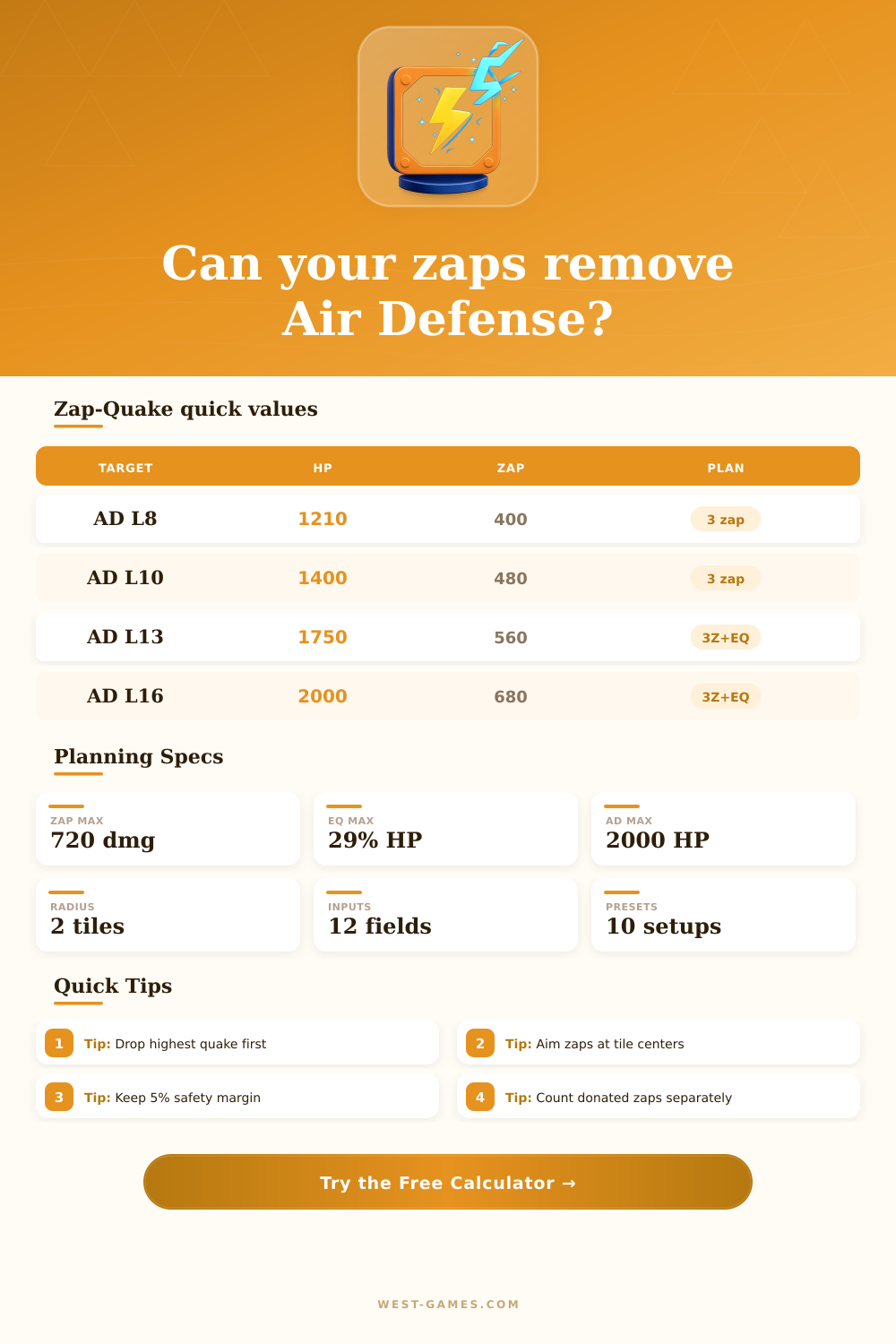
Plan Clash-style Zap-Quake breakpoints for Air Defense HP, home zaps, donated zaps, quakes, and safety margin.
| Package | Damage | Margin | Status |
|---|
| Level | Damage | Use note |
|---|---|---|
| 1 | 150 | Early spell factory |
| 2 | 180 | Starter upgrade |
| 3 | 210 | Low TH support |
| 4 | 240 | Basic zap plan |
| 5 | 270 | TH8 dragon setup |
| 6 | 320 | TH9 transition |
| 7 | 400 | TH10 breakpoint |
| 8 | 480 | TH11 air attacks |
| 9 | 560 | High value zap |
| 10 | 600 | Late-game support |
| 11 | 640 | TH16 lab range |
| 12 | 680 | TH17 lab range |
| 13 | 720 | TH18 lab range |
Lightning damage is flat. Accuracy only matters if the bolt radius misses or clips the target.
| Level | HP | Typical TH |
|---|---|---|
| 1 | 800 | TH4 |
| 2 | 850 | TH4 |
| 3 | 900 | TH5 |
| 4 | 950 | TH6 |
| 5 | 1000 | TH7 |
| 6 | 1050 | TH8 |
| 7 | 1100 | TH9 |
| 8 | 1210 | TH10 |
| 9 | 1300 | TH11 |
| 10 | 1400 | TH12 |
| 11 | 1500 | TH13 |
| 12 | 1650 | TH14 |
| 13 | 1750 | TH15 |
| 14 | 1850 | TH16 |
| 15 | 1950 | TH17 |
| 16 | 2000 | TH18 |
Use custom HP for supercharge states or if an in-game info screen shows a different value.
| EQ level | Building hit | Radius | Zap value |
|---|---|---|---|
| 1 | 14.5% | 3.5 tiles | Small soften |
| 2 | 17% | 3.8 tiles | Low helper |
| 3 | 21% | 4.1 tiles | Mid helper |
| 4 | 25% | 4.4 tiles | Strong helper |
| 5 | 29% | 4.7 tiles | Max building |
| 6 | 29% | 4.7 tiles | Troop bonus |
| 7 | 29% | 4.7 tiles | Troop bonus |
| 8 | 29% | 4.7 tiles | Troop bonus |
Repeated quakes against the same building use 1/(2n-1) scaling, so one quake is usually the key breakpoint.
| Priority | Score | Best when | Risk |
|---|---|---|---|
| Air first | 85 | Dragons need path | May miss sweeper |
| Sweeper bundle | 96 | Both fit radius | Tight placement |
| Queen bundle | 92 | Hero is clipped | HP mismatch |
| Double defense | 94 | Two towers touch | Split accuracy |
| Save spells | 62 | Backend is scary | AD survives |
| Cleanup only | 40 | Troops can finish | Wasted spells |
High score means the target is usually worth spell investment if the damage breakpoint is clean.
| Setup | Target | Package check | Planning note |
|---|---|---|---|
| TH8 Dragons | AD L6 | 4 L5 zaps or 3+EQ | Quake saves one zap when available |
| TH10 Dragons | AD L8 | 3 L7 zaps near exact | Small margin, aim carefully |
| TH11 Electro | AD L9 | 3 L8 zaps clear | Use CC zap for second target |
| TH13 Hydra | AD L11 | 2 L10 + 1 EQ is close | Add safety if Builder repairs |
| TH15 Super Dragons | AD L13 | 2 L12 + 1 EQ clears | Bundle Sweeper if centered |
| TH18 Air Hit | AD L16 | 2 L13 + 1 EQ clears | Watch supercharge and repairs |
These are calculator-style breakpoints, not attack orders. Always confirm live HP and spell levels before war hits.
Air attacks depend on status of the Air Defenses in the defenses to the castle. Air attacks will succeed or fail based off whether or not the Air Defense towers remains standing. Should a player leave one Air Defense tower online, that Air Defense tower has the potential to destroy a Dragon or an Electro Dragon prior to the Dragon reaching the castles Core.
Because Air Defense towers have the ability to destroy troops, it is common for players to use Lightning spells to perform this function during the early portion of an attack. Beyond simply dealing damage to the target with a spell package, a player also desires to ensure that the player eliminates the target with enough margin to account for the possibility of a misclick or repair of that Air Defense tower. Lightning spells have a fixed amount of damage.
How to Plan Spells for Air Defenses
Thus, the spell calculation for Lightning spells is straightforward should a player know the hit points of the target that is to be attacked. However, there are a number of factors that may influence spell outcomes. For example, the target itself may have some damage already built up as a result of previous attacks.
Additionally, any donated spells will have a different level than the spells that is active within a players laboratory. Spells like an Earthquake spell can help to soften a target, but only with the first of any number of Earthquake spells that are cast; later spells will return less of the full value of the spell. The calculator can perform all of the math necessary to calculate the outcomes of using these spells once the player has input there spell levels, there spell counts, and the health of the target defenses.
Accuracy is a factor of spell planning that many players dont consider to be important. Accuracy is, however, a factor that can contribute to the success of spell placement. For example, a Lightning spell will hit the edge of a two-tile radius, but a shift in placement or a misread of the defenses may prevent the spell from dealing any damage to the target.
Thus, the calculator includes a field for entering a safety margin for spells. Five percent of safety margin is important to include to cover the scenario in which a defense with survive a Lightning spell with hit points; in such a scenario, the defense may call in a repair spell. Additionally, a repair buffer is important in defenses with high levels of the Town Hall as Builder Huts can restore the health of a defense during an attack.
There are different priorities for spell placement depending on the type of army that is sent towards the castles defenses. For example, removing an Air Defense that also has the potential to attack troops with a Tornado Trap or an Air Sweeper is more important than removing an Air Defense that does not have these types of traps. Thus, the calculator also allows players to flag these difference in value so that the spell recommendation accounts for their difference in value to the attack.
For instance, if an Earthquake spell can save two Lightning spells in value, the use of the Earthquake spell is a positive decision. However, if an Earthquake spell does not save any Lightning spells, the Lightning spells should be saved for later targets in the castle. The tables included at the bottom of the calculator are provided as a quick reference for players; they are not to be memorized.
While it is possible for players to memorize the breakpoints for spell damage, the tables are provided as a means of providing an easy reference for the impact of a balance patch or the change in a base’s defenses. Additionally, the tables help to teach players why earthquake spells begin to lose there value when used more than once, which helps to prevent overinvestment in such spells. Common mistakes with the use of Lightning spells involve donated spells and accuracy mistakes.
For instance, a difference of only one or two levels in a donated spell may be the difference between success and failure of a spell package that is otherwise near to completing the target’s health with Lightning spells. Additionally, it is common for many to consider every Lightning spell to deal with a full hit to the target; however, by lowering the accuracy in the spell calculator, the player forces the player to create a plan that considers the possibility that not every Lightning spell will deal with its full potential damage. The primary skill in planning spell packages is to determine whether or not an Air Defense is worth the cost of the spells that would be used to eliminate that Air Defense.
In some defenses, an Air Defense is left exposed to the players spells; however, the value of that Air Defense may be low if the castle also has other damage to that same building. In other castles, the Air Defense may be buried in the defenses to the castle so that if the spell is used incorrectly, all of the effort invested in creating the spell package is wasted. Thus, the calculator cannot read the base itself, but it can tell the player of the minimum package of spells needed if the player has decided of the value of the target itself.
Many players make mistakes with the planning of their spells; players who do not consider the current hit points of the defenses that need to be eliminated, who do not account for the level of any donated spells, or who do not consider the value of the target themselves will either use too many spells or too few to successfully eliminate all of the targets in the castles defenses. Players who do account for these factors will find success in the number of spells that is prepared for the attack itself.