Multiverse Tower Defense Value Calculator
Estimate a unit's assumption-based trade value, progression investment, demand pressure, and stability band without claiming live market prices.
Full Breakdown
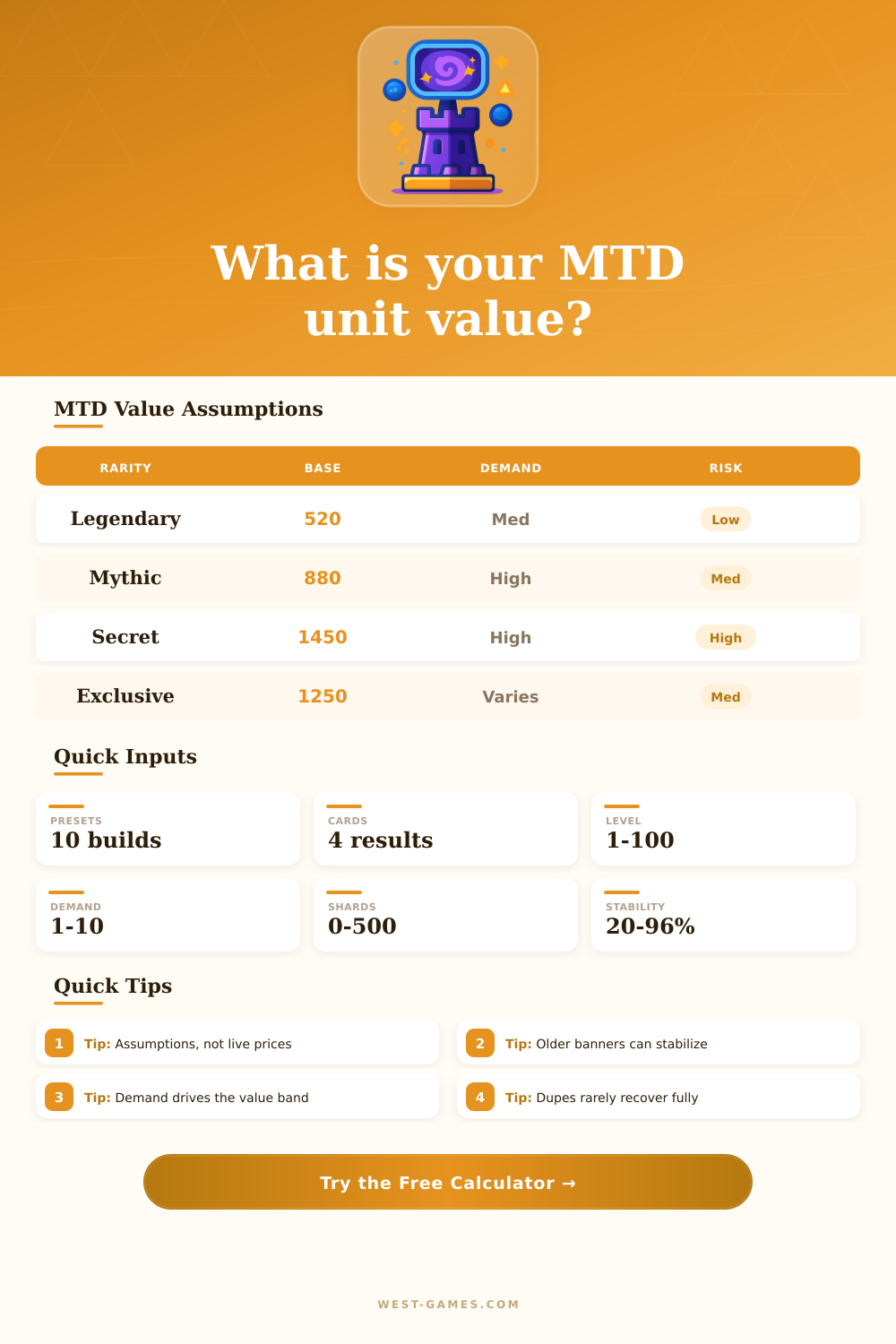
These are internal calculator assumptions for relative comparison. They are not live market prices, official values, or guaranteed trade outcomes.
| Rarity | Base value points | Typical value driver | Stability note |
|---|---|---|---|
| Rare | 80 | Starter progression and collection fill | Stable but usually low ceiling |
| Epic | 180 | Early account utility or niche trait | Moderate if useful, weak if outclassed |
| Legendary | 520 | Accessible carry or strong support | Good stability when demand is steady |
| Mythic | 880 | Meta relevance, evolution, and trait quality | High upside with update volatility |
| Secret | 1450 | Scarcity, flex value, and collector interest | Can swing if demand is collector-led |
| Exclusive / limited | 1250 | Availability window and rerun uncertainty | Often stabilizes as banner age increases |
| Category | Assumption multiplier | When it helps most | Value caution |
|---|---|---|---|
| Swift / cooldown trait | 1.08x | Fast clear units and support uptime | May be less valuable on slow niche units |
| Damage or range trait | 1.12x to 1.14x | General DPS and placement-flex units | Trait value depends on the unit kit |
| Godspeed / celestial trait | 1.23x to 1.32x | High-demand units with meta roles | Premium can fade if balance changes |
| Overlord / chase trait | 1.42x | Showcase trades and perfect builds | High value band because buyer pool narrows |
| Evolution ready | 0.96x | Useful when materials are verified | Not the same as evolved utility |
| Evolved | 1.18x | Units with strong evolved passives | Less impact if evolution is cosmetic only |
| Factor | Low assumption | Middle assumption | High assumption |
|---|---|---|---|
| Demand score | 1-3: niche or cooling | 4-7: normal trade interest | 8-10: active chase demand |
| Banner age | Current units can be volatile | 1-4 months often normalizes | Old limited units can gain stability |
| Dupe investment | Small boost for 1-2 copies | Useful at 3-5 copies | Past that, recovery is capped |
| Shard investment | Minor value if easily farmed | Meaningful for slow shard grinds | Still rarely returns full effort |
| Trade confidence | Uncertain rules lower value | Limited access narrows buyers | Open tradeability supports stability |
Fresh Pull
High attention, lower stability, and less proven long-term demand.
Meta Evolved
Strongest blend of utility, demand, trait leverage, and trade interest.
Collector Secret
Scarcity can lift value, but buyer pool may be narrower and swingier.
Old Limited
Age can improve stability when reruns are uncertain and demand remains active.
Trading in Multiverse Tower Defense involves calculating the value of a unit that is traded. Trading in Multiverse Tower Defense requires player to understand the difference between the cost to build a unit and the value that a unit will recieve in a trade. In many cases, players will encounter difficulties when trading if they arent aware of the difference between these two value.
The calculator will provide an estimate of the value of the unit based off the specific detail about that unit. Rarity provides a minimum value for a unit but does not always provide the maximum value of a unit. For instance, a unit with Mythic rarity may trade for less than a unit with Legendary rarity if the demand for Mythic unit has decreased or if the trait of the Mythic unit is poorly.
How to Estimate a Unit’s Trade Value
The role of the unit, the quality of the trait of the unit, and the evolution of the unit all must be entered into the calculator because these three attributes will determines whether the unit can solve the problems that the buyer is experiencing in their games. A support unit with a strong buff trait will hold its value even if the meta changes, but a unit that deals damage will lose its value within the market if a new unit with betterer damage multipliers is introduced. Banner age will affect the value of the unit in two ways.
First, the age of the unit will create volatility or stability in the market for that unit. New units will be of interest to many players as they test out the new units, but the value of those units are volatile because a new patch may change the value of that unit. Finally, as the units age, the players will understand the value of those units and older units will have stability in their values.
The age of the unit input accounts for both of these factors; limited units that are introduced to the game will be stable for some but lose value for others once all of the players have pull those limited units. Investment recovery is a concept that players of Multiverse Tower Defense undervalue. Investment recovery is a concept that players should consider when they decides to sell their units in the market.
Units that are duplicated, units that have shards, and units with limit breaks have more power than units without these items but the market will not always provide players the cost of these items when they are sold. The calculator will place a cap on the value of the items that are duplicated, have shards, or have limit breaks because the effort that players put into a unit is not the same as the value of the unit. Demand is the factor that will move the trade value estimate.
If the demand for a unit is seven or eight then there are people who are interested in the unit but a demand of seven or eight does not mean that a few people who are willing to lose sleep waiting for the unit to come back online will chase the unit. Demand of seven or eight indicates a general interest but not one that is narrow enough to create a trade of concern if there is a game update. If the demand for a unit is lower than seven then it could be a unit that is niche in nature or a unit that is cooling off in value within the game.
The stability of the unit output accounts for the demand for a unit as well as the other factor that the player can enter into the calculator that indicate whether the value estimate is a tight band or a wide band of value. If the value estimate is a wide band then the negotiation between the player and the buyer for the unit will be more important than the value estimate. The same unit can be entered into the calculator to see the effects of different scenarios.
For instance, you can change the demand for the unit by two points in the calculator to see how this affects the value estimate and the age of the unit can be adjusted to see if the stability of the unit increases or if the value estimate changes. These scenarios will provide players with an understanding of the factors that will affect the outcome of their trade before they enter into a trade chat with another player of Multiverse Tower Defense. When trading with another player, people can close the deal faster if they understand that the low end of the value estimate for the unit is the offer that the other player will make while the high end of the value estimate is the value of the unit if stronger interest is made in the unit.
By providing these estimates the calculator ensures that there is no guessing involved in the price that the player asks for the unit that they would like to trade. Visibility provides players with an understanding that their effort into a unit have a value but that value is not the same as the value that will be placed upon the unit in the market. Players may feel that a unit with many shards and duplicates is valuable but the market will only value the unit based upon the final product that the unit can provide to games and will not provide value to the hours that were spent obtaining that product.
By accepting that the market will only value the product of a unit and not the hours that enters into creating that product, players can make an informed decision regarding in what scenarios they should sell their units and in what scenarios they should hold onto those units.