War Thunder Armor Penetration Calculator
Estimate listed shell penetration against sloped armor using range retention, normalization, line-of-sight armor, overmatch, ricochet risk, and final margin.
Penetration Result
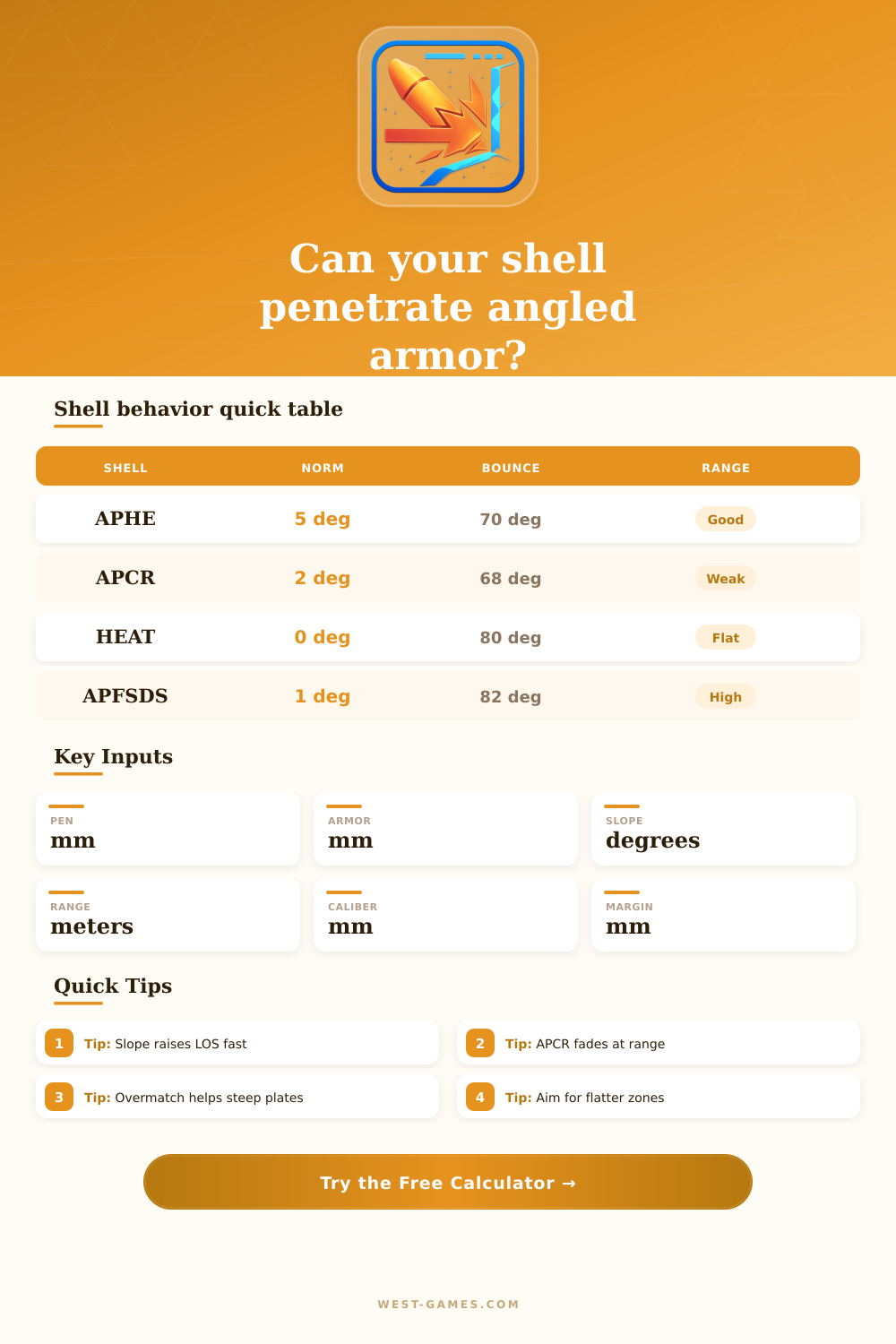
| Shell Type | Typical Use | Default Normalization | Range Retention | Ricochet Watch Zone |
|---|---|---|---|---|
| AP solid shot | Flat plate punching | 4° | Moderate | 65° to 72° |
| APHE / APHEBC | Post-pen damage after armor defeat | 5° | Good | 66° to 72° |
| APCBC | Best classic angled armor work | 6° | Very good | 68° to 74° |
| APCR / HVAP | Flat heavy armor at close range | 2° | Weak | 62° to 70° |
| APDS | High velocity medium range shots | 2.5° | Strong | 68° to 75° |
| HEAT / HEAT-FS | Chemical jet, less range loss | 0° | Flat | 75° to 82° |
| APFSDS | Modern kinetic dart defeat | 1° | Excellent | 78° to 84° |
| HESH | Spall effect against simple armor | 0° | Flat | 70° to 78° |
| Plate Angle | LOS Multiplier | 100 mm Plate Acts Like | What It Means In Battle |
|---|---|---|---|
| 0° | 1.00× | 100 mm | Flat plate; penetration margin is mostly raw pen versus armor. |
| 30° | 1.15× | 115 mm | Common turret cheeks and mild hull angles begin to matter. |
| 45° | 1.41× | 141 mm | Many medium tanks become risky without capped shells. |
| 55° | 1.74× | 174 mm | Glacis plates often need weak spots or high penetration. |
| 60° | 2.00× | 200 mm | Ricochet rules and overmatch can decide the shot. |
| 70° | 2.92× | 292 mm | Only strong overmatch, darts, or specific mechanics are comfortable. |
| Preset | Shell | Armor Area | Main Threat | Best Adjustment |
|---|---|---|---|---|
| Sherman 76 vs Tiger I Front | 76 mm APHE | 100 mm vertical | Low surplus margin | Close range or aim flat front plate |
| Panther 75 vs T-34 Hull | 75 mm APCBC | 45 mm sloped | Ricochet on sharp angle | Use normalization and avoid extreme side angle |
| IS-2 APHE vs Panther UFP | 122 mm APHE | 80 mm at 55° | High LOS armor | Reduce impact angle or aim turret face |
| Centurion APDS vs T-54 Glacis | 84 mm APDS | 100 mm at 60° | Steep frontal slope | Prefer turret ring or lower plate |
| M1 APFSDS vs T-72 UFP | 105 mm dart | Composite estimate | Layered armor factor | Compare equivalent armor, not thickness only |
| Armor Type | Factor | When To Use It | Calculator Effect |
|---|---|---|---|
| Rolled homogeneous armor | 1.00 | Most simple plate estimates | No extra resistance beyond LOS |
| Cast turret armor | 0.94 | Rounded cast sections with lower equivalent resistance | Slightly lowers effective armor |
| Face hardened plate | 1.08 | Early war armor where brittle/capped shell behavior matters | Raises resistance modestly |
| Spaced / layered section | 1.15 | Track links, skirts, mantlet overlap, air gaps | Raises the equivalent target value |
| Composite equivalent estimate | 1.25 | Modern armor when using a simplified RHA estimate | Applies a conservative resistance boost |
In the game War Thunder, penetration occur when a shell passes through the armor of a target vehicle and a ricochet occurs when a shell bounce off of that armor. The difference between penetration and ricochet is caused by an angle of the armor of the target vehicle, as well as the distance of the shot that was fired. While many player use the numbers on a stat card to gain an understanding of a given tank, those numbers does not represent the angle of the armor or the distance of the shot.
However, a practical estimator tool do provide a means of testing a shot that the player is to fire before actualy firing the shot with the gun. Thus, a practical estimator allows the player to make decision regarding the type of shell that should be loaded into the gun and where to aim the gun. Practical estimators allow a player to understand what each input mean for the calculation of the shot that is to be fired.
How to Use a Penetration Estimator in War Thunder
For instance, the type of shell that is to be fired is an important input for the player. Different types of shell will handle angled armor differently. For instance, an APHE shell will have a high normalization rate, indicating that the APHE shell will be able to bite into armor that is sloped at an angle, while a dart or an APCR shell will not.
Additionally, the penetration value for the shell is only a starting point for the player; the estimator will change that value according to the distance at which the tank is to be fired. For instance, kinetic round will lose velocity at long distances, while chemical rounds will not. Additionally, armor thickness is only the thickness of the metal plate of the target vehicle; the angle of the plate will make the shell have to overcome more armor than the thickness of the metal plate alone.
For instance, adding a side angle to a steep glacis will lead to the thickness of armor that must be penetrated increasing rapid. The estimator will reveal a margin figure for the players; this margin figure will show whether the penetration is a surplus or whether it will miss the armor of the target tank. A positive margin will not guarantee the destruction of the target tank, but it will indicate that the shot is worth to attempt.
Additionally, if the margin is close to zero, then the other factors that must be considered include the risk of ricochet of the shell from the armor of the target, as well as the overmatch between the shell and the armor of the target. For instance, overmatch is a game mechanic that permit shells that are wider than the armor plate the target vehicle is made of to penetrate that armor even at steep angles. Additionally, the reference table will allow players to compare, for instance, APCBC shells to APDS shells, as well as HEAT shells to APFSDS shells.
Many players make mistake with shells. For instance, many players treat the penetration value of a shell that is represented on the stat card as the only factor that determine whether a shell will penetrate the armor of the target tank. However, a penetration value of 200 mm at 500 meters may seem strong, but if the armor of the target vehicle is at a 60 degree angle and the distance between the two tanks is 900 meters, the strength of that 200 mm penetration will be much less.
Additionally, range loss for APCR shells is one of the major factor that work against the shells of that type; they should only be used at closer distances to the target than the range at which APCR shells lose the majority of their velocity. Furthermore, armor quality modifier must be taken into account; the game’s mechanics indicate that different types of armor are treated differently by the shells. For instance, cast turrets are likely to resist penetration as much as rolled armor plates, and spaced armor will likely be more resistant to penetration than metal plate.
However, the estimator will automatically account for the quality of armor of the target tank; the players just must remember that a 100 mm plate of any type of armor does not necessarily behave the same as any other 100 mm plate. Another benefit of the estimator is that it makes visible the trade-offs created by the angles of armor. For instance, a target’s hull may seem safe when the tank fires at the hull from the front of the target, but once the target begins to angle its hull towards the firing tank, the tank may find it difficult to penetrate that armor.
Additionally, the normalization that is used to allow a shell to penetrate sloped armor has limit; the estimator allows the player to become aware of the angle at which the armor will be penetrated and how quickly that angle increases as the tank attempts to target the armor of the tank from an angle. Thus, players can use that information to target other areas of the target’s armor that may be flatter than the armor that is facing the threat of the attacking player. For instance, finding a different plate to shoot that target’s armor may be more beneficial to the attacker than attempting to penetrate the armor of its frontal glacis.
The use of the estimator will change the way that a tank player approach the battlefield. For instance, with experience using the estimator tool, a player will learn that APFSDS shells work well at long distances, but that older capped shells work well at medium distances. Furthermore, while the estimator will not replace other types of analyses that could be performed on the tanks in the game, the estimator will allow the players to test the variable that they have control over.
For instance, when the margin is close to zero, the player can use the estimator to make certain that the type of shell that is used for firing the target’s armor and the angle at which the armor is aimed at the target will make certain that the armor is penetrated.