MLB The Show Parallel XP Calculator
Estimate card PXP pace, tier targets, action value, difficulty boosts, and the number of games needed to reach the next parallel.
Parallel XP Result
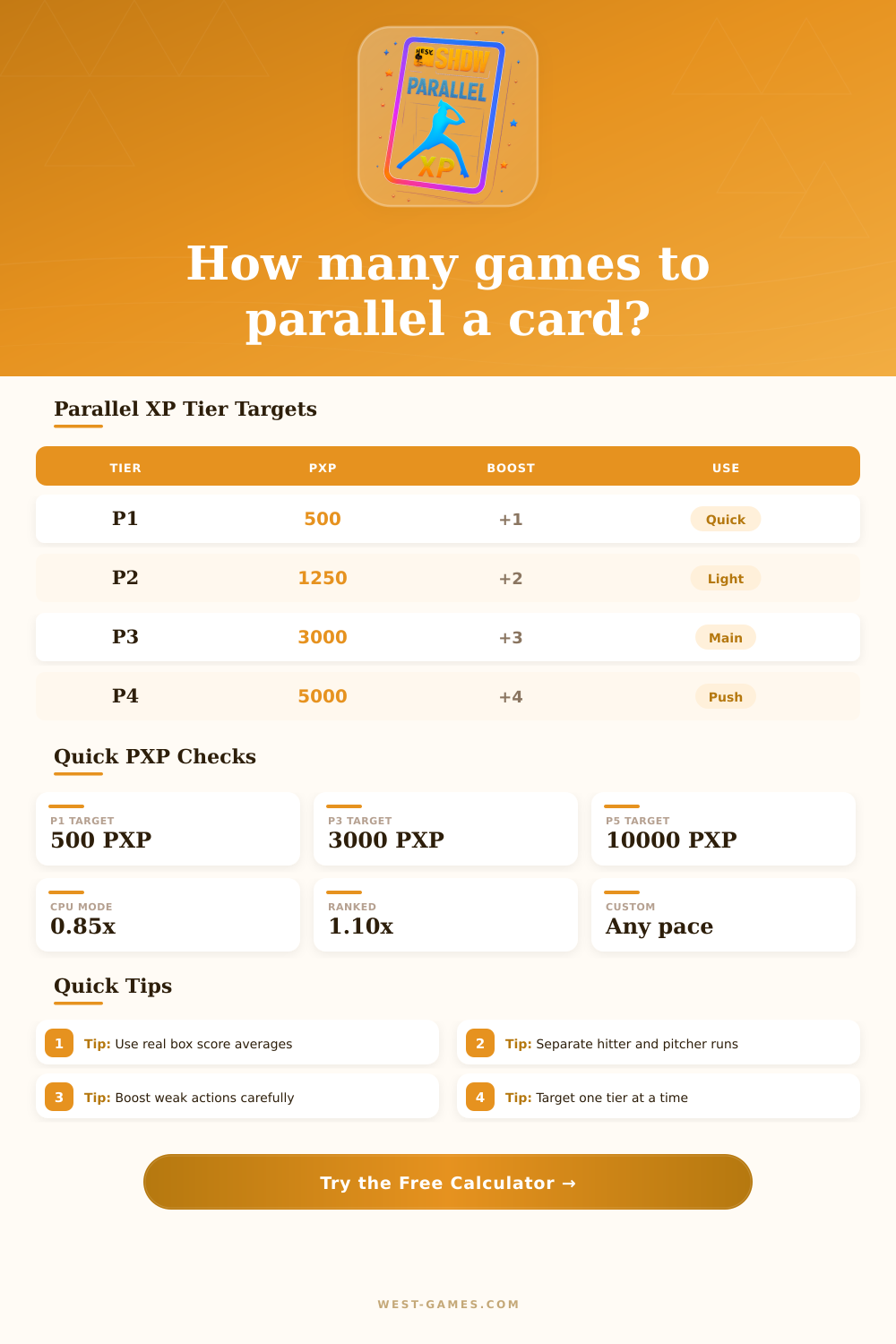
| Parallel Tier | Total PXP Target | Attribute Boost | Planning Use |
|---|---|---|---|
| Base card | 0 PXP | No parallel boost | Starting point for a fresh card |
| Parallel I | 500 PXP | +1 attribute layer | Quick first checkpoint |
| Parallel II | 1,250 PXP | +2 attribute layer | Light card commitment |
| Parallel III | 3,000 PXP | +3 attribute layer | Main squad progress goal |
| Parallel IV | 5,000 PXP | +4 attribute layer | High-use card checkpoint |
| Parallel V | 10,000 PXP | +5 attribute layer | Full card completion target |
Tier targets are used as calculator checkpoints. Enter your exact card PXP if you are already between two tiers.
| Action | Default Value | Best For | Calculator Field |
|---|---|---|---|
| Plate appearance | 10 PXP | Every hitter card pace estimate | PXP per plate appearance |
| Hit | 5 PXP | Contact hitters and high-average cards | PXP per hit |
| Home run | 10 PXP | Power bats and small stadium grinds | PXP per home run |
| RBI | 5 PXP | Middle-order lineup spots | PXP per RBI |
| Strikeout | 5 PXP | Pitchers with swing-and-miss stuff | PXP per strikeout |
| Inning pitched | 15 PXP | Starters, openers, and two-way cards | PXP per inning pitched |
Because PXP rewards can vary by game version and mode, every action value is editable so the calculator can match your observed postgame screen.
| Setting | Multiplier | When to Use | Effect on Games |
|---|---|---|---|
| CPU / conquest style | 0.85x | Fast repeat games with lighter assumptions | More games, safer estimate |
| Mini seasons | 0.95x | Short games with stable lineup control | Near-neutral pace |
| Events / casual online | 1.00x | Neutral baseline for mixed matchups | No pace adjustment |
| Ranked seasons | 1.10x | Longer games with full plate appearance volume | Fewer games if stats hold |
| Rookie difficulty | 0.80x | Use when you want conservative CPU math | Inflates game count |
| Legend difficulty | 1.15x | Use only if your stat pace still holds | Can reduce game count |
| Preset | Role | Core Inputs | Best Target |
|---|---|---|---|
| CPU Power Bat | Hitter | 4.6 PA, 1.4 H, 0.5 HR, 1.4 RBI | P1 through P3 |
| Ranked Balanced Bat | Hitter | 4.2 PA, 1.1 H, 0.25 HR, 0.8 RBI | P2 through P4 |
| Starter Pitcher | Pitcher | 6.2 IP, 7.1 SO, low batting stats | P3 through P5 |
| Relief Pitcher | Pitcher | 1.2 IP, 1.7 SO, repeat entries | P1 through P3 |
| Two-Way Card | Mixed | 4.0 PA, 3.0 IP, 1.0 H, 3.2 SO | P4 and P5 |
Burnout: You log in one day and realize you’re three thousand points away from parallel five and has spent 45 minutes just to gain a single attribute layer. Playing Diamond Dynasty isn’t baseball anymore; now it’s a data entry gig with prettier graphics. That’s not the issue with putting forth effort. That’s the issue of having no idea what sort of effort is necessary.
Because most players never check if their game style matches the grind economy, they plug their cards into ranked seasons without thinking. Parallel progression isn’t as complex a math concept as you might think but that’s what makes it so easy to use wrongly.
Plan Your Grind Like a Pro
Here’s the math: do something, get points; points increase based off the difficulty multipliers of the thing done; the wild card is how much you do something. If you treat a power hitter like a contact hitter in your calculations, your projected timeline will be off by a week or more. So, if you’re plugging in your hits/plate appearances into the calculator up top, the math happen automatically for you.
But knowing why you’re plugging them in is where the difference between a planner and a casual player come in. I mean, think about how you actualy play. Are you sitting there with a lower multiplier, but you’re running CPU power because it’s fast? That’s a trade off you have to accept.
If your time window is narrow, choose speed over efficiency. Or maybe you’re playing ranked, which might get you a higher multiplier per game. But if you struggle to get plate appearances or keep getting benched against tougher pitching, your points per hour go down significantly. You can toggle through different difficulty levels and game modes. The tool lets you visualize it. It forces you to realize that you’re gaining less for your card progress in an easy mode win than you would for losing in hard mode.
It is also worth mentioning the card role. The way the points add up can make pitchers a bit tricky for those unfamiliar with the system. Whether it’s striking out batters or pitching innings, it’s all about staying healthy and working hard for the team rather then just being in the lineup. So while your relief pitcher may get a higher K/Frame ratio (or anything else), he’ll always be behind a guy who toss six innings per game. This keeps the math honest. It forces you to pick an alpha function for the card. It also prevents you from accidentally mixing frames with batting average.
It’s important to keep in mind that parallel cards are short term investments in a season long meta. Paralleling all of your furnitures isn’t necessary unless they’re giving your lineup a tangible improvement today. That’s where the point cost breakdown and tier system on the page comes into play. It’s a nice reality check for what’s realistically possible before events expire. Looking at those numbers side by side might help you rethink what’s possible during a single weekend tournament.
What was once a marathon becomes a sprint when you aim for parallel four. Failing to account for your base line is by far the most common player error. For example, you think you earn five-hundred points per game. However, once you adjust for your stat lines and the difficulty multipliers, it’s more like three-hundred. That discrepancy add up fast across several games.
Your best guess is always going to be better than hoping or hyping your way to an answer. Use your actual stat lines from your last few matches, such as what your box scores say, to get a relatively safe idea of what your stats are. Boring, yes. But it’ll save you hours of useless grinding once the deadline looms and you’re suddenly behind where you expected.
It completely changes how you plan out your grind. Rather than just playing blind and hoping for levels, you have something to shoot for and can track how close (or far) away from that goal you are. Maybe you reach parallel three on this one card and realize the diminishing returns aren’t worth investing more time in it so you choose to stop grinding on that. If you didn’t understand your position in relation to your goal, you couldn’t make that strategic withdrawal; it would become a tiresome chore instead of a workable project with a defined end-point.
In the end, though, I think that’s what we’re all looking for: a way to play the game instead of serve the game. It is a way to work as little as possible while still getting the right number of games in to reach our goals. You want to slot them neatly around the rest of your life so that they don’t eat up all of your free time.
Spend 20 minutes grinding just before bedtime and know you’ve made some real gains. Pull out something fun and forget about the numbers entirely. That’s the true power up here. Anxiety turns into math.