Baldur Gate Character Planner
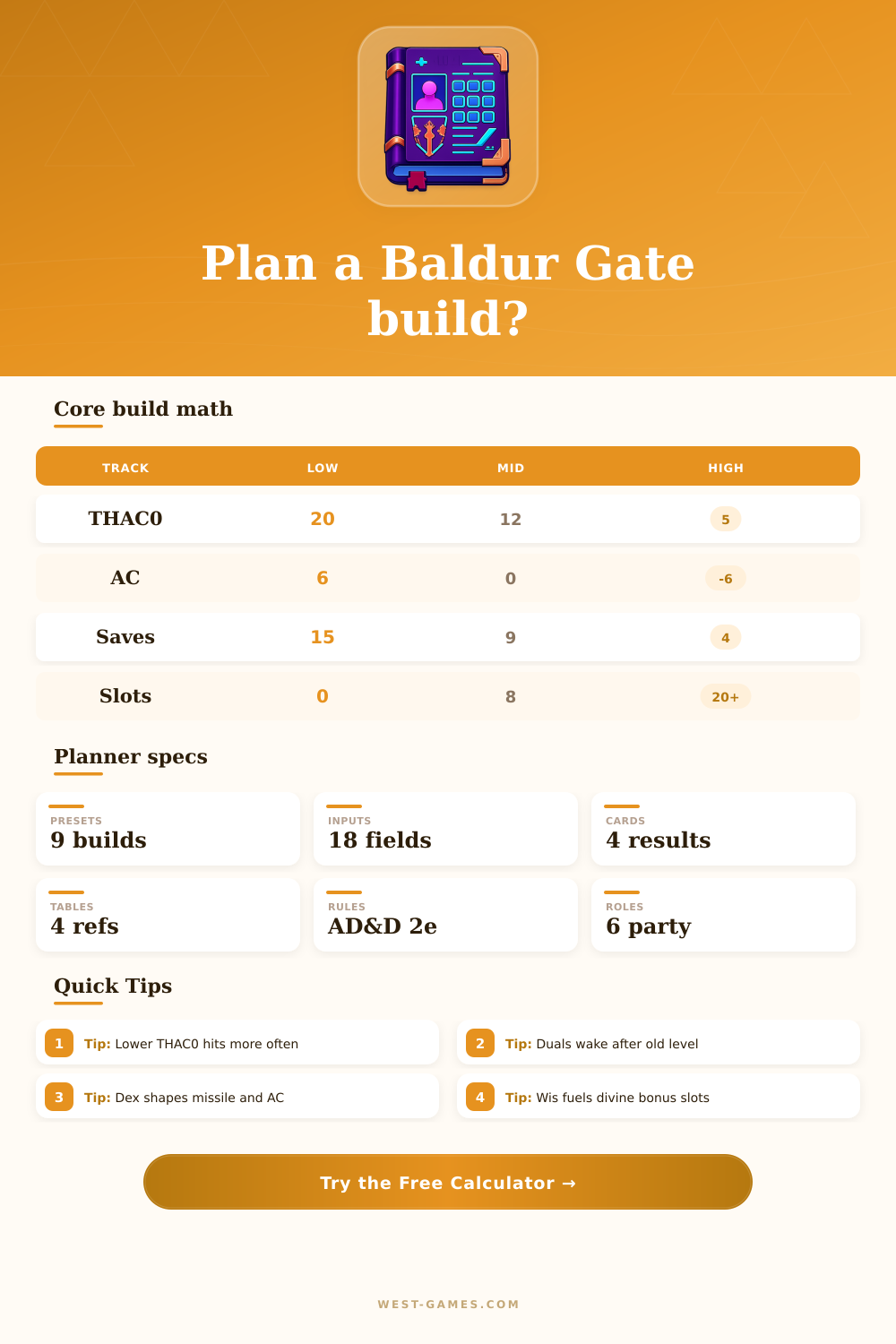
Model classic Infinity Engine AD&D build math: race, kit, ability roll, THAC0, AC, saves, proficiencies, dual timing, party role, and spell slots.
| Ability band | Combat effect | Defense or slots | Planner note |
|---|---|---|---|
| STR 17-18 | +1 to hit, +1 to +2 damage | Carry and bash roles improve | Best for frontliners and slingers using strength damage |
| DEX 15-18 | +1 to +2 missile accuracy | AC improves from -1 to -4 | Strongest universal defensive stat in BG-style combat |
| CON 15-18 | No attack boost | +1 to +4 HP by class group | Warriors receive the largest high-CON benefit |
| INT 9-18 | Arcane learning and scroll safety | Higher spell access comfort | Critical for mages, less urgent for pure warriors |
| WIS 13-18 | No weapon boost | Bonus divine spell slots | Clerics and druids scale noticeably from high Wisdom |
| Class group | THAC0 pace | Save flavor | Good level timing |
|---|---|---|---|
| Warrior: fighter, paladin, ranger | Improves every level | Strong breath and martial saves | Level 7 to 9 gives a major combat breakpoint |
| Priest: cleric, druid | Improves in steady blocks | Solid poison and spell saves | Level 7 unlocks important mid-tier divine slots |
| Rogue: thief, bard | Moderate weapon pace | Good reflex-style saves | Level 10+ improves utility reliability |
| Wizard: mage, specialist | Slowest weapon pace | Best when protected by control magic | Level 5 and 9 are major arcane slot steps |
| Race | Build strengths | Common planner fit | Tradeoff to watch |
|---|---|---|---|
| Human | Dual-class access and broad kit support | Berserker to mage, thief to mage, cleric duals | No multiclass chassis |
| Elf | Dexterity lean and fighter/mage flavor | Fighter/Mage, Archer-style ranger, arcane tank | No human dual-class timing |
| Dwarf | Shorty save profile and high Constitution | Fighter, fighter/cleric, defensive axe roles | Limited arcane access |
| Gnome | Shorty saves plus illusionist multiclass identity | Illusionist/Thief utility and control | Specialist school limits matter |
| Halfling | Dexterity, sling accuracy, and shorty saves | Fighter/Thief scout or ranged support | Lower strength ceiling in classic rules |
| Caster level | Arcane planning | Divine planning | Build implication |
|---|---|---|---|
| 1-4 | Few low-level slots; protection and sleep-style control | Bless, command, armor support | Weapon or party support carries early fights |
| 5-8 | Level 3-4 spells enter the plan | Key buffs and removal tools expand | Hybrids begin to feel complete |
| 9-12 | Level 5-6 arcane power becomes central | Raise, chaotic commands, and stronger summons | Common dual-class recovery window |
| 13+ | High-level spellbook defines encounters | Large buff package and strong saves | Party role score rewards slot depth heavily |
Building a character in the Baldur’s Gate games requires that you understand how each of your decisions will have an impact on that character over a long periods of time that the game is played. Character building isnt about making a character with high statistics. Character building is a series of tradeoffs and decisions about how the character will perform in the game.
Each of the decisions you make in the early portions of the game will have an impact upon whether the character can stand up to the challenge of level 5, and will have an impact upon whether the character can stand up to the challenges of higher level of the game. Many players view character building as a math problem to be solved when the character is first built, but character building is a process that occurs throughout the game that ensures that the character can function within the challenges of the more difficult portion of the game. Each of the initial decisions that a player must make with the creation of the character will have an impact upon the functions of that character.
How to Make a Good Baldur’s Gate Character
Characters of the human race have access to the widest variety of character kits, and because humans have the ability to dual-class with another class, human characters are some of the most flexable within the game. Elves and half-elves have the best statistics for dexterity, and each of those races has access to multiclass options for their characters, making them some of the most useful characters for players that wish to create a hybrid character that has access to both spellcasting and melee attack ability. Dwarves have advantages in both constitution and saving throws, making these races some of the most useful for players that wish to employ a tanky type of character within the game.
Gnomes and halflings have abilities that provide them with a focus upon using illusion spells, as well as ranged attack spells and abilities. Each of these races is useful for fulfilling specific role within the party of six characters. The character calculator allows the player to input the character’s ability scores, armor selections, and weapon proficiency to calculate the mathematical results of those statistics.
Each of the statistics will impact the character differently, but some of the more important statistics to understand are strength and dexterity statistics. Strength and weapon bonuses impact the damage that a character can deal with their attacks, but dexterity is important for both armor class and the accuracy of ranged attack. Constitution impacts both how many hits a frontline character can absorb, as well as how often a cleric must utilize healing spells to heal that frontline character.
These statistics are the same for each character, regardless of what is built. Due to the fact that dual-classing creates a temporary weakness for the character during the transition period between the two character classes, players must decide when to create such a character. For example, if a character that can dual-class into a mage at level 9, that character will not be able to function as a fighter until those mage classes have leveled up.
The planner helps the player to determine whether the power that the character can gain through leveling up as a mage is worth the weakness of that character during this transition period. Multiclass characters dont have this period of weakness, but they must split their experience points for leveling up, which means that their levels will be lower than those of a single class character. Therefore, each of these options has its benefits and its drawback, and players must decide which they prefer.
One of the primary decisions for which players must make is the planning of spell slots. During the early levels of the game, players should focus upon control spells and protection spells rather than damage spells. As the level of the character increases, the number of spell slots that the character has will help to determine the role that the player creates for their character within the game.
Though the reference tables help to reveal how many spell slots for arcane and divine spells that each level provides, players must also make a decision about whether they require a dedicated spellcaster in their party, or whether another of the characters is able to fulfill that role. Each of the characters within the party have different roles in the party. For example, fighters and tanks have different statistical requirements than arcane spellcasters.
Both of these characters, though, are members of the same six-person party. Each of the roles provides a role-fit score for the character. That role-fit score indicates how well the statistics of that character support the role that the character is built for within the party.
A high role-fit score will not ensure victory for the party in every battle, but will reduce the chance of failure by damage dealers or support characters. Players should avoid designing each of their characters to best optimize their abilities for one boss or one dungeon within the game. Such an optimization of a character for one role will make that character brittle for other scenarios within the game.
Instead, each player should ensure that their character can still contribute to the success of the party should the composition of the party change, or if the characters do not uncover the armor that they needed for that dungeon. While the game will make this process faster, each of these character builds are based off the relationship between the characters, their levels, their abilities, and the other characters within their party. Players should of considered how much time they will spend on character creation because it can take alot of effort to get it right.