🎮 POE2 Experience Calculator
Estimate leveling time, XP penalties, death loss, and kill targets for Path of Exile 2 farming routes.
Speed Farm
Best when monster level stays inside the safe zone and deaths are rare.
Lower Tier
Often wins for fragile builds because death loss can exceed XP gained.
Breach Loop
High density rewards party coordination, uptime, and strong clear coverage.
Boss Rush
Useful for progression rewards, but usually weaker for pure XP per minute.
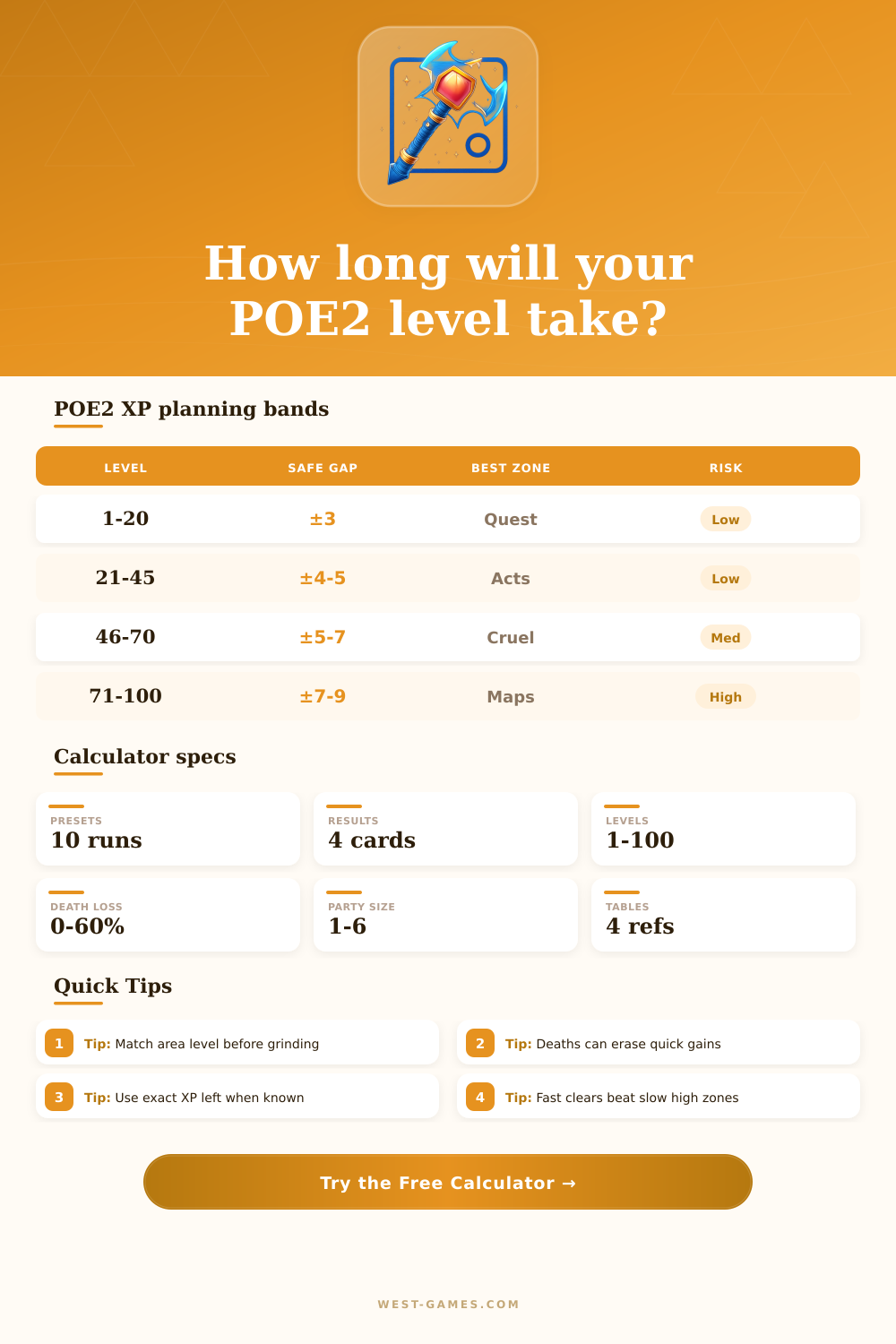
| Character Level | Safe Gap | Typical Use |
|---|---|---|
| 1-15 | ±3 levels | Questing and early acts |
| 16-31 | ±4 levels | Act catch-up zones |
| 32-47 | ±5 levels | Mid campaign repeats |
| 48-63 | ±6 levels | Cruel progression |
| 64-79 | ±7 levels | Early and white maps |
| 80-95 | ±8 levels | Yellow and red maps |
Safe gap is estimated as 3 plus one extra level per 16 character levels.
| Profile | XP/Kill | Kills/Min | Downtime |
|---|---|---|---|
| Campaign story | 180 | 34 | 18% |
| Repeat zone | 520 | 48 | 10% |
| Cruel push | 1,050 | 44 | 14% |
| Early waystone | 2,900 | 56 | 12% |
| White map | 5,800 | 72 | 9% |
| Yellow map | 12,800 | 66 | 11% |
| Red map | 28,000 | 54 | 15% |
| Party breach | 18,000 | 118 | 8% |
| Penalty | Best For | Planning Meaning |
|---|---|---|
| 0% | Campaign | Deaths cost time only |
| 5% | Soft penalty | One death can erase a short run |
| 10% | Endgame | Safety often beats raw XP |
| 15% | Harsh mode | Use conservative area levels |
| Style | Speed | Safety | XP Role |
|---|---|---|---|
| Safe melee | 0.94x | High | Stable grind |
| Minions | 0.98x | High | Low deaths |
| Ranged clear | 1.16x | Medium | Fast maps |
| Caster burst | 1.10x | Medium | Dense packs |
| Boss rusher | 0.72x | Medium | Quest goals |
| Glass cannon | 1.28x | Low | Risky speed |
| Step | Formula | What It Controls | Warning Sign |
|---|---|---|---|
| Safe zone | 3 + floor(level / 16) | How far area level can drift | Gap above safe zone |
| Gap penalty | Penalty curve from excess gap | XP lost from overleveling or underleveling | Efficiency below 85% |
| Adjusted kill XP | Raw XP x penalty x modifiers | Value of each monster kill | Low XP with high danger |
| Net XP/min | Kill XP x kills/min x uptime | Practical leveling speed | Downtime above 25% |
| Death loss | Level XP x death penalty | How much progress is erased | More than 20 min lost |
Numbers are planning estimates, not a replacement for exact in-game XP values. Enter exact XP remaining when precision matters.
Path of Exile 2 leveling involve a balance between the kill speed and the death frequency for the character leveling up. A person must find a balance between the speed at which they kill monsters and the number of experiences that a person lose when they die. There are many factor that affect the experience that a person will gain while completing a leveling session for Path of Exile 2.
These factor include the zone level, the number of death that a character has, and the ability of the character’s build to maintain their kill speed throughout the session. A calculator can help a player to understand these factor and how they can impact the experience calculation for a character. The first factor to consider with Path of Exile 2 leveling is the gap between the character’s level and the level of the monsters in the zone.
How to Use the Leveling Calculator
The game includes safe zone that offer specific experience ranges for players. However, if the gap between these two level is too large, the player will receive a penalty for the experience they will gain while playing. The calculator will ask for the character’s level and the area’s level to calculate the experience penalty that the player will have to deal with.
Even if the experience penalty for a single monster is low, the experience penalty multiplied by the number of monsters that is slain will result in a high number for the player’s experience gain. It is possible for a zone to have high experience rewards, but if the experience penalty is high, the player can end up gaining less experience than from playing in a lower level zone. The second factor to consider in the leveling process is the death penalty.
If a player dies during their session, they will lose the time that they spent while leveling up. The death penalty will depend on the experience loss from dying at a specific level for the character. The player will have to enter the number of death that will occur for the leveling session and the percentage of the death penalty into the calculator.
The experience that is lost from dying is also a measurement of the time that the player will need to invest into leveling up their character to recover the experience that they lost to dying. The player will have to consider how much time they will lose to death when planning their leveling up session. The third factor is the player’s kill speed and the amount of downtime that they will have while leveling up.
Players may be fast at killing monsters, but they may lose a significant amount of time while doing tasks such as traveling to and from the monster zone, using the stash, or waiting for the game to load. The player will have to enter the downtime percentage into the calculator to reflect the amount of time that a player will lose while not killing monsters. The experience per minute calculation will take into account the downtime that the player will have to lose.
The route that a player takes may have a higher kill speed but a higher downtime percentage than another route. The player will gain more experience on one route then the other. The fourth variable to factor into the leveling up process is the size of the player’s party.
A larger party mean that there will be more monsters to kill, and there will be more shared experience between the players. However, there will also be different experiences distributed between the players in the party. The size of the party can also affect how safe each player will feel while playing with others in the party.
The calculator will ask for the size of the party, but a conservative estimate will be applied to ensure that all parties are of similar skill with the same level of coordination. Using this calculator, players can test the effect that different party sizes has on their experience gain while leveling up. The reference tables on this page include information about the safe gaps between the player’s level and the monsters’ level and the default settings for each route.
While players can use these tables as a starting point for experience calculation while leveling up, the tables do not replace the player’s own testing of the routes. If the efficiency rating for a player’s route are low, the reference tables can help the player to decide whether the low efficiency is due to the area level, the number of deaths that the player has had, or if the player is expecting too much experience per kill. Many people make mistake when using the calculator.
For example, one mistake is to try to find the route that will provide the highest experience per kill without considering the experience loss from the level gap. Another mistake is to enter a kill speed value that is significantly higher than there actual kill speed. Both of these mistake will result in players in overly-optimistic estimates of their experience per minute while leveling up.
While the calculator will provide results based on the player’s inputs, the calculator will not prevent the player from entering such unrealistic value. One of the main uses of the calculator is to compare the efficiency of different routes for the same character. The player can keep the character level, the number of deaths, and the build the same while testing different route profiles.
For example, the player could compare one route to another that will take less time to reach their target level. The time estimate generated by the calculator will allow the player to determine whether the risk of taking a longer route is worth the experience that they can earn by taking the more risky route. While it is difficult for the player to remember all of the variable for a leveling session, the calculator will keep these variable visible on the screen so that the player can always consider the risks and the rewards of each route.
In the end, the calculator will allow the player to decide how much risk they are willing to take to generate a specific amount of progress in the game. If the player has high defenses and a high kill speed, then taking the risks of playing more aggressive maps could be a better idea than playing in safer maps. However, if the player dies in one of these safer maps, they will have to start from where they died.
In this situation, it would of been a better idea to play in maps that are less risky. While the calculator does not make the decision for the player, it does provide the player with the information that they need to make an informed decision about their playstyle in Path of Exile 2.