🧙 Dragon Age Veilguard Skill Tree Calculator
Plan Warrior, Mage, and Rogue builds, then tune your specialization depth, weapon style, and node spread before you respec.
| Lane | Points | Tier | Tree note |
|---|---|---|---|
| Core Skills | Tier 4 | Sword and shield or two-handed. | |
| Abilities | Tier 4 | Spells, combos, and active slots. | |
| Passives | Tier 4 | Traits, minor passives, and stat boosts. |
| Class | Weapon style | Core specs | Focus note |
|---|---|---|---|
| Warrior | Shield or 2H | Champion, Reaper, Slayer | Guard, rage, and pressure |
| Mage | Staff or blade | Death Caller, Evoker, Spellblade | Spell burst and control |
| Rogue | Bow or dual | Duelist, Saboteur, Veil Ranger | Dodges, crits, and setups |
| Hybrid | Any | Flexible path | Even coverage everywhere |
| Shape | Node type | Role | Depth note |
|---|---|---|---|
| Large circle | Class | Core skills | Weapon and class base |
| Diamond | Ability | Active slot | Swappable combat tool |
| Medium circle | Major passive | Upgrade | Big scaling lever |
| Hexagon | Trait | Modifier | Counter or combo tweak |
| Small circle | Minor passive | Stat boost | Clean filler value |
| Build goal | Core | Ability / Spec | Note |
|---|---|---|---|
| Bossing | 18-22 | 24-30 | Heavy spec depth |
| Leveling | 22-26 | 16-22 | Front-load core kit |
| Crowd control | 16-20 | 20-26 | Use control tools |
| Support | 14-18 | 18-24 | Keep combo uptime |
| Speedrun | 20-24 | 18-22 | Move fast, swap fast |
| Hybrid | 18-20 | 18-22 | Spread points evenly |
| Weapon | Best class | Best use | Play feel |
|---|---|---|---|
| Sword and Shield | Warrior | Guard and taunt | Safe, steady, direct |
| Two-Handed | Warrior | Heavy bursts | Slow but punishing |
| Staff | Mage | Spell casting | Controlled, ranged |
| Arcane Blade | Mage | Close combat | Aggressive, mobile |
| Bow | Rogue | Long range | Precise and tactical |
| Dual Swords | Rogue | Quick combos | Fast, fluid, lethal |
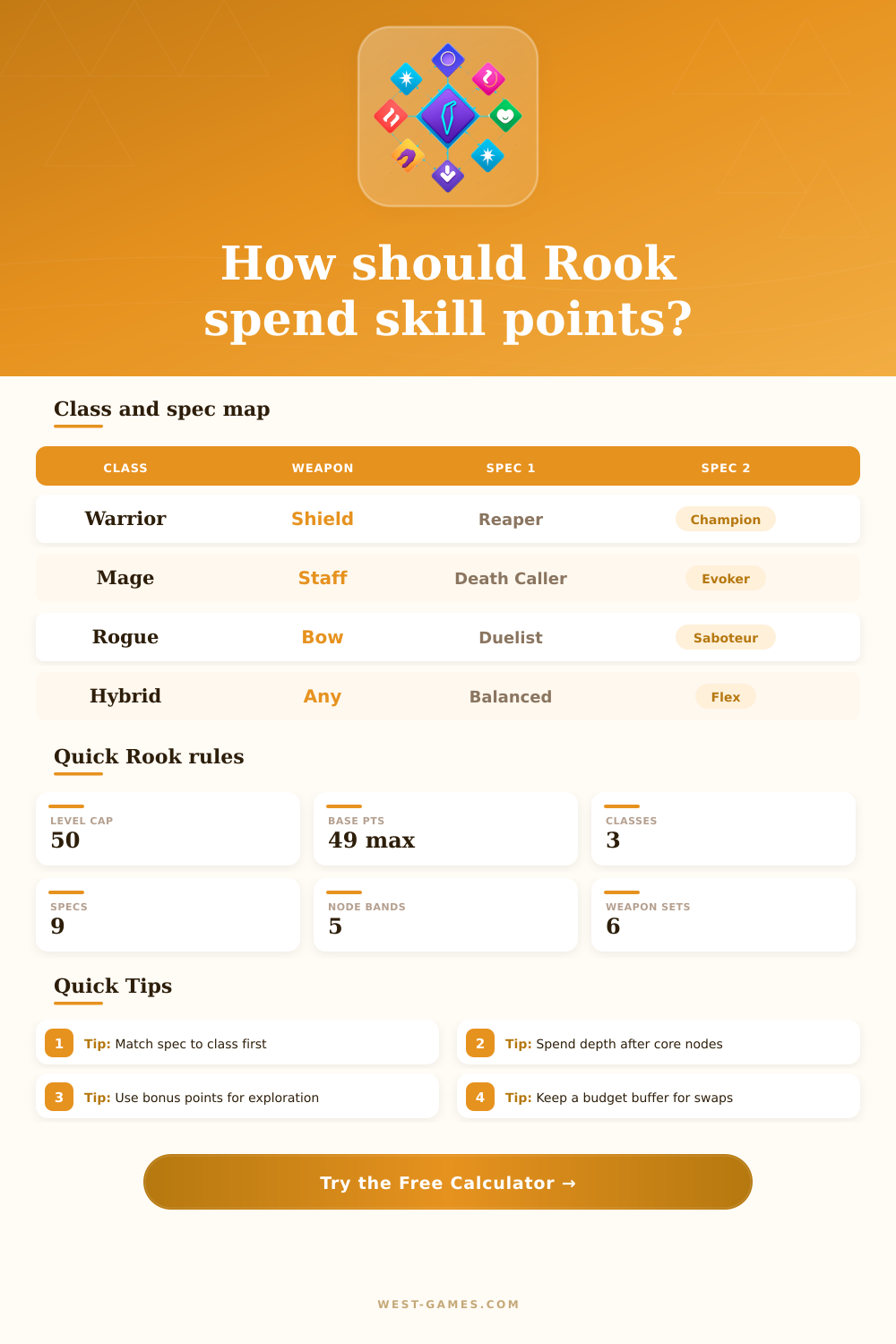
In *Dragon Age: Veilguard*, the skill tree system is a means of progression for the player. Within the game, the skill tree use 49 base points to determine how the character fights and survives. These 49 base points will determine which abilities your character have, and the better your choice in these abilities, the more better that your character will perform in the game.
If you choose the wrong abilities, you may need to spend some in-game currency to reset your skill tree. There are three different classes within the game: the Warrior, the Mage, and the Rogue. The Warrior class is defined by its focus on combat.
How the Skill Tree Works
Warriors use guard and rage burst ability to survive combat. If you play a Warrior class that uses a shield or two-handed weapon, you should invest your skill points into the core skills that provide durability to your character. The Mage class use spells of different elements to fight enemies.
This class uses staves and arcane blades to channel their elemental magic. The Rogue class specializes in mobility within combat. Rogues use bows or dual swords to perform critical hit on enemies.
While the game allows for builds that is hybridized between the different classes, these builds can be weak if not appropriately balance between the classes. Within these classes, you must specialize your character to match the class that you play. For example, you can use the Champion specialization with a character that uses sword and shield to increase the defense of the character.
The node shape within the game determine the function of that node within the combat system. Large circle nodes are the foundation of the classes, and they provide proficiency with weapons. Diamond nodes are active abilities that you assign to hotkeys that are used in the combat system.
Medium nodes are passives that increases the power of the character’s primary attacks. Traits are used to fine-tune the character’s combat combos. Minor nodes are used to fill in small gap in the character’s stats.
You should not specialize too much in one area of the class skill tree because you must balance your character’s nodes so that it isnt too weak when fighting against elite enemies. Specializations for the classes change the playstyle that you use for your character in the game. The Reaper Warrior specialization allow the character to drain the life from its enemies while under heavy pressure from those enemies.
This specialization is useful for fights with bosses that will last for long period of time. The Evoker Mage specialization allows for powerful spell to be unleashed in short bursts of time. This specialization requires an even spread of skill points into the various ability that the Mage can use.
The Saboteur Rogue specialization allows the character to place traps that damage enemies over time. This specialization turns the Rogue’s mobility in the game to a means of placing these traps for the Rogue to deal damage to their enemies. You can use a calculator to view the details of each of these specializations.
The calculator can help you to determine how your investing in these specializations will affect your character. Your companions also has an effect on your skill tree. If your companions already have some form of crowd control abilities, then you should focus on your skill tree to develop abilities that enhance your damage or your guard system.
If you play a support Warrior, you will want to invest in your warrior’s core skills and special node that provide beneficial effects to your companions. Each play style will require a different allocation of skill points within your tree. Speedrunners will require an even spread of points into each lane within the game.
Bossing will require more points to be invested into one specialization over the other. Builds that focus on leveling up characters will require points to be invested into the character’s core skills to ensure that they are not underpowered within the game. There are some common mistakes that can be made when using the skill tree within the game.
One of the most common mistake is investing all of your skill points right away. You need to leave two or three skill points unassigned in your tree, as you may need to change one of your nodes for another weapon or for one of your companions to have a better synergy with your character. Another of the most common mistakes is using weapons that do not match your specialization.
For example, if you have chosen a specialization for a class that use bows, but you use a melee weapon, your combat will feel awkward and unnatrually. The weapon that you choose also has an effect on the importance of specific skill nodes. Classes that use swords and shields have nodes that provide skills for guarding.
Two-handed warriors focus on heavy swing with their weapons, so their nodes are different than those of sword and shield warriors. Staff magic allows the mages to control the combat from a distance, while arcane blade magic is more aggressive and up close with the enemies. Bows require precision in skill to hit the enemies accurate, while dual swords require fluidity in skill to use both swords at the same time.
The best way to improve your builds within the game is to experiment with your character after losing a match to your enemies. Builds can be started with a pre-set build of your character. For example, a Champion tank or an Evoker blaster.
After playing with these pre-set characters, you can experiment with moving skill points within your tree until your specializations are providing beneficial effect to your character. While you do not want to focus too much on any one build, a character that is prepared for combat will be less likely to die during combat scenarios.