🥽 VR Headset Lifespan Calculator
Estimate how long your VR headset will last based on usage habits, care, and headset type
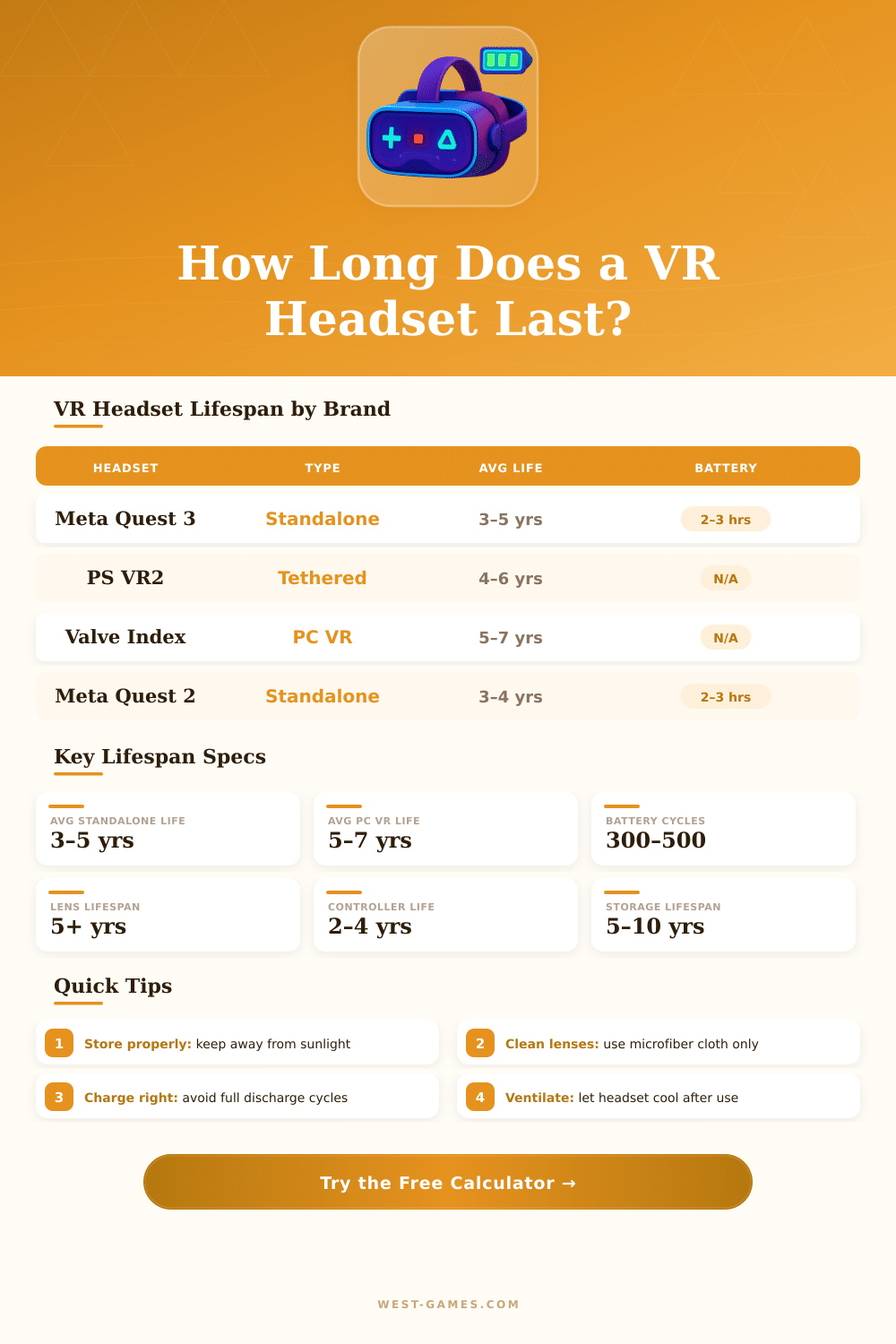
| Headset | Type | Avg Lifespan | Battery Life | Battery Cycles | Typical Failure |
|---|---|---|---|---|---|
| Meta Quest 3 | Standalone | 3–5 years | 2–3 hrs | ~500 cycles | Battery / controllers |
| Meta Quest 2 | Standalone | 3–4 years | 2–3 hrs | ~400 cycles | Battery degradation |
| PlayStation VR2 | Console Tethered | 4–6 years | N/A (wired) | N/A | Cable / lens yellowing |
| Valve Index | PC VR | 5–7 years | N/A (wired) | N/A | Controller joystick drift |
| HTC Vive Pro 2 | PC VR | 4–6 years | N/A (wired) | N/A | Lens / display panel |
| Pimax Crystal | PC VR | 4–6 years | Optional battery | ~300 cycles | Lens alignment |
| Apple Vision Pro | Standalone | 3–5 years | 2 hrs (external) | ~500 cycles | Battery pack / software |
| Google Cardboard | Mobile | 1–2 years | N/A | N/A | Cardboard wear / lens |
| Care Factor | Good Practice | Poor Practice | Lifespan Impact |
|---|---|---|---|
| Storage | Case or dedicated shelf | Tossed in bag or floor | Up to +2 years |
| Lens Cleaning | Microfiber cloth only | Paper towels / fingers | Scratching = irreversible |
| Charging | Keep 20%–80% charge | Full drain before charge | +200 extra battery cycles |
| Sunlight Exposure | Store away from windows | Left near windows | Lens burn in minutes |
| Ventilation | Cool down after sessions | Stored while hot | Reduces overheating risk |
| Strap Care | Wipe sweat, air dry | Left damp/sweaty | Foam life halved |
| Software Updates | Keep firmware updated | Ignore updates | Extends feature lifespan |
| Component | Expected Life | Warning Signs | Replaceable? |
|---|---|---|---|
| Internal Battery | 2–4 years (standalone) | Rapid charge drain | Sometimes (third-party) |
| Fresnel Lenses | 5–10 years (if cared for) | Scratches, cloudiness | Rarely (voids warranty) |
| Foam Face Gasket | 1–3 years | Odor, deterioration | Yes (common accessory) |
| Head Strap | 2–4 years | Elastic stretch, cracking | Yes (third-party) |
| Controllers | 2–4 years | Joystick drift, button fail | Yes (sold separately) |
| Display Panel | 5–8 years | Dead pixels, burn-in | No (replace headset) |
| Tethered Cable | 2–5 years | Signal drops, fraying | Yes (manufacturer) |
| Tracking System | 4–7 years | Jitter, lost tracking | Rarely |
VR headsets changed a lot, and now you have many choices based on what matters most for you, your budget or the kind of experience that you want. The Meta Quest 3 stands as the mainstream go-to for standalone headsets. It does well in everything, from graphics and tracking to software comfort and whole value.
You find 30 percent more sharp resolution than in past generations, together with double graphical power, what gives clear display.
How to Choose a VR Headset
What makes the Quest 3 shine is its portability. You simply put it on your head and play with friends or family somewhere. You could travel with only the headset, mouse and keyboard, then switch virtual desktop to your computer from a hotel room.
The Meta store and standalone games form real strength, although the store side leaves a bit to want. The Quest 3 and the cheaper Quest 3S work well as everyday headsets; they probably are the most flexible choices available. For tight budget, the Quest 3S costs around 250 dollars and includes 50-dollar credit for extras.
Here the mainstream downside of standalone headsets however: they not always match with wired models in image quality and tracking. When you connect a headset directly to a strong computer, you open bigger otuput. The Valve Index is wonderful, if you want prime tracking and silky smooth images, but it requires outside sensors installed around the room.
The controllers that come with it follow your fingers during game, so you skip needing controllers with buttons for click.
If you are ready to spend more, the Bigscreen Beyond is without doubt the most comfortable headset that keeps good images. The OLED screen and light build show, although it costs almost 1700 dollars for the whole set. The Pimax Crystal gives the most sharp images that you can get now, although it weighs a lot.
The Somnium VR1 matches the kind of the Crystal, but it sits in a more standard size.
Valve works on something new with the Steam Deck, that will be a standalone headset with Snapdragon 8 Gen 3 chip. You get 110-degree field of view, 2160 x 2160 resolution each eye and 144 Hz refresh rate. The mainstream difference is that it processes the graphics instead of depending on a computer connection.
Every game that you have in Steam works on all SteamVR-compatible headsets, so you do not stay locked in one ecosystem.
The PlayStation VR system uses double lenses and 3D depth sensors, with the PlayStation camera following everything from every direction. The PSVR2 even works threw a computer adapter, if you want to use it outside the console. Wireless and portable VR headsets keep getting better with wider field of view and comfortable forms.
In 2025, there really is a good range of headsets to choose from, and although VR stays a bit niche, it becomesmore accessible now.