Win Rate to Rank Calculator
Estimate ranked climb pace from win rate, LP gain, LP loss, current points, target points, games per day, and streak variance.
The calculator uses expectation math, so real sessions can land above or below the estimate when streaks cluster.
Break Even
Minimum win rate before the ladder stops moving backward.
42.9%Current Pace
Expected points after one normal daily ranked block.
+15 LPFast Track
Games needed if win rate rises by five percentage points.
43 gamesRough Patch
Games needed if win rate drops by five percentage points.
109 games| Win Rate | With +24 / -18 | Climb Feel | Best Use |
|---|---|---|---|
| 50% | +3.0 points per game | Slow but positive | Long season climb with stable mental |
| 53% | +4.3 points per game | Manageable | Normal solo queue improvement block |
| 56% | +5.5 points per game | Reliable | Focused role pool and good session control |
| 60% | +7.2 points per game | Fast | Strong matchup knowledge or duo synergy |
| 65% | +9.3 points per game | Very fast | Smurf-like pace or clear skill gap |
| Scenario | Point Gap | Typical Win Rate | Expected Plan |
|---|---|---|---|
| One division push | 80 to 120 points | 52% to 56% | Short sessions, watch LP loss average |
| New rank threshold | 180 to 260 points | 54% to 58% | Keep champion, agent, deck, or role pool tight |
| Season reset recovery | 300 to 500 points | 55% to 60% | Expect variance and review rough sessions |
| High ladder climb | 500 to 900 points | 57% to 63% | Track daily net points and stop after tilt losses |
| Promotion buffer | 40 to 100 points | Any positive rate | Add safety points before calling the climb done |
| Variance Setting | Range Added | What It Means | Practical Read |
|---|---|---|---|
| Calm Queue | Lower spread | Stable role, stable matchmaking, low tilt | Use when recent match quality is predictable |
| Normal Swings | Medium spread | Typical ranked streaks and team variance | Best default for most players |
| Volatile Nights | High spread | Win and loss streaks cluster heavily | Use for off-role, patch shift, or late sessions |
| High Tilt Risk | Very high spread | Performance drops after losses | Use when stop rules matter more than volume |
| System Type | Point Unit | Usual Step | Calculator Setup |
|---|---|---|---|
| MOBA ranked ladder | LP | 15 to 30 per match | Use exact LP gains and losses from history |
| Tactical FPS rating | Rating | 10 to 35 per match | Include wider variance for streaky lobbies |
| Card game ladder | Stars | 1 star per match | Convert each star to 20 or 25 points |
| Battle royale ranked | Rank points | Placement plus eliminations | Use average net gain and average failed match loss |
| Fighting game league | League points | Small repeated sets | Use match-set average and daily set count |
The calculator take in three variables: your anticipated winning percentage, points earned from each win, and points deducted for each loss. From there it computes how much ground you’ll move every game.
Your “winning percentage” is what everyone’s focused on (fifty-five percent is the magic number). They fail to realize, though, that their loss penalty are just as important as that winning percentage. Eighteen points off of a loss, and only twenty-four off of a win, means you can still be moving forward even with fifty percent record. The way it hurts to lose make it seem like a slog, while the fact that winning isn’t rewarding makes it hard to believe math is so straightforward. But it is.
Why This Calculator Helps You Win
There’s also an option to set streak volatility, a measure of how much variance there is in the game’s result. Rarely does the game go “win-loss-win-loss” exactly as planned. More likely it’ll be something like: three wins -> four losses in rapid succession. This slider increases the predicted number of games required based off this type of deviation. Essentially, it makes you plan for crap nights too rather than just perfect nights. That’s where most people fall short. They don’t consider the psychology that breaks down when you’re on a losing streak.
The tool model that friction using different patterns of change. These range from low-tilt risk scenarios where the queue is calm, to high-tilt risk situations where your pants are on fire.
Additional games beyond normal point earning (like tiebreaker matches) is necessary for promotions in ranked play. Also, weeks of progress can vanish when season resets at the beginning of each new season. To account for this possibility, you can put a percentage buffer into the calculator as well. It’s reasonable thinking, the transition from Gold to Platinum isn’t usually a direct route. You’ll encounter some stronger competition in promotional series. You’ll hit a plateau or two. You might even get tired and make an odd mistake.
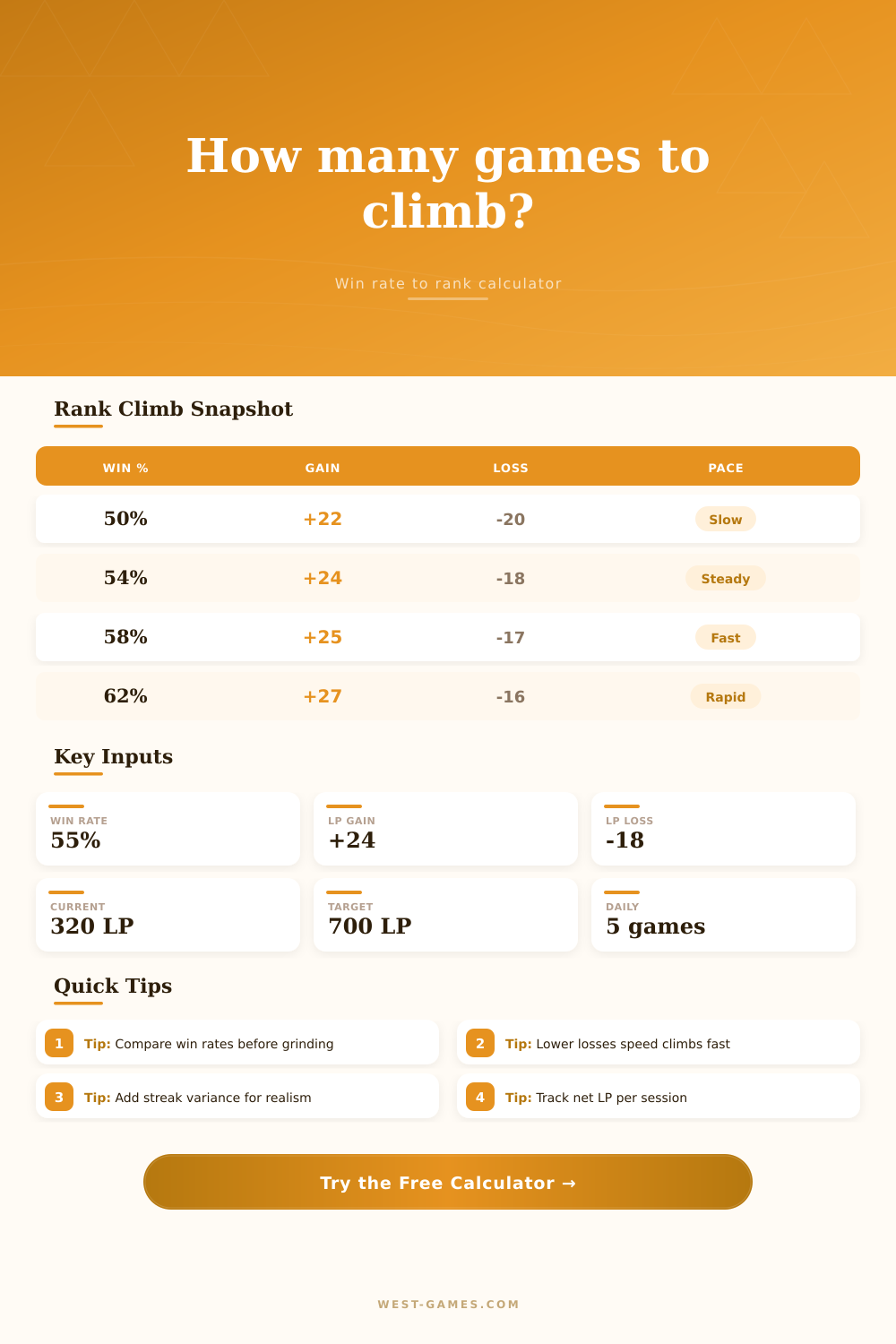
As this reference table on the page show, even tiny adjustments to win rate can drastically affect your climb speed. Even if an increase from 50% to 54% doesn’t seem like much better in any single match that will compound very rapidly across dozens of games. This is where the way this builds on itself works and allows you to determine if you should of take a break if your numbers are dipping or continue grinding daily.
Sometimes it is faster to stop and review your replays until your net points per game reach a certain level different than it is to just play less. It’s not about beating everyone in one match or another. It’s about being consistent over hundreds of them to keep climbing ranks. That’s why the tool filters out all the game-specific noise and looks at big picture. It sees how cutting down on your loss penalty can be as good as, if not better than, boosting up your win rate. Because of this, it also shows you that what matters isn’t necessarily winning but getting a positive net points balance over time.
When you adopt this perspective, you’ll find yourself less prone to tilt since you’re not battling against the system anymore. You’ll stop scrambling after each loss and instead take charge of your own long-term path. You’ll go from a chaotic scramble to a calculated climb back to where you should be.