Toilet Tower Defense Trade Calculator
Compare two Toilet Tower Defense offers with editable unit values, demand multipliers, trend pressure, proof confidence, downgrade risk, and a clear fairness delta.
| Unit | Role | Base Index | Default Demand |
|---|---|---|---|
| Titan Cameraman | Core titan | 38,000 | Steady |
| Upgraded Titan Speakerman | Premium DPS | 72,000 | Hot |
| Engineer Cameraman | Support carry | 58,000 | Hot |
| Chef TV Man | Event utility | 46,000 | Steady |
| Santa TV Man | Event collector | 42,000 | Hot |
| Titan Clockman | Premium control | 95,000 | Very Hot |
| Titan Drill Man | Boss pressure | 64,000 | Steady |
| Sinister Titan TV Man | Collector titan | 120,000 | Very Hot |
These are fixed sample assumptions for this calculator, not a live market list.
| Input | Low | Neutral | Strong | Use Case |
|---|---|---|---|---|
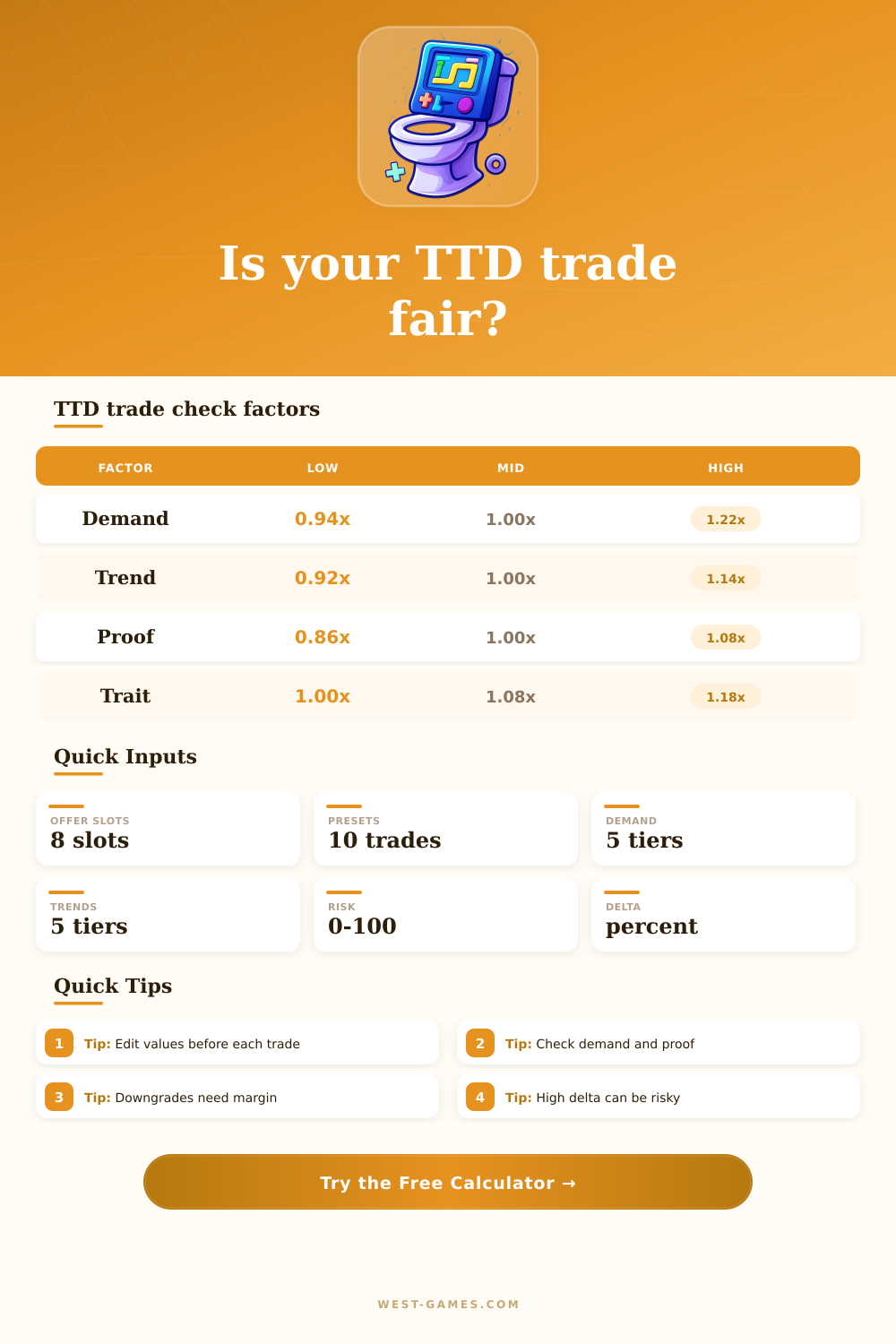
| Demand | 0.88x cold | 1.00x steady | 1.22x very hot | How easy a unit is to move in trades. |
| Trend | 0.92x falling | 1.00x flat | 1.14x spike | Recent direction from your own observations. |
| Proof | 0.86x rumor | 1.00x normal | 1.08x trusted | Confidence in value screenshots or trade logs. |
| Trait | 1.00x none | 1.08x shiny | 1.18x collector | Extra value for signed, shiny, serial, or collector appeal. |
| Delta | Band | Meaning | Action |
|---|---|---|---|
| -15% or lower | Heavy overpay | Your offer is much larger. | Ask for adds or lower your side. |
| -8% to -15% | Soft overpay | May be okay for a dream unit. | Check demand and roster fit. |
| -8% to +8% | Fair zone | Values are close. | Use risk score to decide. |
| +8% to +20% | Value gain | Their side is larger. | Check if low proof explains it. |
| +20% or higher | Suspicious gain | Large win may hide risk. | Verify unit names and trade window. |
| Score | Risk Level | Main Cause | Practical Check |
|---|---|---|---|
| 0 to 25 | Low | Clear values, stable market. | Confirm quantities and names. |
| 26 to 50 | Moderate | Some trend or proof pressure. | Recheck demand before accepting. |
| 51 to 75 | High | Volatility, downgrade, or big delta. | Slow down and verify each slot. |
| 76 to 100 | Extreme | Unstable or suspicious trade. | Do not rush; rebuild the offer. |
| Metric | Formula | Why It Matters |
|---|---|---|
| Item adjusted value | base x quantity x demand x trend x proof x trait | Normalizes every unit slot before the two sides are compared. |
| Side value | sum adjusted items x market stance x context penalties | Applies the same calculator rules to your offer and their offer. |
| Fairness delta | (their side - your side) / your side x 100 | Positive means the modeled value favors you; negative means you overpay. |
| Risk score | delta pressure + volatility + trust + concentration + proof + downgrade | Separates value math from practical trading risk. |
| Fairness band | delta compared with your overpay limit | Connects the raw percentage to your personal comfort zone. |
For the safest result, edit base values and multipliers using your own recent observations.
Trading in Toilet Tower Defense involve exchanging units with other players. Trading in Toilet Tower Defense require an understanding of the concept of the value of units within the game. The value of a unit is not constant; the value of a unit change based on the demand for that unit and the value of that unit changes based on the trends of that units value.
If you make a trade that you believe is not a good trade, you could end up with unit that are difficult to trade for valuable resources later. Because the market for Toilet Tower Defense units change so quick, what could be an acceptable trade one day could turn out to be an unflavorable trade the next day. In order to avoid making trades that could potentially end up negative for you, you should of use a calculator prior to trading with another player.
Use the Trade Calculator Before You Trade
To use the calculator to determine if a trade will be beneficial for you, you must input several variable into the calculator. One of these variables is the demand for a certain type of unit, another is the trend of the value of those units, another is proof of the legitimacy of the units being traded, the trait value of the units (which might indicate a value for collectors who might be interesting in the unit), and the value of the units themselves. You must adjust each of these variables to reflect the true value of the units being traded.
If the variables that you input into the calculator are not accurate, the calculator will model an incorrect outcome for the trade. In addition to the variables, there are also a few context setting that must be adjusted in the calculator. For example, the volatility pressure setting adjust for the impact of game patches on unit values.
The trust risk setting accounts for the uncertainty of a trade if the other player dont provide proof of ownership of the units that are to be traded. The duplicate penalty and the downgrade penalty both account for the fact that it is often difficult to trade a collection of smaller value units for the same value as one premium unit; however, the same total value can be obtained through the trade of a premium unit. The calculator accounts for these difficulties so that the two player dont ignore them when they negotiate the trade.
Once you have all of the variables and the context settings adjusted to reflect your situation and the state of the Toilet Tower Defense market, the calculator will provide an outcome that indicates whether or not the two player consider the trade to be within your preferred range. It will also provide a risk score for the trade; the lower the risk score, the less likely that there will be issues with the trade. However, a low risk score doesnt ensure that the trade will be beneficial to you.
Based off the risk score, you can decide whether or not you would like to ask for additional units to be included in the trade, or whether or not you would like to walk away from the deal altogether. While many might rely on there instinct when trading for Toilet Tower Defense units, their instinct might be incorrect. Thus, using the calculator to help you decide whether or not to accept a trade from another player is a good idea.
Edit the base values within the calculator to reflect your observations of the market, and use the trade comparison function to see what the outcome will be. While the calculator cannot see how urgently you want to trade for these units, or how much you like what they are, it can show you the difference between the mathematical value of the units and the perceived value of those same unit. You could make a mistake if you accept a trade simply based off the headline value of the units; it’s possible that the demand for those units might be low.
However, by using a trade calculator, you can identify these variables prior to completing the trade with the other player. Although using the calculator will not eliminate all guesswork in the trading process, it will make the guesswork visible to you. Make using the calculator a habit in your trading process.
Whenever you find a trade that seems tempting to make with another player, use the calculator to determine if the trade will be beneficial to you. Make sure to adjust the multipliers for each trade attribute to reflect the current trend in the market. Finally, use the output of the calculator to determine whether or not you should accept the trade when you encounter another player who is interested in trading with you.
The units and the events in Toilet Tower Defense will cycle, so you must constant use the calculator to ensure that your assumptions about the value of the units are correct.