🐾 Pet Stat Calculator
Estimate power, bulk, and arena viability from your pet's species profile, scaling path, and combat tuning stats.
| Species | Atk | Def | HP | Speed |
|---|---|---|---|---|
| Ember Fox | 128 | 78 | 510 | 124 |
| Stone Turtle | 84 | 142 | 760 | 62 |
| Storm Hawk | 142 | 74 | 490 | 136 |
| Coral Otter | 92 | 106 | 660 | 88 |
| Shadow Lynx | 136 | 82 | 540 | 132 |
Start from species identity first, then tune role and progression layers around that baseline profile.
| Tier | Stat Mult | Trait Cap | Practical Use |
|---|---|---|---|
| Common | x1.00 | 15% | Early ladder |
| Rare | x1.08 | 22% | Story scaling |
| Epic | x1.16 | 30% | Main roster |
| Legendary | x1.25 | 40% | High arena |
| Mythic | x1.35 | 50% | Top ladder |
Star rank adds additional multiplicative growth, so rarity and stars should be upgraded as a pair.
| Affinity | Atk Mod | Def Mod | Speed Mod |
|---|---|---|---|
| Neutral | x1.00 | x1.00 | x1.00 |
| Fire | x1.08 | x0.97 | x1.03 |
| Water | x0.98 | x1.09 | x0.99 |
| Earth | x0.96 | x1.12 | x0.95 |
| Wind | x1.04 | x0.96 | x1.09 |
| Light | x1.03 | x1.03 | x1.02 |
| Dark | x1.10 | x0.94 | x1.04 |
Affinity influences both damage tempo and defensive stability, so matchup context matters as much as raw totals.
| Tier | Target Rating | Power Band | Survival Band | Skill Impact |
|---|---|---|---|---|
| Bronze | 1200 | 2500+ | 1400+ | 900+ |
| Silver | 1800 | 3300+ | 2000+ | 1300+ |
| Gold | 2400 | 4200+ | 2600+ | 1700+ |
| Platinum | 3000 | 5200+ | 3200+ | 2200+ |
| Diamond | 3600 | 6200+ | 3900+ | 2800+ |
| Master | 4200 | 7300+ | 4600+ | 3400+ |
Rating is weighted from combat power, survivability index, and skill impact to model ladder consistency rather than one-shot damage only.
Pet statistic in arena match are determined by a combination of base profile and tuners. Pet statistics isnt random but the result of specific multiplier. Understanding pet statistics is crucial to understanding how pet will perform in combat and in team composition within the game.
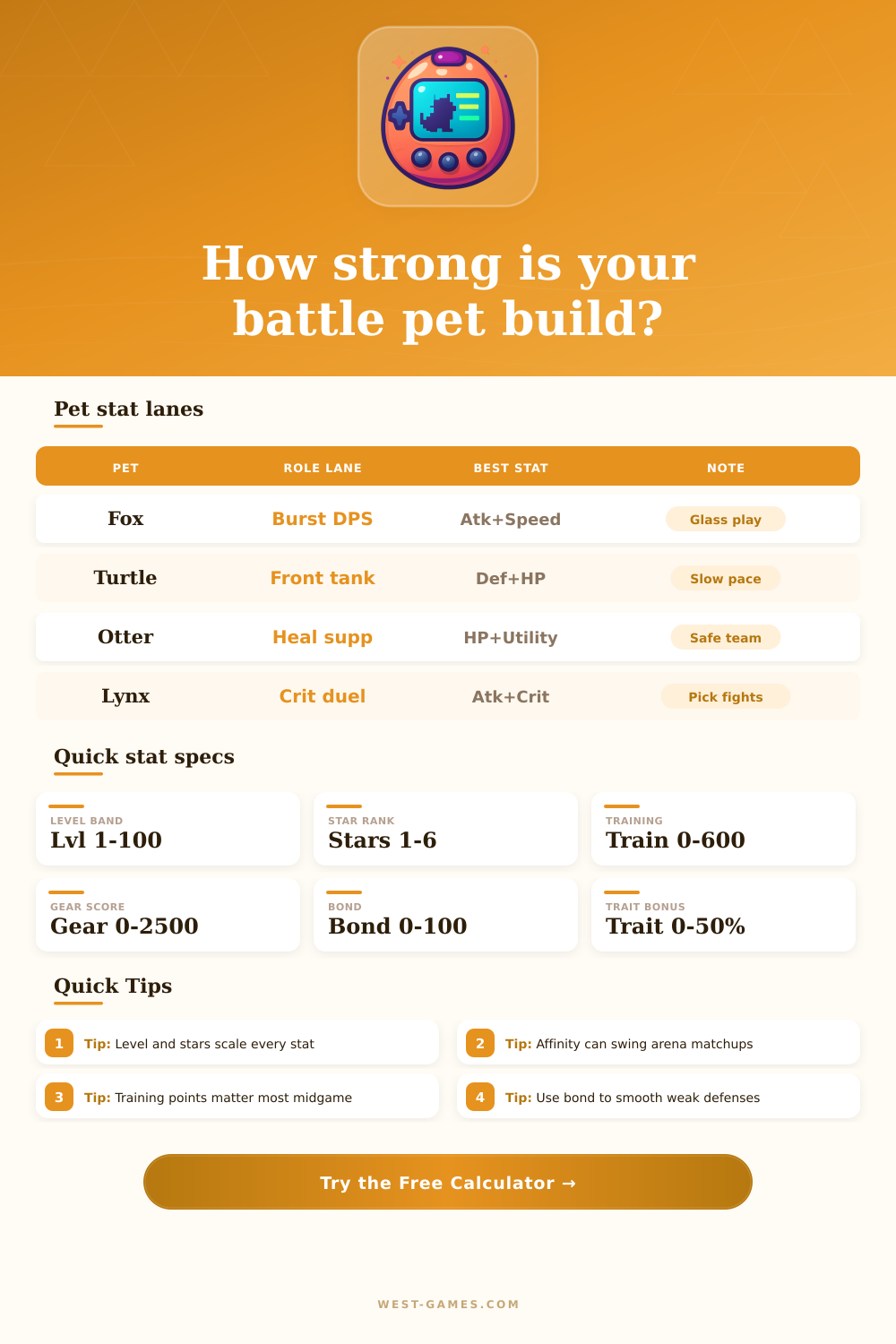
The species of a pet dictate the base statistics of the pet. For instance, an Ember Fox has high attack and speed stat making it a great pet for those who want to perform quick attacks with their pet. A Stone Turtle, on the other hand, has high defense and health stat but low speed stats.
How Pet Stats Affect Arena Fights
When choosing the species of a pet, player must ensure that the species fit into the type of combat playstyle that they would like their pet to have. Next, the role focus of a pet can change its base statistics. If a player choose a striker role for their pet, it will increase its offense and speed stats but decrease its defense stats.
If they choose the tank role, the pet will increase its defense stats at the cost of its speed stats. Many player make mistakes with the role of their pets as they often want to focus on one stat too soon. A pet’s level and star rank also impact its strength as the stats increase in multiplication with each level increase or star rank.
The rarity and star rank of a pet will also impact its statistics. As a general rule, an epic pet will have more higher statistics than a rare pet. An epic pet with many stars will have higher statistics than one with fewer stars.
Additionally, players can use training points to adjust the statistics of their pet. They can use these points to increase the value of one statistic over another. For example, a pet may have good attack and defense stats but low speed.
In this case, the player can use training points to increase the speed of their pet. Other stats can be improved with gear, bond, and traits. Gear has flat efficiency stats for the pet.
Bonds to the pet provide stability in long battle. Traits multiply the output of the pet’s role. Other statistics that can be adjusted include affinity as certain affinities will increase either the offense or defense stats of the pet by a small percentage.
For instance, fire affinity is aggressive, earth affinity is defensive, and wind affinity is fast. Another statistic for pets is its mood. Fierce mood will increase the attack and defense stats of a pet but decrease its defense.
Calm moods will increase the survival stats of the pet which is beneficial to pets used in support role. Moods can change a pet’s interaction with the enemy it fights. Another factor in a pet’s performance in the arena is its tier.
Each arena have specific requirements for the stats that a player controls. For example, matches in the gold tier have lower requirements for the stats than those in the master arena. If the player finds themselves battling against an arena of a similar rating to their pet, they may be better off adjusting the affinity or mood of their pet than upgrading the level of their pet.
The last factor that impacts the performance of a pet in the arena is the use of presesets. Presets allow the player to load a set of stats for their pet that has been proven to work well in the arena. For instance, the Shadow Lynx Duelist preset will allow for a pet with a high speed stat to engage in duels with other pets with the same role.
Other presets include the Coral Otter Healer which work well for healing teams of pets. Although presesets work well as a starting point to configure the stats of a pet, players should of understand the species baseline and affinity matrix for their pet. For instance, a Dark-affinity Lynx will perform better in critical hit duels since the Dark affinity of the Lynx will increase its speed and attack stats.
One of the most common mistake that players make is not understanding how the different pet statistics interact with each other. For instance, some players will put all of their training points into the attack stat for their tank pet but this will cause their pet to die too soon. A similar mistake is to neglect the bond stat that the player forms with their pet.
This stat is beneficial in that it will increase the health and utility stats of their pet during longer battle. A third mistake players make is an affinity mismatch for their pet. For example, a fire striker will defeat water foes but will lose to earth stats.
In order to have a well-performing pet in the arena, players must master the mathematics of pet statistics. If they nail the baselines for the different stats, they can improve their pet’s performance in the arena. Additionally, if they properly allocate their training points to weak stats, their pet will be able to move up through the various arena tier.