🔌 Laptop Charger Lifespan Calculator
Estimate how long your laptop charger will last based on usage, brand & care habits
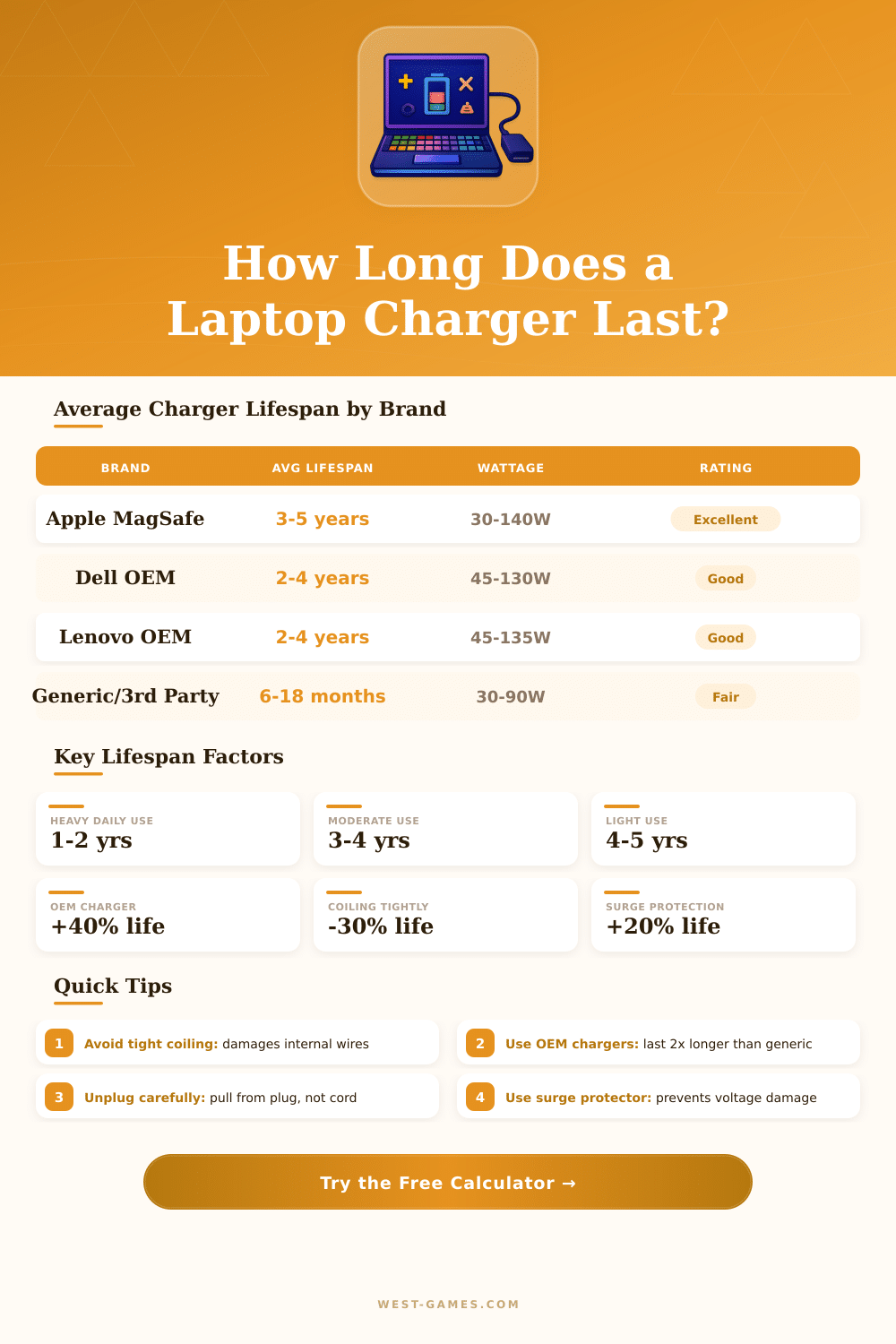
| Usage Pattern | Hours/Day | OEM Lifespan | Generic Lifespan | Top Risk Factor |
|---|---|---|---|---|
| Light / Occasional | 1–3 hrs | 4–6 years | 1.5–2 years | Moisture / Storage |
| Moderate / Home Use | 4–6 hrs | 3–5 years | 1–1.5 years | Coiling damage |
| Heavy / Work Daily | 7–10 hrs | 2–3 years | 8–14 months | Heat buildup |
| Intensive / Gaming | 8–12 hrs | 1.5–2.5 years | 6–12 months | Thermal stress |
| Frequent Travel | 5–8 hrs | 1.5–3 years | 6–10 months | Bend / pull stress |
| Habit | Effect on Lifespan | Severity | Recommendation |
|---|---|---|---|
| Tight coiling (small loops) | −25% to −35% | High | Use loose figure-8 or velcro wrap |
| Pulling cord to unplug | −15% to −25% | High | Always pull the plug head directly |
| No surge protector | −10% to −20% | Medium | Use a UL-listed surge protector |
| High heat exposure | −20% to −30% | High | Keep out of hot cars / direct sun |
| Frequent travel (bag stress) | −10% to −20% | Medium | Use a protective cable pouch |
| Using surge protector | +15% to +25% | — | Recommended for all setups |
| Flat storage / no coiling | +20% to +30% | — | Best for desk / home setups |
| Warning Sign | Urgency | What It Means |
|---|---|---|
| Fraying or exposed wires | 🚨 Replace Now | Fire & shock hazard — stop use immediately |
| Charger gets extremely hot | 🚨 Replace Now | Internal short or overload risk |
| Intermittent charging | ⚠ Replace Soon | Damaged cable connection or internal fault |
| Charging very slowly | ⚠ Replace Soon | Degraded output, battery strain risk |
| Burning or plastic smell | 🚨 Replace Now | Internal component failure |
| Visible kinks or bends in cable | ⚠ Monitor | Wire stress — may fail soon |
| Laptop not recognizing charger | ⚠ Replace Soon | Handshake chip failure (common in USB-C) |
The Laptop Charger for computer consists mainly of two parts: electrical plug and separate adapter. That type of setup was popular, because computers need bigger energy than cells. The adapter part commonly gets the name “energy-brick” while the cable, that binds it to the computer, is the conductor for the steady electricity.
Together they form that, what the most many folks simply call “Laptop Charger”.
Laptop Charger Basics and Safety
When swapping a Laptop Charger the replacement must match in the values of voltage and strength with the original. Also the plug itself must fit the input port of the computer. There are no truly uniform rules between different makers.
Every brand acts differently, and even different models of the same company can use different Laptop Charger types. A Laptop Charger of 65 W with USB-C is commonly chosen, because it works with many brands, thanks to the universal nature of USB-C. Every USB-C Laptop Charger can serve, if it meets the needed specs.
GaN technology aims to charge devices more quickly and effectively than the usual USB Laptop Charger types with several ports. A universal Laptop Charger for computers with GaN is ideal for trips, because it easily fits in a pocket or bag for computer and can carry adapters for different lands. Some Laptop Charger types offer swappable plugs, so that one can buy only a new tip instead of a whole new device.
It is strongly advised to use real Laptop Charger types from the maker. Many computers received damage because of unofficial replacements. Bad voltage, flow, kind of plug ore quality can cause harm, shorten the life or cause trouble.
Some branded adapters for computers, sold online, are false and commonly lack important safety features.
USB-C PD Laptop Charger types can easily charge both computers and cells at once. Well built models talk with the connected device to set the charging skills. The device itself only takes the energy, that it needs.
For instance, a Laptop Charger of 65 W can give energy to a device, that only needs 45 W, without any trouble. The Anker Prime 240 W GaN Laptop Charger has four ports and can reach up to 140 W at one of them, which allows to charge two computers at once.
A power bank of 10 000 mAh can extend the battery of MacBook Air by more than 50 percent. With output of 18 W it charges at half of the pace of a home Laptop Charger, if the computer is not under heavy work. Modern Laptop Charger types usually accept from 100 to 240 volt AC.
To check, whether a Laptop Charger works well, one can use a multimeter at the output plug. If no voltage appears, thedevice is broken.
Gaming computers are made to be used while connected, and that does not hurt the battery. Some of them do not support charging by means of USB-C and only work with barrel Laptop Charger types. The computer takes from the Laptop Charger only the energy, that it needs, so using a slightly stronger model is widely safe.