🎯 Destiny Elo Calculator
Estimate Crucible Elo movement from playlist pressure, current rating, team average, opponent average, match result, fireteam size, streak state, and score differential.
| Playlist | K | Team weight | Margin cap |
|---|---|---|---|
| Control | 24 | Medium | 18 points |
| Clash | 24 | Medium | 18 points |
| Iron Banner | 26 | Medium-high | 20 points |
| Trials | 36 | High | 7 rounds |
| Competitive | 32 | High | 10 rounds |
| Rumble | 28 | Solo | 12 places |
K-factor is highest where a single match is most meaningful and lower in broader casual playlists.
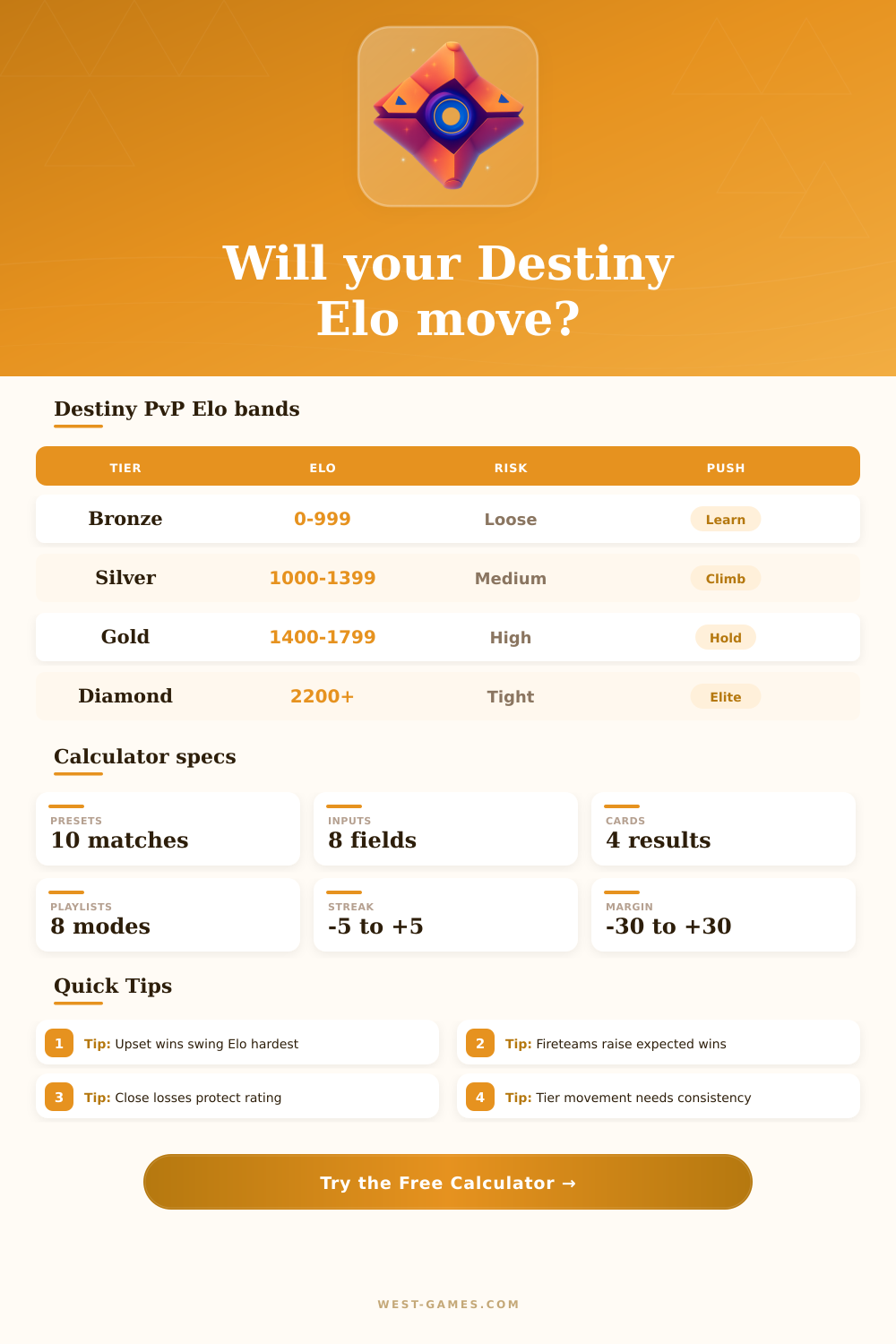
| Tier | Range | Movement feel | Pressure |
|---|---|---|---|
| Bronze | 0-999 | Loose | Low |
| Silver | 1000-1399 | Recoverable | Medium |
| Gold | 1400-1799 | Volatile | High |
| Platinum | 1800-2199 | Tighter | Very high |
| Diamond | 2200-2599 | Strict | Elite |
| Ascendant | 2600+ | Minimal | Peak |
Tier names are planning labels for this calculator, not official in-game rank names.
| Factor | Input | Effect | Limit |
|---|---|---|---|
| Result | Win | Positive delta | K-based |
| Result | Loss | Negative delta | K-based |
| Result | Tie | Near neutral | Half score |
| Margin | Blowout | Amplifies | 18 percent |
| Margin | Close game | Softens | 8 percent |
| Streak | Plus or minus | Nudges K | 12 percent |
The model rewards upset wins most because expected score is lower against stronger opponents.
| Fireteam | Adjustment | Best use | Warning |
|---|---|---|---|
| Solo | -18 Elo | Queue review | More variance |
| Duo | +8 Elo | Quickplay | Small edge |
| Trio | +18 Elo | 3v3 or Rift | Coordination assumed |
| Partial stack | +28 Elo | 6v6 groups | Lobby-dependent |
| Full fireteam | +42 Elo | Trials or Banner | Raises expectation |
A larger fireteam can still lose Elo on a win if the lobby was heavily favored and the margin was tiny.
In Crucible, when you win a match and don’t see your rank rise much, you get frustrated. That’s because Destiny competitive play are not just about who kills the most or makes the flashiest play. Instead it rewards consistent play at the level expected of you. It will raise or lower your rating to match how hard your opponents is playing, not necessarily how well you think you did. Knowing that difference will make it easier for you to ascend the tiers instead of getting stuck in Gold for too long.
You don’t have to second-guess which loss impacted your rank the most because the calculator will run through those figures for you based off the lobby details and playlist context. Be aware, however, that Elo reflects your expected performance. So if you’re rated at 1500 and face an average of 1600, it expects you to lose. Winning gets you a big bump in rating because you performed better then predicted. Losing results in smaller rating drops because it was already expected.
How Destiny’s Rank System Works
In reality, the difference between your team rating and the opposing team rating tend to be more decisive than individual scores. Focusing only on your K/D ratio (as many players do) while forgetting that you faced a group of well-coordinated Platinum player misses this aspect. That all changes when talking about fireteams. In team modes, queueing by yourself will put you at a loss due to lack of coordination, and so the model reduce expectations accordingly to make up for this difference.
When playing in a full fireteam, you’re expected to be coordinating, so the bar goes back up. Now if you lose against some lower rated randoms with your trio, it’s worse than losing with them on your own. Losing together means your fireteam was supposed of to win, just via teamplay alone. So now we have a scenario where teams of high elo gets unfairly penalized for coming close, yet players queuing solo get given a pass for doing the same thing. And it sucks in the short term, but it does even out the distribution of ranks over time.
These are baseline expectations with detail added through streaks and margin of victory. Sure, you get more points for a blowout win but only if you were likely going to win in the first place. To account for this, the calculator lowers the reward for expected wins and lessens the penalty for unexpected losses. It also slightly reduces how volatile your ratings can change if you’re on a losing streak; after all, maybe you’re just on a bad run? So it won’t let one bad game derail all your hard work over the past few weeks.
On the flip side, if you’re on a hot streak, it will increase your gains when facing stronger competition, rewarding consistent excellence instead of luck. Not all playlists are created equal. Matches is short and decisive. They are quick, big swings with high pressure. This is the opposite of a controlled environment where you can fix things if you make a mistake. The rating movement is aggressive. It’s not designed to give people much wiggle room in case they go on a losing streak.
Quickplay or control modes is steadier, with lower volatility as a result of their more casual environments. The system expects higher variance there. You’re going to be able to drop five matches consecutively and it won’t bring your rank crashing down. Understanding what playlist you’re in will help you understand how stable (or not) your rating is going to be.
Destiny’s PvP ladder is as much about managing lobbies as it is being a skilled player. It wants you to play games just below your skill level, but not too low because then the game isn’t rewarding enough. That takes time and occasionally means strategically queuing into different playlists. If you know what those bands look like, they have a page that lists them out. You can see how those tiers change based on expectation.
You’ll stop taking it personally if you’re stuck at a certain rank period, because now you know that the system simply needs you to show it you deserve to be there by consistantely beating people. When you accept that and work with the system rather than against it, it stops getting frustratingly.