Damage Falloff Calculator
Model weapon damage at any distance with start and end falloff ranges, minimum damage, projectile class behavior, headshot multiplier, armor mitigation, fire rate, hit accuracy, and time-to-kill breakpoints.
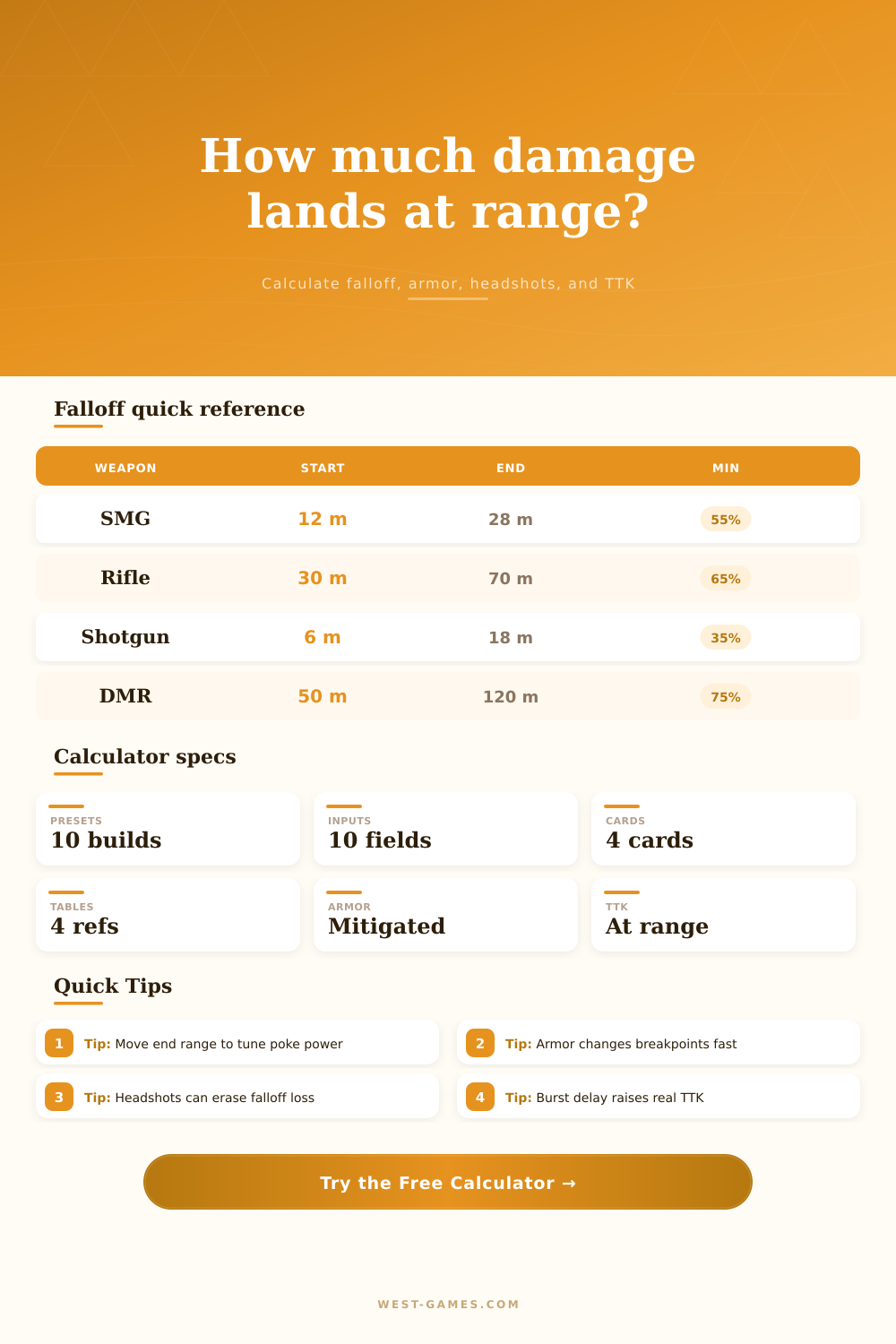
Falloff model: full damage applies before the start range, minimum damage applies after the end range, and distances between them interpolate by the selected projectile class curve.
Calculation Breakdown
TTK Read
Point Blank
Damage and TTK before falloff starts, useful for checking close-range breakpoints.
Start Range
Damage at the last full-power distance before the curve begins to reduce output.
Target Range
Armor-adjusted body damage at the selected combat distance.
End Range
Damage at the minimum floor where additional range no longer changes the hit.
| Class | Curve | Best use | Tuning note |
|---|---|---|---|
| Hitscan linear | Straight line | Rifles, SMGs | Easy to read and balance across lanes. |
| Projectile gentle | Late taper | Travel-time weapons | Keeps mid-range damage more stable. |
| Shotgun steep | Early drop | Pellet weapons | Protects close-range identity strongly. |
| Beam sustained | Smooth ramp | Tracking beams | Rewards aim while trimming long-range burn. |
| Explosive splash | Soft floor | Area damage | Preserves chip damage at distance. |
| Weapon style | Start | End | Floor |
|---|---|---|---|
| Close SMG | 10-14 m | 24-34 m | 50-65% |
| Combat rifle | 28-38 m | 60-85 m | 60-75% |
| Pellet shotgun | 5-8 m | 14-22 m | 25-45% |
| Heavy pistol | 18-28 m | 45-70 m | 55-70% |
| DMR or scout | 50-75 m | 110-160 m | 70-85% |
| Armor | Damage kept | Breakpoint effect | Use case |
|---|---|---|---|
| 0% | 100% | Raw weapon testing | Sandbox or no armor modes. |
| 15% | 85% | Often adds one bullet | Light armor or shield layer. |
| 30% | 70% | Strong TTK shift | Mid armor in hero shooters. |
| 45% | 55% | Heavy mitigation | Tank roles or armored targets. |
| 60% | 40% | Needs weak point pressure | Boss armor or vehicle plating. |
| TTK range | Feel | Risk | Balance lever |
|---|---|---|---|
| Under 0.35s | Instant burst | Low counterplay | Raise falloff or lower head multiplier. |
| 0.35-0.65s | Fast duel | High lethality | Tune recoil, armor, or range band. |
| 0.65-1.10s | Readable fight | Stable pacing | Good baseline for many shooters. |
| 1.10-1.80s | Sustained trade | Can feel spongey | Improve crit reward or close damage. |
| Over 1.80s | Long burn | Weak threat | Raise floor or reduce armor impact. |
| Preset | Class | Damage | Start / End | Min | Multiplier |
|---|---|---|---|---|---|
| Arena SMG | Hitscan | 24 | 12 / 32 m | 58% | 1.50x head |
| Tactical Rifle | Hitscan | 31 | 32 / 76 m | 68% | 1.75x head |
| Pump Shotgun | Shotgun | 96 | 6 / 18 m | 34% | 1.25x head |
| Marksman DMR | Projectile | 48 | 55 / 130 m | 78% | 1.80x head |
| Beam Weapon | Beam | 9 | 20 / 55 m | 62% | 1.20x head |
Use the grid to sanity-check whether a custom weapon is behaving like a close-range, mid-range, or long-range profile.
Maybe you’re playing a shooter and you missed a bullet at 50 meters. That sucks, but it probably wasn’t bad luck, it was likely some math that snuck up on you. As you get further from an enemy, your weapon’s effectiveness decreases in what we call “damage falloff.” Even when you place the crosshair perfectly, you might lose if the damage drop is greater than your opponent’s health pool can handle.
Knowing where this occurs change how you hold an angle. Instead of wondering if your shot will count, you act confidentely. This model lets you input variables like distance, headshot multiplier, and armor class to see what the result are. Base damage is simply the beginning point before the game’s engine apply range penalties. With this tool, you can specify where those start and end. That way, you see the effective lethality instead of a theoretical potential.
How Damage Changes With Distance
Because games don’t fight in vacuums. They fight on various types of terrain against enemies wearing variety of armor tiers. That’s where the tuning comes in: projectile classes. A shotgun profile has a steep drop off. You’ll find a hard wall of utility, but it dissapears fast when you take one footstep backward.
Linear falloffs has a more predictable feel, as they decrease damage across equal distances until reaching a second defined distance. These are all laid out in reference table on the page, so you can check your own custom builds against common expectations.
Knowing a gun does 24 points of damage at point blank, dropping to 10 at 30 meters isn’t good enough. That change impact your engagement and whether you should of rushing forward or holding back. Another overlooked detail that makes tests run so quickly is armor mitigation. A 15% reduction may sound inconsequential, but when that turns your shots-to-kill from two to three, that’s enough to get you killed while trying to reload instead of trading.
This calculator factors that into account, adjusting damage after range falloff but before health subtraction. You see the real-world time-to-kill here, instead of the pretty-paper-DPS number that seem impressive but falls short under fire. Range can be saved by a headshot multiplier… Provided you are actualy accurate enough to hit said headshots. When you’re not getting many headshots, the higher multiplier do you no good because you aren’t hitting anything important enough to use it.
The last part of the puzzle is rate of fire and the delay between bursts. A gun that fires quickly but has a long delay between bursts will deal less total damage during long fights. This mechanically takes those delays into account. It shows how long it should take to kill something by looking at both weapon cycle delays and human reaction time.
This helps us really understand how long it takes to kill someone, helping avoid common pitfall of creating weapons that feel super strong on short bursts but are worthless in longer battles. The challenge in balancing that game (or making your own loadout) is understanding all of this as a connected set of variables. Optimizing one metric breaks another. Boosting min-damage improves long-range performance. However, this hurts close-range dominance and fundamentally changes the weapon’s character.
We’re not trying to make everything good all around; we’re trying to provide each gun with a distinct sweet spot they excel in and a distinct sour spot they suck in. Understanding how falloff defines those edges stop you from guessing and lets you play with purpose. “When do I press? When do I pull back?” is answered by math instead of gut feel. Knowing the answer makes even painful defeats teachable failures. This is why competition is both fun and fair.