🎲 D&D Ability Score Calculator
Point Buy, Standard Array, Manual Roll — Generate optimized stats for any class & race (5e)
| Score Range | Modifier | Saving Throw (Proficient) | Description |
|---|---|---|---|
| 1 | –5 | –5 + Prof | Severely Impaired |
| 2–3 | –4 | –4 + Prof | Extremely Weak |
| 4–5 | –3 | –3 + Prof | Very Weak |
| 6–7 | –2 | –2 + Prof | Weak |
| 8–9 | –1 | –1 + Prof | Below Average |
| 10–11 | +0 | +Prof | Average Human |
| 12–13 | +1 | +1 + Prof | Above Average |
| 14–15 | +2 | +2 + Prof | Talented |
| 16–17 | +3 | +3 + Prof | Very Talented |
| 18–19 | +4 | +4 + Prof | Exceptional |
| 20–21 | +5 | +5 + Prof | Superhuman |
| 30 | +10 | +10 + Prof | Deity-Level |
| Class | Primary Stat | Secondary Stat | Dump Stat |
|---|---|---|---|
| Fighter (Melee) | STR | CON, DEX | INT or CHA |
| Fighter (Ranged) | DEX | CON | INT or CHA |
| Wizard | INT | CON, DEX | STR or CHA |
| Rogue | DEX | INT or CHA | STR |
| Cleric | WIS | CON, STR | INT or CHA |
| Ranger | DEX | WIS, CON | INT or CHA |
| Paladin | STR / CHA | CON | INT |
| Barbarian | STR | CON, DEX | INT or CHA |
| Bard | CHA | DEX, CON | STR or INT |
| Druid | WIS | CON, DEX | STR or CHA |
| Sorcerer | CHA | CON, DEX | STR or INT |
| Warlock | CHA | CON, DEX | STR |
| Monk | DEX / WIS | CON | STR or CHA |
| Level Range | Proficiency Bonus | ASI / Feat Available | Tier |
|---|---|---|---|
| 1–4 | +2 | Level 4 | Tier 1 (Local Hero) |
| 5–8 | +3 | Level 8 | Tier 2 (Hero of the Realm) |
| 9–12 | +4 | Level 12 | Tier 3 (Master) |
| 13–16 | +5 | Level 16 | Tier 4 (World Shaker) |
| 17–20 | +6 | Level 19 | Tier 4 (Epic) |
DND Stat or also called skill-points, form the main values that marks every player in Dungeons & Dragons. Here six of them: Strength, Agility, Constitution, Intelligence, Wisdom and Charisma. Three of those involve physical sides, Strength, Agility and Constitution.
The other three cover mental traits; Intelligence, Wisdom and Charisma. Those Stat affect various skill tests during the game.
DND Stats: Six Traits and How They Work
Every skill point ranges between 1 and 20, where 10 or 11 is average. Stat can reach even 30, which shows almost superhuman level of skill, although that happens very rarely. In older versions, 18 was basically the maximum for playing players.
Having 20 in a Stat commonly counts among the elite of the elite.
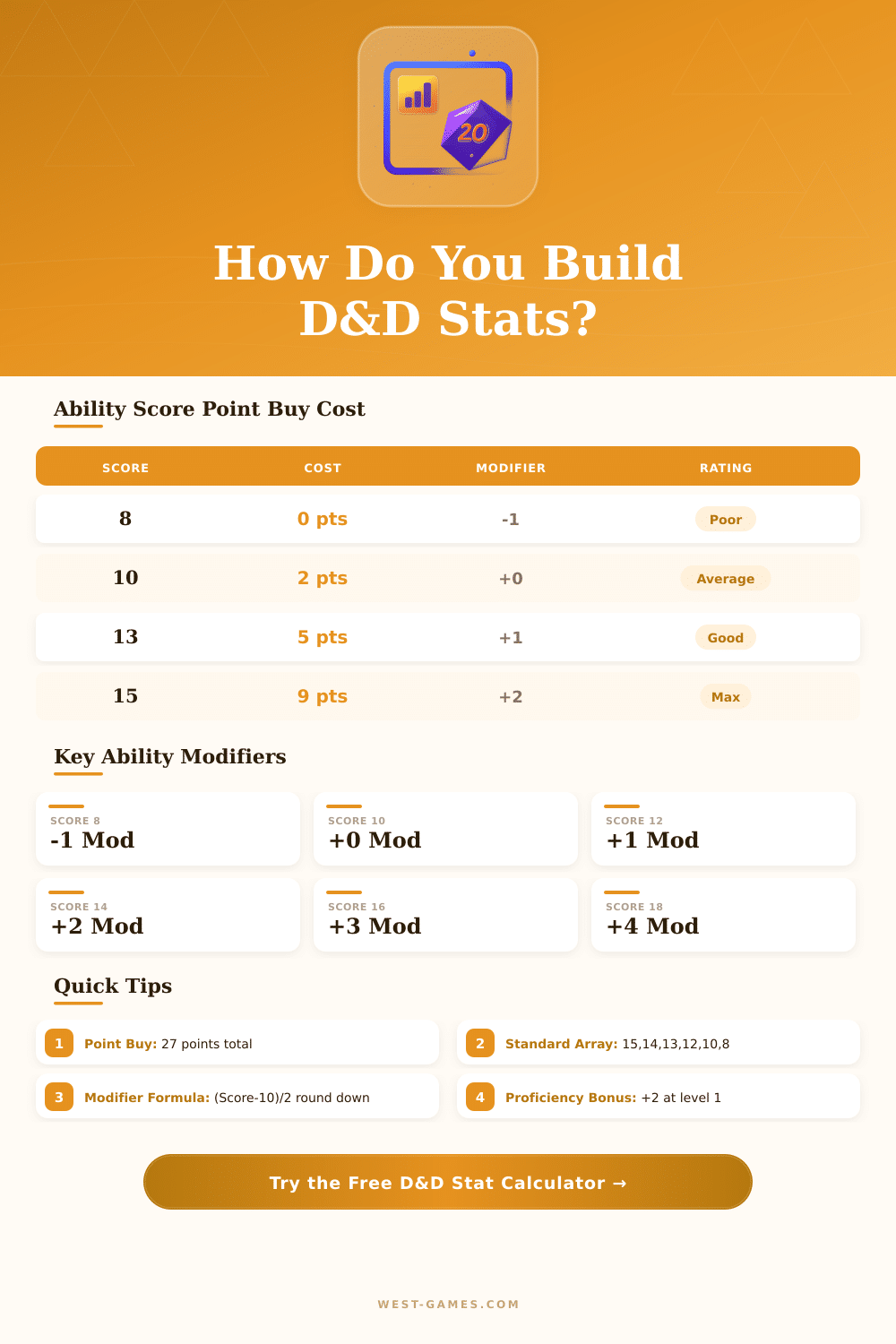
There are three main ways to get your Stat. The standard set gives each the same six values: 15, 14, 13, 12, 10 and 8. Every player later chooses which Stat gets which value.
The point-purchase method gives 27 points, with all Stat starting at 8. Stat higher require more points, and from 14 up they cost two points each. With that way Stat does not pass 15.
Also there is the roll-method, the most ancient of them. The most used version is made up of rolling four six-sided dice, dropping the weakest and adding teh three others. One repeats that six times for all six points.
The standard set results a bit under the typical average of dice-rolls. Here is why: it ensures usable Stat without danger of truly bad results. Rolling with dice stays the traditional style, even though many current players like the point-purchase.
Strength only covers one skill: Athletics. It matters when a player wants to brake a door or move heavy stuff. Charisma matters especially during talks with NPCs.
Deceit, Persuasion and Intimidation involve the main social tests, just like basic Charisma checks for everything like flirting. Agility some call the universal Stat, because it touches many fields. Usually the most helpful Stat depends on the played class, for instance Intelligence for wizards or Charisma for paladins.
Players also have skill bonuses that level decides. That bonus counts for skill tests, saving throws and attack rolls. One does not add it to one single roll more than one time.
Wise strategy is to focus on one or two strong Stat. Planning truly matters, some multiclass choices require 13 in a particular Stat, like Strength.
The DND Stat system has rich past. It existed from the start with rolling for Stat, and over years the scale of 1 to 20 became hardlychangeable. Spells like Polymorph replace all game states, including class traits, with those of the new form.