🦖 ARK Taming Calculator
Calculate post-tame level, bonus levels, taming time, and food needed for every dinosaur in ARK: Survival Evolved.
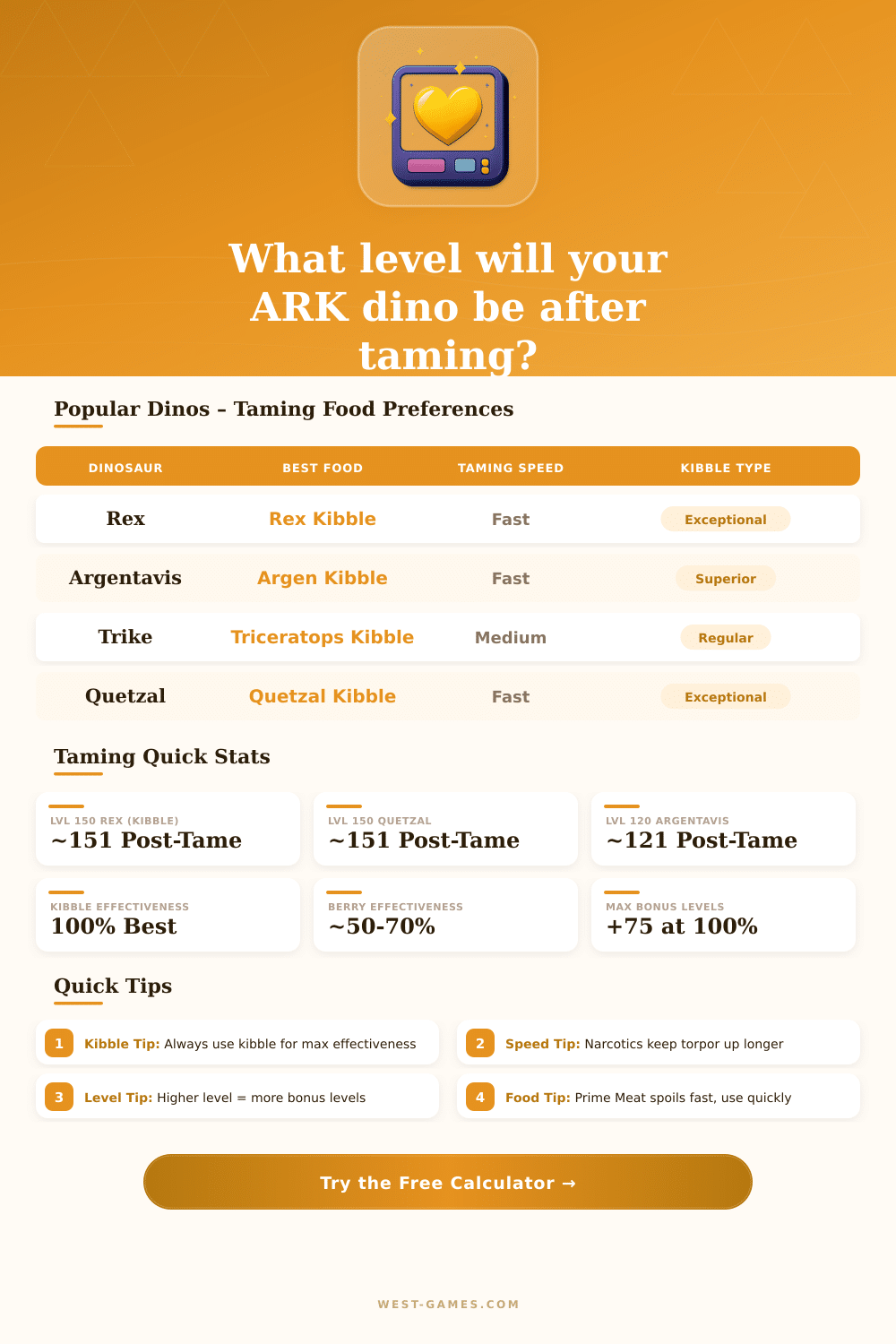
| Dinosaur | Best Food | 2nd Best | Kibble Tier |
|---|---|---|---|
| Rex | Rex Kibble | Prime Meat | Exceptional |
| Argentavis | Argen Kibble | Prime Meat | Superior |
| Quetzal | Quetzal Kibble | Prime Meat | Exceptional |
| Trike | Trike Kibble | Mejoberry | Regular |
| Ankylosaurus | Ankylo Kibble | Mejoberry | Regular |
| Raptor | Raptor Kibble | Raw Prime | Simple |
| Therizinosaurus | Therizino Kibble | Crops | Exceptional |
| Spinosaurus | Spino Kibble | Prime Fish | Superior |
| Effectiveness % | Bonus Level % | Lvl 100 Bonus | Lvl 150 Bonus |
|---|---|---|---|
| 100% | +50% | +50 levels | +75 levels |
| 80% | +40% | +40 levels | +60 levels |
| 60% | +30% | +30 levels | +45 levels |
| 40% | +20% | +20 levels | +30 levels |
| 20% | +10% | +10 levels | +15 levels |
| 1% | +0.5% | +0 levels | +1 level |
| Food Type | Taming Speed | Effectiveness | Notes |
|---|---|---|---|
| Kibble (Preferred) | Fastest | 100% | Best choice always |
| Prime Meat | Fast | 70-80% | Spoils in ~2 min |
| Raw Meat | Medium | 50-60% | Easy to get |
| Mejoberry | Slow | 50-65% | Best berry for herbi |
| Vegetables/Crops | Medium | 60-80% | Herbivore preferred |
Note: This explanation combines practical tips and tricks from the ARK community.
taming is key as one goes from wild dinosaur to friend. After you successfully manage it, you give orders to it lay gear on its body and leave it help you in battle. Moreover, tamed dinos open lots of uses, they carry your stuff, allow you to ride them (well, at least the majority of them), sell items, hunt for you, gather materials and even guard your bases when you are away from the net.
How to Tame Dinosaurs in ARK
The size and body shape decides what one can use for riding, however the options stay truly amazing.
The basic idea for taming in ark: Survival Evolved is quite simple: you feed the dino with its most favourite food, until it considers you fit to become. However the practical method changes hugely by species. Every species has its own rule.
Some you can tame in moments by means of one feeding. Others require more work; one must first catch them, which includes stocking of tranq arrows, crossbows and wooden buildings befoer even start.
The hard method is what you most commonly will use. Here what usually works: find yourself a high cliff or rock, that the creature can not climb, get up, later start bombing it by means of tranq darts or arrows until it faints. The hard part is self-control, too much wound and you will kill it outright instead of simply knocking out, especially at bottom level creatures.
When it lies fainting, put its favourite food in the inventory. As the hunger grows, it eats on its own, and hear it is possible, that your taming progress start to build. Better food helps a lot here.
Kibble and mutton work more quickly, plus they boost the result of your taming.
There is also passive taming, that works on a totally other idea. One lays the right meal in the last slot of your inventory, walk to the creature slowly and give it manually. Some dinos even grab the food from your hand instead of getting it kindly.
Take for example the Lystrosaurus… You prepare its favourite food, usually rare flowers (if needed, use berries in cases of need), and simply keep manually feeding until the taming locks. That mode is less used than the hard method.
Here something important to note: creatures appear in sets, usually each three together. If you want only one from them, take a flyer like Argentavis and carry your target to a lonely place. For fast runners like Raptors, bola does wonders, it holds it, later finish it off by means of slingshot to the head.
A taming calculator helps you escape loads of tests, showing exactly how much food, drugs and time you need. The game stores around 200 species, and some have truly weird taming systems. Almost every creature can be tamed, although some stay locked.
Early dinos give big gains, the Trike doesgreat in the early phase for both collecting and battle.