🎧 Headphone Impedance Amp Calculator
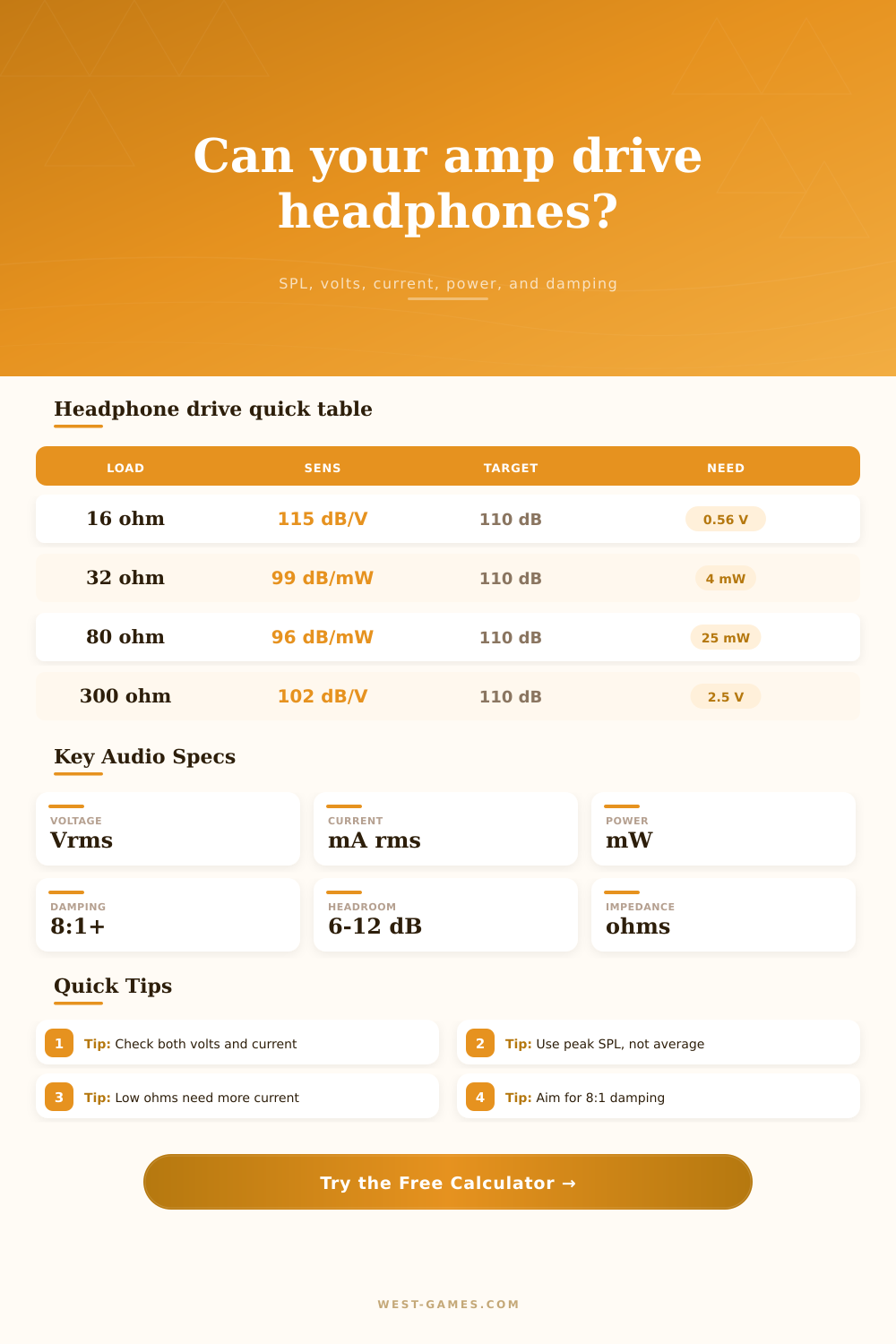
Estimate headphone loudness from impedance, sensitivity, target SPL, amp voltage, current, output impedance, damping factor, and clean headroom for gaming audio, studio monitoring, DAC amps, and portable sources.
| Need | Formula | Input basis | Interpretation |
|---|---|---|---|
| Power from dB/mW | mW = 10^((SPL - sensitivity) / 10) | Sensitivity at 1 mW | A 10 dB increase needs ten times the power. |
| Voltage from dB/V | V = 10^((SPL - sensitivity) / 20) | Sensitivity at 1 Vrms | A 6 dB increase needs about double the voltage. |
| Voltage from power | V = sqrt(P watts x impedance) | Headphone impedance | Uses RMS voltage at the headphone terminals. |
| Current from voltage | I = V / impedance | Ohm law relationship | Low impedance loads need more current for the same voltage. |
| Power from voltage | P = V² / impedance | RMS voltage and load | Displayed as milliwatts per channel. |
| dB/mW to dB/V | dB/V = dB/mW + 10 log10(1000 / ohms) | 1 mW voltage into load | Converts sensitivity specs to the same basis. |
| Output Z loss | Loss dB = 20 log10(load / (load + source Z)) | Voltage divider | Applies when the amp voltage is before output resistance. |
| Damping factor | DF = headphone ohms / source ohms | Output impedance plus cable | The 1/8 rule corresponds to DF of 8 or higher. |
| Headphone type | Typical impedance | Typical sensitivity basis | Main amp limit |
|---|---|---|---|
| Sensitive in-ear monitor | 8 to 32 ohms | Often dB/V or high dB/mW | Noise floor and output impedance matter more than raw power. |
| Gaming headset | 24 to 64 ohms | Usually high dB/mW | Most DAC amps are enough; controller jacks can clip on loud peaks. |
| Studio dynamic headphone | 80 to 250 ohms | Often dB/mW | Voltage demand rises as impedance increases. |
| 300 ohm open-back dynamic | 300 ohms | Often dB/V | Needs voltage swing more than high current. |
| Planar magnetic headphone | 16 to 70 ohms | Often lower dB/mW | Current and power limits can arrive before voltage limits. |
| Vintage 600 ohm studio load | 600 ohms | Varies by model | High Vrms output is the important spec. |
| Metric | Good result | Warning result | What to change |
|---|---|---|---|
| Voltage margin | Required source Vrms below usable amp Vrms | Voltage margin below 0 dB | Use an amp with more voltage swing or reduce target SPL/headroom. |
| Current margin | Required mA below usable amp mA | Current margin below 0 dB | Use a stronger low-impedance amp or lower the peak target. |
| Power margin | Required mW below loaded amp rating | Power rating below required mW | Check both channel rating and the impedance where it was measured. |
| Damping factor | 8:1 or higher | Below 8:1 | Use a lower output impedance source for variable-impedance headphones. |
| Divider loss | Less than 0.5 dB | More than 1 dB | Lower source impedance or use a higher impedance headphone. |
| Headroom | Clean margin after EQ and tolerance | Calculated peak near amp limit | Reduce EQ boost, target SPL, or reserve a stronger amp. |
So you drop some coin on a high end pair of headphones, connect ’em to your desktop amp, and… meh. It sounds flat. The bass is muddy. The detail is smeared. The image feels underwater. Volume knob? It is turned down to thirty percent. Volume’s just right, so what gives?
Typicaly this means that the output impedance of your amp is poorly matched with your headphone’s impedance. Hardware failure are rarely the problem here. Enter your specs into the calculator, let it do the math for you and save yourself from having to remember those pesky coefficient/conversion numbers.
Why Your Headphones Sound Bad
Most of the time, however, it isn’t raw power as people imagine it. Headphones is an inefficient type of transducer; they don’t care about brute force as much different than current delivery and voltage swing. A sensitive pair of in-ear monitor can play painfully loud on a fraction of a milliwatt. However, without enough voltage at the output end to drive the headphone’s driver back and forth with authority, there will be no soundstage and the highs will rolls off. This is where most people goes wrong. They chase watts when they should of chasing clean voltage headroom. Car stereos and home theater system do use watts and we look for those numbers because of it.
The second reason is that impedance isn’t a static value such as thirty-two ohms, rather it’s a curve. The dynamic driver varies its electrical resistance greatly through the frequency range. In some cases, you may see the impedance drop to half its rated value for bass notes and spike up for treble peaks. It’s right here where output impedance matter. A higher output impedance in an amplifier makes it behave more like a voltage divider. This alters the frequency response based off what the headphone is doing at any given time. What happens is the tone shift with the music. Generally speaking, the higher the damping factor (eight or above) the less this will be noticeable.
And then there’s the whole thing about how people actualy listen to music, something theoretical guides never consider. Because music isn’t a steady quiet sound, you don’t typically listen at a static level. There are dynamics. A quiet verse, for example, gives way to a loud chorus. That increase in volume create an instant change in voltage and a matching spike in current. That means if the amplifier is pushed to its limit at your normal listening volume, it’ll clip at the peak. And clipping is bad: not only does it distort the sound, it can actually harm your ears. Six decibels of headroom translates into twice the necessary voltage. On paper, it doesn’t seem like much but that equals four times the power demand. Use the calculator to enter that cushion and you’ll get a look at what your amp’s really doing.
The classic rule-breakers are planar magnetic cans which demand not only high voltage but also a lot of current, usually because their sensitivity is pretty low and impedance is low too. So you can put them on a typical tube amp and get good voltage but no current so all the bass dissapears immediately. Or perhaps you can push one from a solid-state dongle with plenty of current but no way to produce enough voltage to make it loud. In other words, you should test for both end. That’s what the reference table on the page shows, how various driver types stretches different aspects of an amp.
Lastly, don’t ignore the cable. That creates more resistance and adds to the amplifier’s output impedance. Running a long cable with a high output impedance source is creating a filter that chews up your bass. It’s a small thing but it matters. Go through your setup, add your headroom buffer if needed, and see if the math works out instead of just relying on your ears. A few volts makes all the difference sometimes between a good match and a poor match.