TFT Gold Interest Calculator
Project standard Teamfight Tactics economy from banked gold, interest thresholds, win or loss streaks, round income, leveling, rolling, bench sales, and a target gold plan.
| Round | Result | Start Gold | Spend | Bench Sold | Interest | Streak | Income | End Gold | Signal |
|---|---|---|---|---|---|---|---|---|---|
| Run the calculator to show the projection. | |||||||||
| Rule | Value | How it affects planning | Calculator handling |
|---|---|---|---|
| Base income ramp | +2, +2, +3, +4, then +5 | Stage 1 and 2-1 pay less than the normal midgame rhythm. | Select the starting round; later rounds use +5. |
| PvP win gold | +1 | Winning a player combat adds one extra gold before the next shop. | Toggleable because some review paths include PvE or unknown fights. |
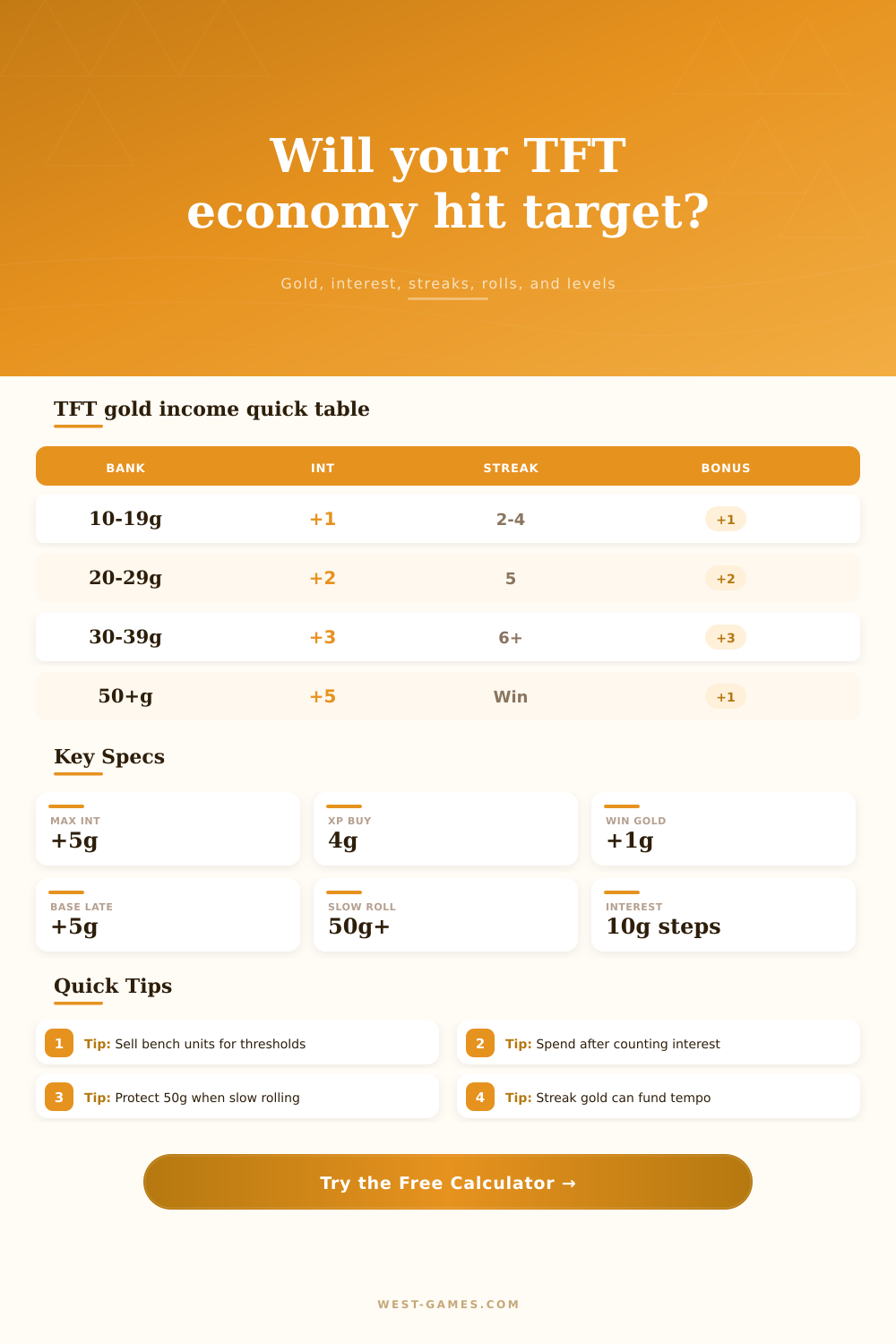
| Interest | +1 per 10 gold | 10, 20, 30, 40, and 50 gold are the normal breakpoints. | Floors banked gold divided by 10 and caps at max interest. |
| Streak gold | 2-4 +1, 5 +2, 6+ +3 | Long win or loss streaks can equal several interest tiers. | Updates the streak after each projected result. |
| Reroll price | 2 gold | Rolling two shops spends one full interest threshold. | Use the reroll spend field for planned rolls. |
| XP purchase | 4 gold | Buying XP trades future interest for board size and shop odds. | Each XP purchase entered spends 4 gold per round. |
| Bank before income | Interest | Missing to next tier | Typical decision |
|---|---|---|---|
| 0-9 gold | +0 | 10 minus current gold | All-in, reroll, or rebuilding after a roll down. |
| 10-19 gold | +1 | 20 minus current gold | Keep cheap pairs only if they matter soon. |
| 20-29 gold | +2 | 30 minus current gold | Good early economy if the board is still playable. |
| 30-39 gold | +3 | 40 minus current gold | Strong Stage 2 or Stage 3 bank without maxing interest. |
| 40-49 gold | +4 | 50 minus current gold | Often worth selling low-priority bench units. |
| 50+ gold | +5 | Max normal tier | Best state for slow rolling or saving toward levels. |
| Plan | Gold target | Spend pattern | Watch point |
|---|---|---|---|
| Fast 50 | Reach 50 as early as possible | Buy only core units and threshold holds | Do not lose too much health while saving. |
| Win streak tempo | Stay near 20-40 while strong | Level or buy pairs to preserve wins | Losing the streak can erase the payoff. |
| Loss streak bank | Bank 40-50 before stabilizing | Minimal buys, carousel priority, planned roll down | Scout damage and stabilize before danger range. |
| Slow roll | Hold 50 and roll only excess | Spend above 50 for shops | Stop if health or lobby tempo forces a spike. |
| Level spike | Spend XP, keep reserve | 4 gold chunks for XP purchases | Check if the level actually protects the streak. |
| Roll down | Accept lower bank for upgrades | 20+ gold rolling burst | Plan the rebuild path after the spike. |
Greed vs. Survival, That’s what Teamfight Tactics is all about. You have 50 gold sitting in your bank, but you has to balance that with survival! Your health deplete. The enemy scores kills. Your team sucks. People around you are winning.
And that’s why most people fail: They’re unable to predict how something will play out economicaly over the next few rounds. After setting your boundaries, let calculator do the math (above). Without risking your own match placement, play out various scenario. Don’t just tally up the coins, learn to appreciate how spending and earning work together.
How to Use the Math Tool
Enter your starting round and bank. The tool will plot the effect of streak bonuses, interest thresholds, and base income. It will project whether you can afford to roll for that three-star unit or if you’re speeding into a nosedive. The rules are listed in a handy table on page, but it gets interesting when you see how these rules compound with additional variables such as bench sales or XP buys.
This happens because people don’t understand interest thresholds. Interest come in multiples of 10 gold. Thirty and thirty-nine is economically identical. Keeping those nine does not benefit you in any way. Many people has odd amounts for no particular reason. They never sell it off for a bit of an upgrade or to buy some XP.
That’s what the tool illustrates too, where’s your bank sitting compared to next tier? Is it at forty-eight? Sell one unimportant bench to reach fifty. That’s mathematically a clean win. You’re earning more over time because you earn five instead of four. It is never going to make up for having it but it adds up over time.
The calculator models probable results, but pure math doesn’t account for streaks which introduce volatility. Winning gives you an instant windfall of gold, but maintaining the win streak require spending gold to continue winning. That depletes your interest. Toggling between different combinations of wins, losses, and mixtures will show whether or not your economy hold up to the strain.
If you’re banking gold by riding out a loss streak, the forecast will reveal how long you have until you’ll need to stabilize yourself. It’s easy to push a loss streak past the point of return, incurring more health damage than the gold is worth. Even worse, you might do this right as the lobby are near zero life. Do you have enough time to wait another round? Or should of you roll down now? The numbers answer those questions.
The reasoning behind leveling and rolling decisions is also consistent: Leveling improves your shop odds and buys you more time. It costs four gold per XP purchase, that’s a fixed tax on your economy. The calculator factors that in. It will tell you how many rounds of savings are required to get to level seven or eight. This allows you to determine whether your potential board can support the investment based off its strength. If the prediction indicates that you’ll fall below a safe reserve upon leveling up, the math caution against it because you may lack the resources to weather a poor roll.
Flexibility is what economy realy boils down to. Saving gold isn’t the only thing that makes a player good. Spending it well when they need it is too. This tool removes the madness of the game and replaces it with math. Before you make a decision, this will show you how much money it’ll cost.
You’ll come back off the ladder thinking less about how much money you have sitting in the bank. You’ll think more about how much money you’re going to have after the next round. That’s the difference between winning consistently and playing casualy.