🎯 Burst Fire DPS Calculator
Compare damage per shot, shots per burst, burst delay, RPM, reload, magazine size, accuracy, crit rate, headshot rate, burst-window DPS, cycle DPS, and sustained DPS.
| Metric | Formula used | What it includes | Best use |
|---|---|---|---|
| Expected shot damage | Damage x accuracy x average multiplier x target modifier | Hit rate, headshot rate, crit rate, and target adjustment | Comparing aim, perk, armor, or weak-point changes |
| Burst damage | Expected shot damage x shots per burst | All shots in one trigger burst | Checking peek damage or stagger thresholds |
| Burst-window DPS | Burst damage / burst firing time | Only the shots while the burst is firing | Short exposure trades or damage race openings |
| Burst-cycle DPS | Burst damage / (burst firing time + burst delay) | Cadence lockout after every burst | Repeated tap fire before reload matters |
| Sustained DPS | Magazine expected damage / empty-mag time plus reload | Full magazine, partial final burst, reload timing | Bosses, shields, elites, long target exposure |
| Profile | Damage focus | Timing profile | Calculator setting to watch |
|---|---|---|---|
| Tactical 3-round rifle | Balanced body and headshot damage | Medium RPM with a visible post-burst delay | Burst-cycle DPS and accuracy sensitivity |
| Pulse rifle | Lower shot damage but tighter repeated bursts | Four or five shots with moderate lockout | Shots per burst and burst delay |
| Burst SMG | High close-range hit volume | Fast internal RPM and short lockout | Accuracy, magazine size, and reload penalty |
| Two-shot marksman | High headshot multiplier and high base damage | Low shot count, slower rhythm | Headshot rate of landed shots |
| Heavy burst weapon | Large magazine damage and boss pressure | More shots per burst and slower reload | Sustained DPS and delay after final burst |
| Input change | Direct effect | Where it shows | Practical interpretation |
|---|---|---|---|
| Higher damage per shot | Linear increase to every damage and DPS result | All four result cards | A 10% damage perk is roughly 10% DPS before rounding |
| Higher accuracy | Linear increase to expected shot damage | Burst damage and sustained DPS | Missed burst shots are expensive because the delay remains |
| Higher burst delay | No change to burst damage, lower cycle and sustain DPS | Burst-cycle DPS and sustained DPS | Delay-heavy weapons look strong only in short peeks |
| Faster reload | No effect before the magazine empties | Sustained DPS only | Reload bonuses matter most in long target windows |
| More magazine shots | More time before reload and more total magazine damage | Magazine profile and sustained DPS | Large magazines soften reload penalties |
You’ve pulled the trigger. The gun spits out three bullet quickly. They exit the barrel one after another, and then the gun stops for a split second, unable to shoot until its ready. It seems like it fires fast, but that isn’t the critical metric.
What really counts is average damage from the full cycle, including the pause between shots, the reload time, and wasted rounds. Everyone stares at the burst window and think they’re getting away with it, but they aren’t.
Why Cycle DPS Matters More Than Burst Speed
This means after entering all of the statistics for your weapon, the calculator do the rest of the math for you, saving you from having to guess at your actualy output with a weapon’s post-burst delay. But what are we measuring? That’s where the trick come in.
Cycle DPS measures how much damage you’re doing over the entire cycle, including its lockout time. This number tell you how you should of play the weapon. If your cycle DPS is on the lower end, then you can’t compete with someone on a fair trade during a drawn out fight, instead needing to force an exchange early and then disengage.
On the other hand, burst window DPS measures only how much damage you’re doing when the gun is firing, which of course include none of this lockout time, and so will always be higher.
What else matters? Accuracy is incredibly important when it comes to burst weapons. Sure, you may be firing a weapon with massive potential damage output, but if you’re getting below an 80% hit rate, then you’re gonna pay a price. You pay the exact same amount of burst delay whether you hit or miss. If you go below 80%, you are literally throwing away ammo which will hurt burst efficiency.
That’s why the calculator consider accuracy by multiplying your expected damage times your accuracy percentage. If your accuracy goes down from say 90% to 80%, that doesn’t just result in a ten percent decrease in damage done, but a waste of time. Burst weapons wastes the most time, and that is what people fail to understand.
The other wrinkle is that critical hits and headshots complicate things. Based off how a game handles damage, you can either stack a headshot with an incoming damage multiplier (headshot + 3x) or treat it as a separate event (headshot x3). Enter your headshot rate accordingly. If a headshot is merely a damage multiplier on a landed hit, then your headshot rate is the % of hits where a headshot was achieved rather than the number of triggers pulled.
Why? Because if you miss a headshot, that’s all it is, a miss. It doesn’t convert into a body shot. That means the math recognize this reality and you’re accepting greater variance for lower consistency. Greater variance is fun in a highlight reel, but it is bad news in a ranked match.
The last piece of that chain are reloads. How long does it take you to top off your mag? Short fights don’t care about this at all. It doesn’t factor into sustained damage per second. It also doesn’t factor into downtime if we’re talking suppressive fire. For sustained suppression or boss fights, however, it matter. Having a big mag reduces the penalty of a slow reload, but having a big mag means you’ve got more time to be vulnerable as you shoot.
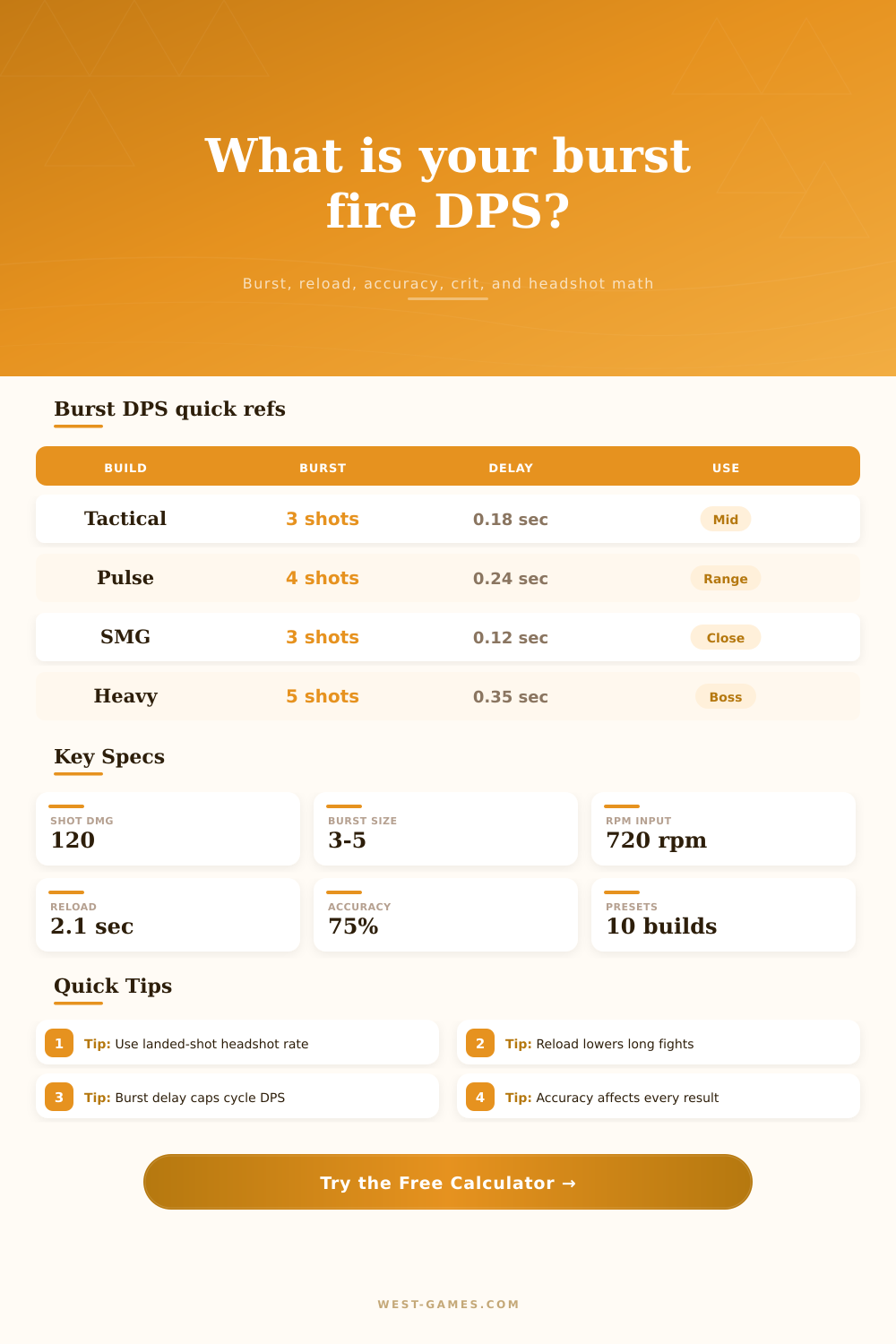
Different weapons has different profiles, which you can see in the reference table on the page. A heavy burst weapon sacrifices uptime for raw stopping power. A tactical rifle will balance out burst and sustain. The presets are there to give you an understanding of the base-line, and then you can tweak each variable individually and observe how that affect the result.
Change the burst delay by just one hundredth of a second and watch how the cycle DPS drops. What happens if you change accuracy by five percent? How much does that affects your expected damage per shot? Sensitivity testing is realy the place where you learn, because you no longer think of guns as static things but rather timing puzzles.
Not having the biggest number isn’t the goal. Having the appropriate number for whatever situation you anticipate facing is the goal.
The gaps between bursts: This isn’t so much a matter of firing quickly; it’s a matter of mastering the gaps. Firing is simple, pausing is difficult. Math tells you exactly how costly those pauses are. It shows the rhythm of the gun and removes the illusion of speed. See that rhythm and let it happen rather than resist it. Shots exit the barrel rapidy, but math always catches up with you.