⚡ Pokemon Hidden Power Calculator
Calculate Hidden Power type, older-generation base power, IV parity, target matchups, and practical valid spreads from Pokemon IVs.
| Index | Type | Index | Type |
|---|---|---|---|
| 0 | Fighting | 8 | Fire |
| 1 | Flying | 9 | Water |
| 2 | Poison | 10 | Grass |
| 3 | Ground | 11 | Electric |
| 4 | Rock | 12 | Psychic |
| 5 | Bug | 13 | Ice |
| 6 | Ghost | 14 | Dragon |
| 7 | Steel | 15 | Dark |
| Gen | Type source | Power | Category |
|---|---|---|---|
| II | Atk/Def DV | 31-70 | By type |
| III | 6 IV parity | 30-70 | By type |
| IV-V | 6 IV parity | 30-70 | Special |
| VI-VII | 6 IV parity | 60 fixed | Special |
| BDSP | 6 IV parity | 60 fixed | Special |
| Legends | Opponent | 50 listed | Special |
| Aim | HP | Atk | Def | Spe | SpA | SpD |
|---|---|---|---|---|---|---|
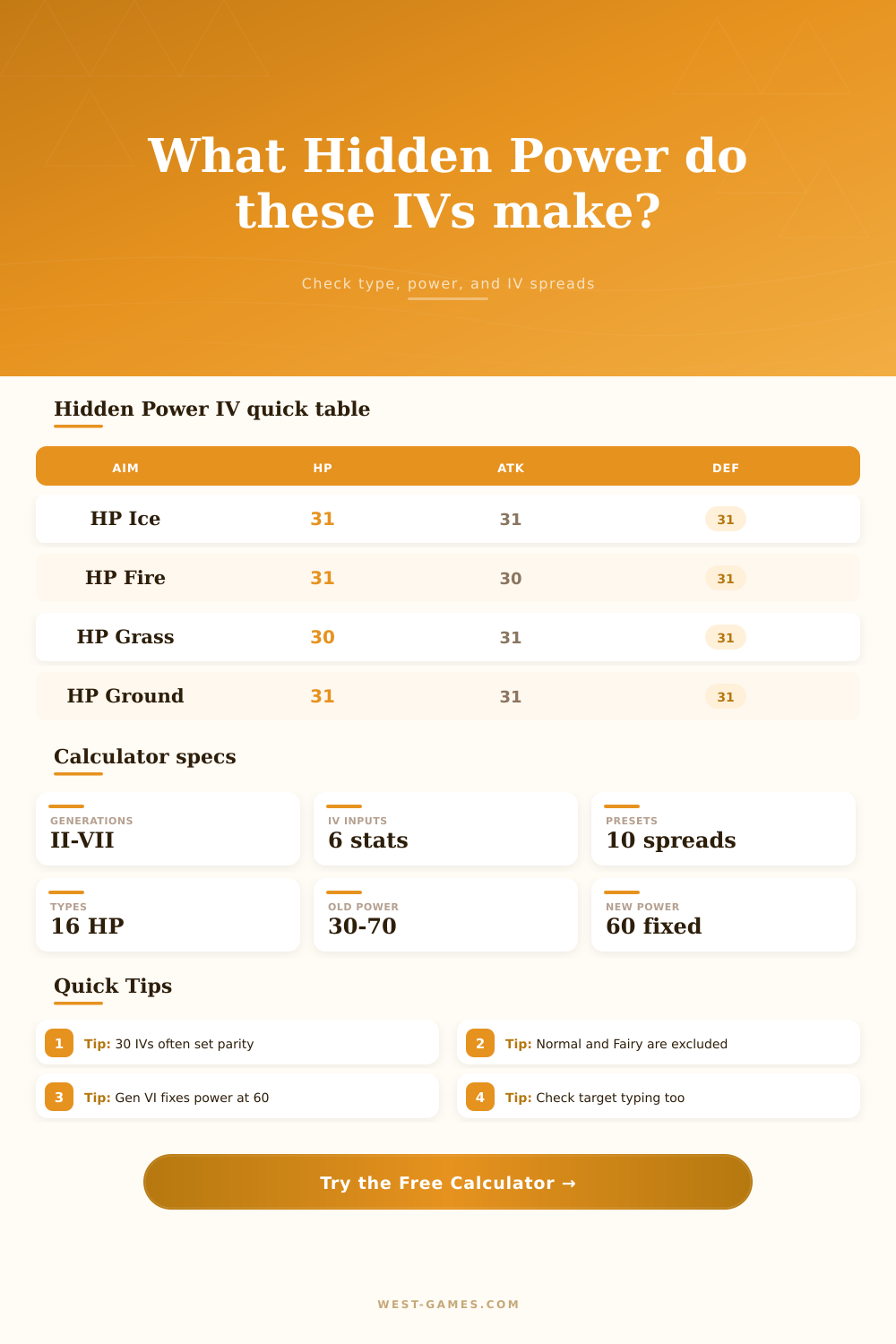
| HP Ice | 31 | 31 | 31 | 30 | 31 | 31 |
| HP Fire | 31 | 30 | 31 | 30 | 30 | 31 |
| HP Grass | 30 | 31 | 31 | 31 | 30 | 31 |
| HP Ground | 31 | 31 | 31 | 31 | 30 | 30 |
| HP Electric | 31 | 31 | 31 | 31 | 30 | 31 |
| HP Fighting | 31 | 31 | 30 | 30 | 30 | 30 |
| IV mod 4 | Example IVs | Type bit | Power bit |
|---|---|---|---|
| 0 | 0, 4, 28 | Even = 0 | 0 |
| 1 | 1, 5, 29 | Odd = 1 | 0 |
| 2 | 2, 6, 30 | Even = 0 | 1 |
| 3 | 3, 7, 31 | Odd = 1 | 1 |
Then there’s the time you’re staring at a pristine-looking Gyarados, perfectly specced out, when it misses finishing blow. Your Dragonite barely dodged what would of knocked him out cold. And then you remember: Hidden Power.
That’s where your Pokémon’s hidden Individual Values come into play. This system has always worked like a breed-and-deal-with-it remainder equation, as much a part of the parity-based balancing than for years. Give up a stat point here to cover yourself there. A little thing, but when you’re working toward every last drop of juice from your team… In theory, it’s pretty straightforward, but in practice it can get a little finicky.
Understanding Hidden Power and IVs
It all comes down to your Pokemon’s six IVs. Each one will either be even or odd. For the sake of simplicity, if you’re looking to teach them an Ice-type Hidden Power, they must has a certain combination of odds and evens. The calculator does math for you. Simply plug in your IVs, and it’ll calculate based off that. There’s no need to remember what stats require an even number for their HP to have an Ice-type Hidden Power. Just plug in your target, and let the calculator take over.
This is where it gets tricky because there’s also that type requirement to consider alongside battle performance. In older generations, base power of a hidden power fluctuated based on second digit of each IV. For example, if you wanted seventy power, your general IVs would be something like thirty/thirty-one. Which is where you find those competitive spreads. Why are they all thirties except for one that is also a thirty? Because that one point is the price of doing business. You have a solid move but you’re hitting that type parity you want. Be mindful of this trade-off.
For example, a special attacker may sacrifice their Speed IV for extra bulk with no ill effects, though that means you’ll be slow when facing important threats. An attacker with a mix of offensive and defensive abilities may have to sacrifice Attack or Special Attack, affecting your damage output. By displaying workable spreads close to your chosen IV floor, the tool lets you picture your options. What can you tweak without compromising your approach? That’s no longer a guess, it becomes a calculated decision.
It gets even more strategic with target matchup analysis. It’s nice to know that your Hidden Power is Ice. It’s nicer still to know that it’ll do quadruple damage against Flying/Dragon type. That’s when the need to check targets comes into play. You’re no longer breeding for type, per se, but rather for a counter. If your metagame is currently being dominated by Dragon-types, then an Ice Hidden Power can be a strong choice. Now it isn’t about raw power so much as it is about coverage. A mediocre move now serves as a situational knockout button, filling a hole in your offensive toolkit.
The spread itself take some patience to breed out. You’re aiming for two thing at the same time: a given parity and a given remainder. Finding a perfect thirty-one across all six stats is easier than finding a perfect thirty-one in five of those plus another perfect thirty in one particular stat. The odds aren’t in your favor. But now with the ability to check IVs early on and more advanced breeding methods, this can be managed. The trick is to focus on the stat you don’t mind sacrificing most. Say you want it to have high Speed; you get that to be thirty-one and make adjustments accordingly.
In later generations, they standardized the strength of Hidden Power to sixty. Why? There was no longer any reason to pursue certain IV leftovers for their potency. All that mattered now were the type match-ups. Now it has become less of a power tool and more of a coverage option. But the concept persists. Your Pokémon’s hidden stat becomes something strategic. Something that puts you in control.
When you know what your IVs are, you can use them for the right moves, taking control of the way your Pokemon works together. You no longer leave it up to chance. You no longer build off random number generation. You will have no more random rolls, only calculated gains. And that single point loss is worth it.