💎 Diablo 2 Rune Upgrade Calculator
Plan Horadric Cube rune upgrades from El through Zod, including tier distance, 3:1 and 2:1 recipe steps, required gems, owned stock gaps, legacy ladder restrictions, and stash slot estimates.
| Step | Recipe | Crafts | Input runes consumed | Gem required | Output | Rules note |
|---|---|---|---|---|---|---|
| Calculate to show each rune upgrade step. | ||||||
| Gem item | Quality | Family | Recipes using it | Total needed | After buffer |
|---|---|---|---|---|---|
| Calculate to show chipped, flawed, normal, and flawless gem totals. | |||||
| Band | Starting runes | Ratio | Gem rule | Legacy realm non-ladder rule | D2R current mode |
|---|---|---|---|---|---|
| Basic low runes | El through Ort | 3 same runes | No gem | Works | Works |
| Early gem recipes | Thul through Shael | 3 same runes | Chipped Topaz to Chipped Ruby | Works | Works |
| Legacy gated 3:1 | Dol through Lem | 3 same runes | Chipped Emerald through Flawed Emerald | Blocked on closed realm non-ladder | Works |
| High rune 2:1 | Pul through Cham | 2 same runes | Flawed Diamond through Flawless Emerald | Blocked on closed realm non-ladder | Works |
| Tier | Rune | Character level | Next recipe | Gem item | Recipe band |
|---|---|---|---|---|---|
| 1 | El | 11 | 3 El to Eld | None | Basic 3:1 |
| 2 | Eld | 11 | 3 Eld to Tir | None | Basic 3:1 |
| 3 | Tir | 13 | 3 Tir to Nef | None | Basic 3:1 |
| 4 | Nef | 13 | 3 Nef to Eth | None | Basic 3:1 |
| 5 | Eth | 15 | 3 Eth to Ith | None | Basic 3:1 |
| 6 | Ith | 15 | 3 Ith to Tal | None | Basic 3:1 |
| 7 | Tal | 17 | 3 Tal to Ral | None | Basic 3:1 |
| 8 | Ral | 19 | 3 Ral to Ort | None | Basic 3:1 |
| 9 | Ort | 21 | 3 Ort to Thul | None | Basic 3:1 |
| 10 | Thul | 23 | 3 Thul to Amn | Chipped Topaz | Chipped 3:1 |
| 11 | Amn | 25 | 3 Amn to Sol | Chipped Amethyst | Chipped 3:1 |
| 12 | Sol | 27 | 3 Sol to Shael | Chipped Sapphire | Chipped 3:1 |
| 13 | Shael | 29 | 3 Shael to Dol | Chipped Ruby | Chipped 3:1 |
| 14 | Dol | 31 | 3 Dol to Hel | Chipped Emerald | Legacy gated |
| 15 | Hel | 33 | 3 Hel to Io | Chipped Diamond | Legacy gated |
| 16 | Io | 35 | 3 Io to Lum | Flawed Topaz | Legacy gated |
| 17 | Lum | 37 | 3 Lum to Ko | Flawed Amethyst | Legacy gated |
| 18 | Ko | 39 | 3 Ko to Fal | Flawed Sapphire | Legacy gated |
| 19 | Fal | 41 | 3 Fal to Lem | Flawed Ruby | Legacy gated |
| 20 | Lem | 43 | 3 Lem to Pul | Flawed Emerald | Legacy gated |
| 21 | Pul | 45 | 2 Pul to Um | Flawed Diamond | High 2:1 |
| 22 | Um | 47 | 2 Um to Mal | Topaz | High 2:1 |
| 23 | Mal | 49 | 2 Mal to Ist | Amethyst | High 2:1 |
| 24 | Ist | 51 | 2 Ist to Gul | Sapphire | High 2:1 |
| 25 | Gul | 53 | 2 Gul to Vex | Ruby | High 2:1 |
| 26 | Vex | 55 | 2 Vex to Ohm | Emerald | High 2:1 |
| 27 | Ohm | 57 | 2 Ohm to Lo | Diamond | High 2:1 |
| 28 | Lo | 59 | 2 Lo to Sur | Flawless Topaz | High 2:1 |
| 29 | Sur | 61 | 2 Sur to Ber | Flawless Amethyst | High 2:1 |
| 30 | Ber | 63 | 2 Ber to Jah | Flawless Sapphire | High 2:1 |
| 31 | Jah | 65 | 2 Jah to Cham | Flawless Ruby | High 2:1 |
| 32 | Cham | 67 | 2 Cham to Zod | Flawless Emerald | High 2:1 |
| 33 | Zod | 69 | No higher rune | None | Final tier |
“I’m trying to make some Spirit armor but I only have this crappy chest full of runes.” The distance from that point to your goal feels huge…until you crunch the numbers. Players tend to estimate that they’ll need like a couple dozen initial ingredients. In fact, it’s more like thousands.
That’s where thoughtful planning prevents your brain from melting out of your ears while saving space in your stash. The tool up top will do math on the exponential increase for you; but knowing why the numbers get so ridiculous is what helps you avoid pricey blunders.
Why You Need to Plan Your Runes
Diablo 2’s runes don’t scale linearly; they’re exponential, and they also aren’t created equally. Every higher tier rune consume several of its predecessors. In the early game, that’s a three-to-one. Drop three Els for an Eld. Three Elds for a Tir. It seems reasonable, like a bit of work. You can grind through it with your initial stash as you blow past the Countess, clearing a couple caves and running home with some materials to bump yourself up a tier or two.
But then each tier jump increases quantity required. By gem-rush tiers, amount you need to feed into the machine has grown huge. And this is where people go awry. They believe they’re farming for one rune. No, no, no. They’re farming for the whole chain below it.
Fortunately, calculator takes all of this into account. Once it knows where you’re trying to go and how much stuff you have to start with, it calculates exact number of inputs required at each stage. If you reach Thul, then it includes gem requirements as well. Flawed gems aren’t hard to come by, but flawless gems take some work. Chipped gems is easy to find. This tool divides up everything for you so you’ll always know exactly what to focus on when you log in.
Do you really want to get halfway through a craft only to find out you don’t have enough Flawed Diamonds? Yeah, no thanks. That’s a huge waste of time.
The other hidden bottleneck is inventory management. In the base game, runes don’t stack. Each rune take up one square. Cubing a Zod requires hundreds of lower level runes at hand to feed it. Where to put them? How to keep track of them? How much room do they take up moving around?
It’ll calculate how many stash slots your planned runs require. This will help you plan for your mule setup. If your char drops lots of runes but has zero stash space, he’s gonna stall out quick. Storage planning is just as critical than the drop rate planning itself.
That’s another level of complexity added by legacy rules. Some recipes are locked if you’re playing on an old school, non-ladder account. Recipes in Dol or higher can’t be made with the cube on closed realms. The tool includes a mode switching feature so it shows those limitations. This way, you don’t waste time or effort on characters that won’t go anywhere and you don’t get false hope.
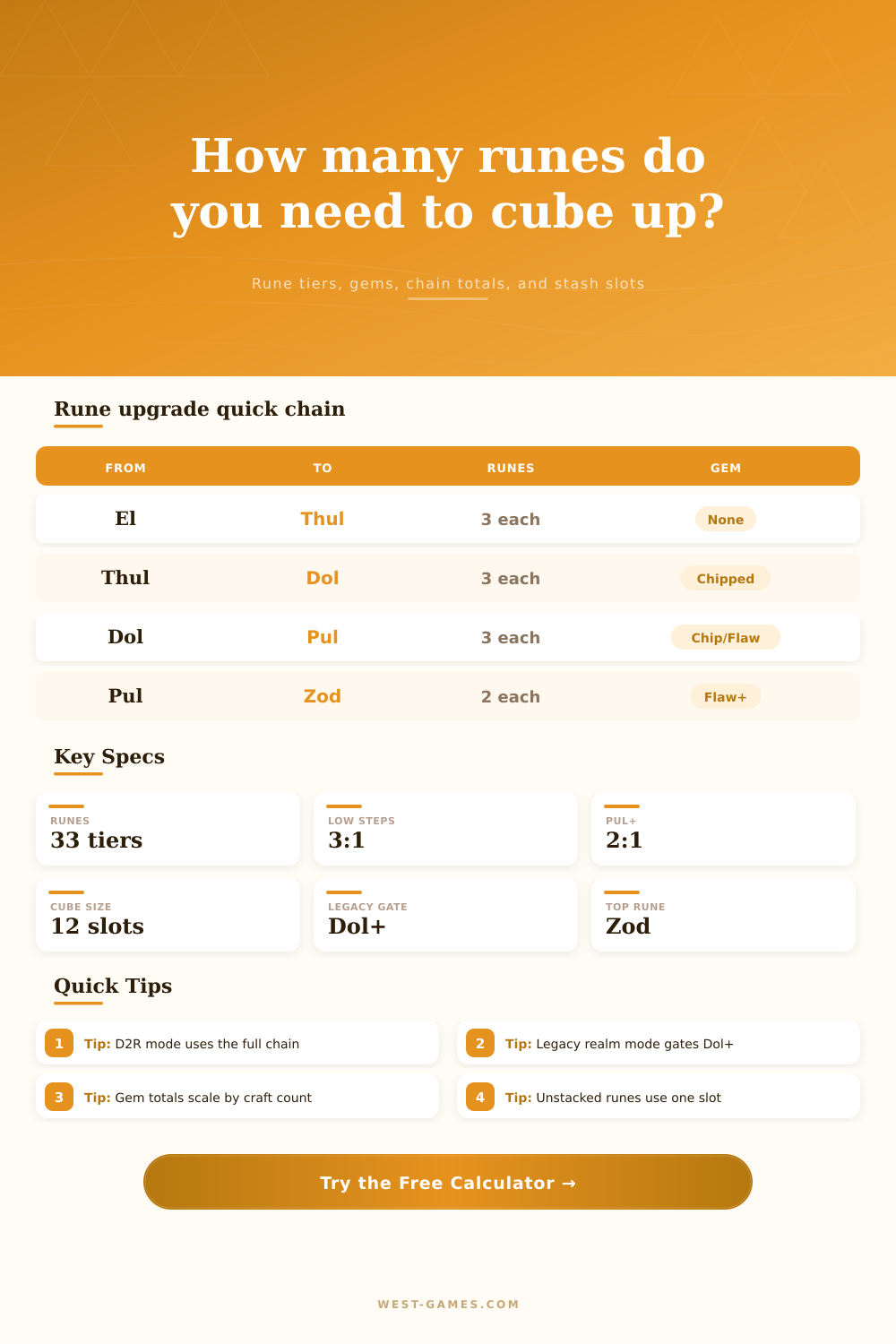
On moddern accounts, all the recipes are unlocked. The math is the same. The rules are different. It’s important to know what rules apply to your particular account. Here’s how it all breaks down; the reference table on the page has the whole thing laid out. You can see where they go from three-to-one to two-to-one at the Pul tier. That reduces the exponential rate of growth a bit, but man are those numbers big.
There’s technically nothing stopping you from cubing high runes, though more times than not it would of been less expensive for you to just buy/drop them outright. The calculator lets you do that comparison too. It’ll tell you if what you’re asking for isn’t worth the effort you’re willing to put in to get it. It gives you the information so you don’t make the emotional decision, you make the rational one.
But really, rune crafting is all about logistics and patience. It’s a lesson in planning and punishing guesswork. The more you visualize the whole chain before clicking that transmute button, the less of a chaotic grind it becomes. You have an idea of what you’re looking for. You have an idea of where you’re lacking pieces. You have an idea of how much room you need to clear. If you do, the runes comes next. And when that last one finally comes together, that feeling is worth it. Not only did you get some sweet gear, but you understood the system to earn it.