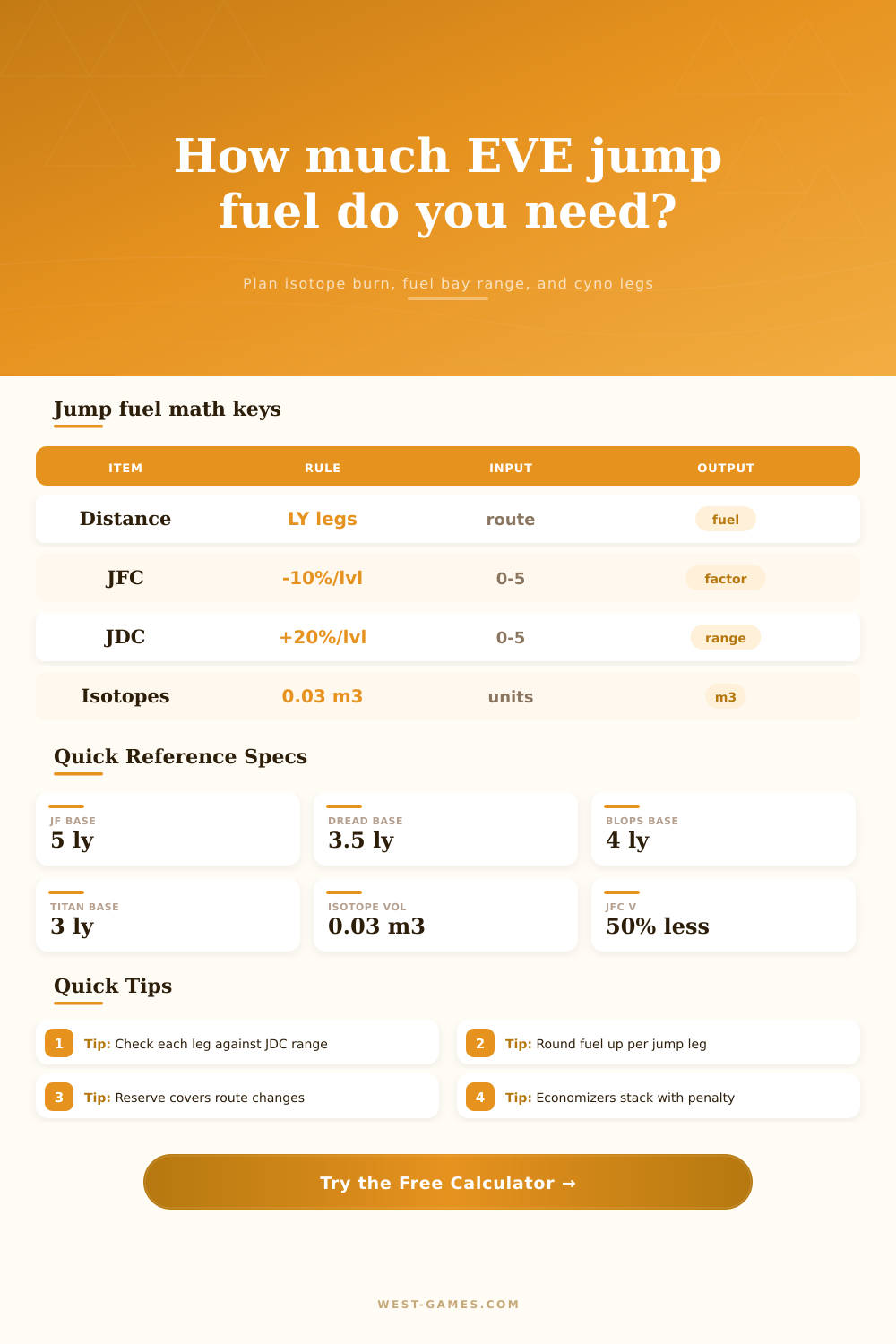
EVE Online Jump Fuel Calculator
Estimate isotope units for jump freighters, capitals, Rorquals, black ops, and titan moves using light-year distance, cyno chain legs, jump skills, economizers, and fuel bay capacity.
Calculation Breakdown
| Hull | Class | Isotope | Base Range | Base Fuel / LY | Fuel Bay | Bay Units |
|---|---|---|---|---|---|---|
| Ark | Jump freighter | Helium | 5.0 ly | 8,800 | 12,000 m³ | 400,000 |
| Rhea | Jump freighter | Nitrogen | 5.0 ly | 10,000 | 12,000 m³ | 400,000 |
| Anshar | Jump freighter | Oxygen | 5.0 ly | 9,400 | 12,000 m³ | 400,000 |
| Nomad | Jump freighter | Hydrogen | 5.0 ly | 8,200 | 12,000 m³ | 400,000 |
| Rorqual | Industrial capital | Oxygen | 5.0 ly | 4,000 | 10,000 m³ | 333,333 |
| Dreadnoughts | Capital combat | Racial | 3.5 ly | 3,000 | 8,000 m³ | 266,666 |
| Carriers | Capital combat | Racial | 3.5 ly | 3,000 | 3,000 m³ | 100,000 |
| Black ops | Battleship | Racial | 4.0 ly | 700 | 2,150 m³ | 71,666 |
| Titans | Supercapital | Racial | 3.0 ly | 3,000 | 60,000 m³ | 2,000,000 |
| Factor | Applies To | Per Level or Module | Calculator Use | Example |
|---|---|---|---|---|
| Jump Drive Calibration | Jump range | +20% maximum range per level | Base range × (1 + 0.20 × JDC) | 5 ly at V = 10 ly |
| Jump Fuel Conservation | All jump drives | -10% isotope use per level | Fuel factor = 1 - 0.10 × JFC | Level IV = 60% |
| Jump Freighters skill | Jump freighters only | -10% jump fuel need per level | Extra JF factor = 1 - 0.10 × skill | Level IV = 60% |
| Limited Economizer | JF and Rorqual | -4% fuel need | Stacked as fitted module factor | 1 module = 96% |
| Experimental Economizer | JF and Rorqual | -7% fuel need | Stacked as fitted module factor | 1 module = 93% |
| Prototype Economizer | JF and Rorqual | -10% fuel need | Stacked as fitted module factor | 1 module = 90% |
| Hull Group | Base Range | JDC IV Range | JDC V Range | Planning Note |
|---|---|---|---|---|
| Jump freighter | 5.0 ly | 9.0 ly | 10.0 ly | Long logistics chains usually hinge on station or structure cynos. |
| Rorqual | 5.0 ly | 9.0 ly | 10.0 ly | Economizers can help, but check bay room and refit choices. |
| Dreadnought or carrier | 3.5 ly | 6.3 ly | 7.0 ly | Shorter range means more cyno legs for the same total route. |
| Black ops battleship | 4.0 ly | 7.2 ly | 8.0 ly | Lower fuel per LY, smaller fuel bay, and often many bridge decisions. |
| Titan | 3.0 ly | 5.4 ly | 6.0 ly | Large bay supports many jumps, but cyno placement is stricter. |
| Empire / Hull Race | Isotope | Type ID | Volume | Common Hull Examples |
|---|---|---|---|---|
| Amarr | Helium Isotopes | 16274 | 0.03 m³ each | Ark, Revelation, Archon, Redeemer, Avatar |
| Caldari | Nitrogen Isotopes | 17888 | 0.03 m³ each | Rhea, Phoenix, Chimera, Widow, Leviathan |
| Gallente | Oxygen Isotopes | 17887 | 0.03 m³ each | Anshar, Moros, Thanatos, Sin, Erebus, Rorqual |
| Minmatar | Hydrogen Isotopes | 17889 | 0.03 m³ each | Nomad, Naglfar, Nidhoggur, Panther, Ragnarok |
You’ve undocked a jump freighter, misjudged the length of the chain, watched as your fuel bar depletes, and there’s that particular type of fear settling on your shoulders. You’re in low-security space, three jumps from home, waiting for someone who might or might not come along to give you a boost.
If you approach jump fuel logistics like you do high-sec piracy, you never have to deal with this situation again. How your modules and skills works together to impact your hull consumption is often what makes the difference between an easy flight and a price tag worth writing home about. Isotopes alone won’t cut it, you also need to know precisely how much fuel each light-year require, and be able to verify if your remaining range extend to the nearest cyno.
How to Manage Jump Fuel
With a few clicks, you input your route length and hull type into the calculator and it does the math for you. No need to worry about keeping track of stacking penalties yourself.
First, choose your ship. Each hull class have a different fuel profile. A Titan consumes far more then a Black Ops battleship. A Rhea burns Nitrogen while an Ark burn Helium isotopes at a different rate. The hull is just the starting point though.
Your Jump Fuel Conservation skill decreases your isotope burn by ten percent per level. That means if you don’t have your conservation skills maxed out when flying a capital ship, you’re paying a premium for inefficiency. This will not only hurt your wallet but also limit how far you can go on one tank.
There’s another limitation that catches inexperienced pilot off guard: range. Having a full fuel bay doesn’t increase your jump drives’ range. It simply increases the number of jumps you can make before exhausting the fuel supply. Your Jump Drives’ maximum range (adjusted for Jump Drive Calibration bonuses) is equal to your hull’s base range times its bonus. To put it another way, if distance of the leg you intend to jump exceeds your adjusted max range, the jump will fail, fuel or no fuel.
That’s what throws people off. People think having enough fuel means they’ll be able to get where they want. They’re not. Double-check the range output. Confirm each and every leg of your cyno chain is physically within reach before you consider any other factor.
The next level of complication come from Modules. Jump Drive Economizers reduce fuel costs by some percentage, but each one stacks. However, the stacking has diminishing returns. That means that you don’t just multiply everything together. This penalty is accounted for in the calculator. So when you’re running three modules in sequence, you might think it’s worth it, but it isn’t.
In fact, because the modules take up space inside your ship, especially if you have a big hull (like a Rorqual or Jump Freighter), there’s an associated volume cost to the modules. How much value is the reduction in fuel worth vs. You might lose valuable cargo space. It can be more economical to purchase additional isotopes rather than sacrificing valuable cargo space for a five percent fuel saving. It really depends on how long the chain is, as well as what you’re hauling. Rarely does a short hop justify fitting the module(s). A long haul across the map absolutely does. This is laid out neatly in the reference tables on the page so you can double check easily enough.
But the truth is, these aren’t textbook missions. Cynos don’t stay in place. Pilots don’t hit their drop point. You get off track somewhere. That’s what the operational reserve input is there for. Put a ten percent buffer in to account for minor route changes and any rounding errors. If you don’t, you’re not just on the edge of failure, you’re flying blind. It’s that margin for error that determines whether you reach your destination or leave behind a multi-million ISK asset.
And then there’s isotype. Don’t waste your time and ISK by mixing up Hydrogen and Helium; it’s a rookie mistake. The right isotope for your chosen hull and race is highlighted on the tool. Burning Nitrogen in an Amarr ship doesn’t work. You can’t. Plan ahead when buying so you don’t show up at a station with the wrong kind of fuel in your hangar.
EVE Online warfare and economy are logistics driven. It’s all about getting your stuff where it needs to be as efficiently and silently as possible. Get that right and you’re good to go. Get it wrong and you’ll become a charity case to other pilots. Always spend a few minutes checking range, calculating your burn, and building some buffer in there. It’s only a few minutes spent typing in numbers but oh man does it give you peace of mind. Future you thanks you, as he sits comfortabley in his orbit instead of floating around in a dead system.