Race Distance to Laps Calculator
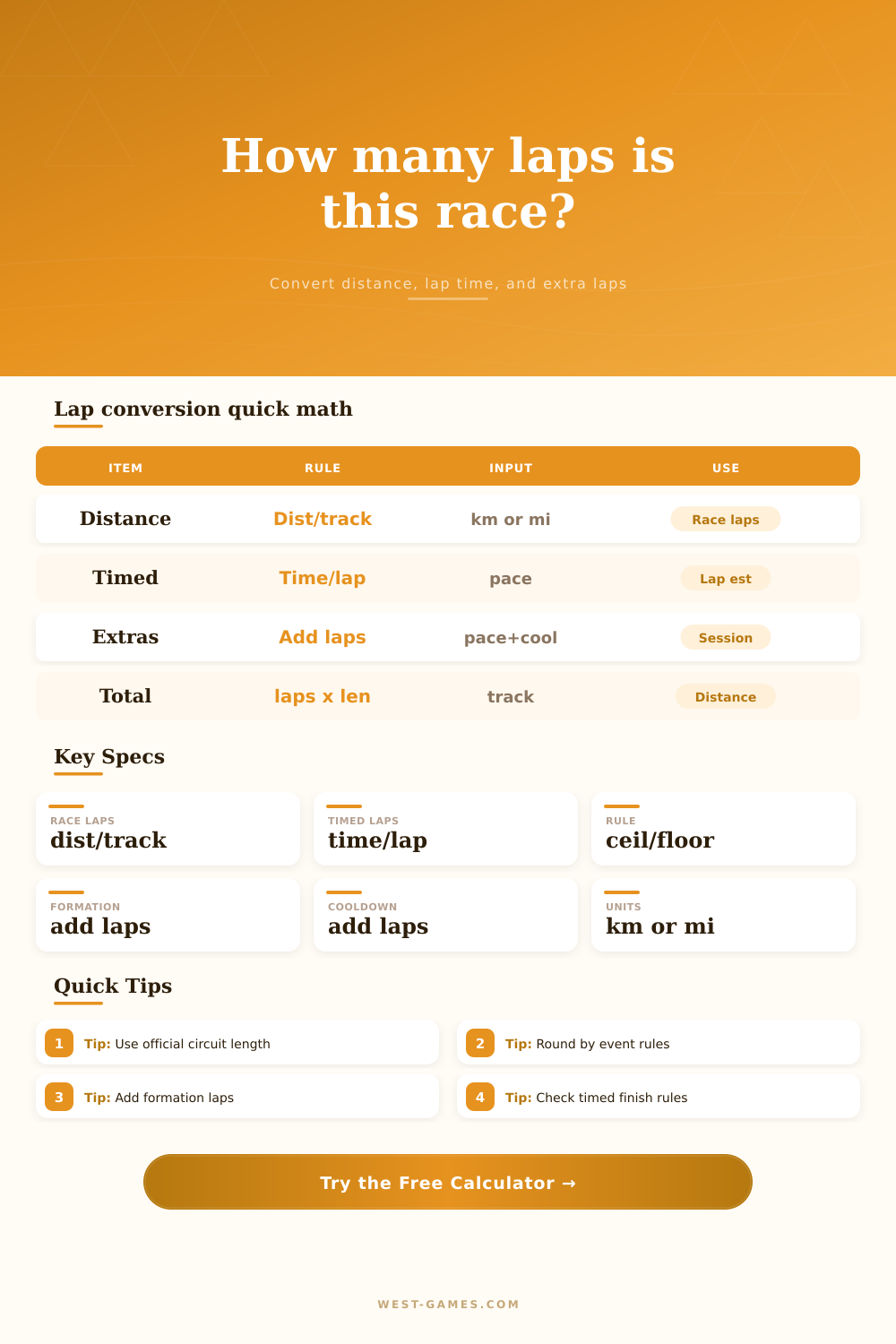
Convert a race distance into laps from track length, estimate timed-race laps from lap time, apply a finish rule, and include formation or cooldown laps in kilometers or miles.
Breakdown
| Calculation | Formula | Rounding | Inputs needed | Result meaning |
|---|
| Preset | Mode | Track | Race target | Lap time | Extras | Best use |
|---|
| Track profile | Length km | Length mi | 50 km laps | 100 mi laps | Notes |
|---|
| Rule option | Formula used | When it fits | Effect on laps | Total distance impact |
|---|
If you’re a racing fan, you know there’s more to a Formula One Grand Prix than the headline numbers. They cover about 30 miles, or forty-four laps around Monaco, while an endurance sprint might last two hours. Those sound like straightforward distances until you’re in driving seat. There’s a fuel gauge staring back at you that doesn’t seem to align with what’s going through your mind. And it always seems to be down to the precise number of turns left before you run out of fuel, whether you’ll finish on lead lap or not.
Distance isn’t all. Fuel load, tire wear… Those hidden miles don’t figure into the trophy tally but impact your car.
How to Calculate Race Distance
It’s simple math: Divide the track length into the planned race distance. Say the track is two kilometers long and you’re racing two hundred kilometers? That is one hundred laps. That’s how it works on paper, anyway.
In reality, things aren’t so simple; race organizers don’t schedule their events to finish precisely at the desired distance. They tack on a couple of laps, there’s a formation lap and there’s a cool down lap. These extras puts a bit more actual mileage on your vehicle.
To accommodate this, the calculator will automatically do the legwork when you input your track length and race mode. No need for you to guess the conversion or coefficient, just throw those numbers into the machine and you’ll know exactly where you stand. Oh, did we mention that? We’ve got you covered with both imperial and metric options since half the planet wants miles while the other half think in kilometers.
Finish rules also affect timed races and many folks don’t take them into account. A timed race means that the clock will stop the session. However, most times the cars still get to cross the finish line as time runs out during their last lap. Some series does give an additional lap when the clock reaches zero so all the cars end up crossing at once. That single lap can be the difference between making the lap record and missing it entirely.
You can choose with the tool if the race should stop precisely at the moment the clock does or include some sort of finishing buffer lap. That makes a difference on pace. If you believe you’ve got ten minutes remaining then find out later you had eleven thanks to the finish rule; that’s a different game plan.
Non-scored laps also play a part here. Before races, there’s a formation lap; after them, a cool-down lap. These aren’t included in the official race distance, yet they still eat up fuel and tear up parts. This is something people often forget about when sim racing or preparing for an endurance stint. You think: I have fifty laps of fuel, so I’ll be fine. Then you realize it was actualy fifty-two.
The calculator has fields for such extras, allowing you to see the actual distance of your entire session. It is not just the scored distance that decides who wins, but the overall distance that decide if you cross the line at all.
Some of these circuits also have more than one layout so you can run into issues with track length as well. For example, the grand prix circuit at Spa-Francorchamps is different than the old layout with the Bus Stop Chicane. If you use the incorrect length, it will throw off your average speed calculations and even throw off your number of laps completed. Always make sure to check the actual line you’re racing. That info is listed in the table of references on the page for some of the bigger tracks. However, if they are running a modified track or shortened version for practice runs, you can always change your inputs to match.
This is all about managing uncertainty. It is fuel. Tires. Time. That’s racing, where every second counts. And by dividing it up into cool-down circuits, formation loops and scored laps, you convert an intangible feeling of endurance to something tangible: a plan for how to make those seconds count.
You won’t have to guess or wait for the checker to wave in the distance. Now you’re counting it down. There’s one more lap to go. Two turns left. Three turns left. You know it is happening because you did the math ahead of time, not because you checked the clock. You should of known that before starting.