🎮 RimWorld Food Stockpile Calculator
Plan a RimWorld food reserve from colonist nutrition, practical meal counts, animal hunger, raw ingredient conversion, spoilage buffer, current stockpile, and crop tile production using verified wiki constants.
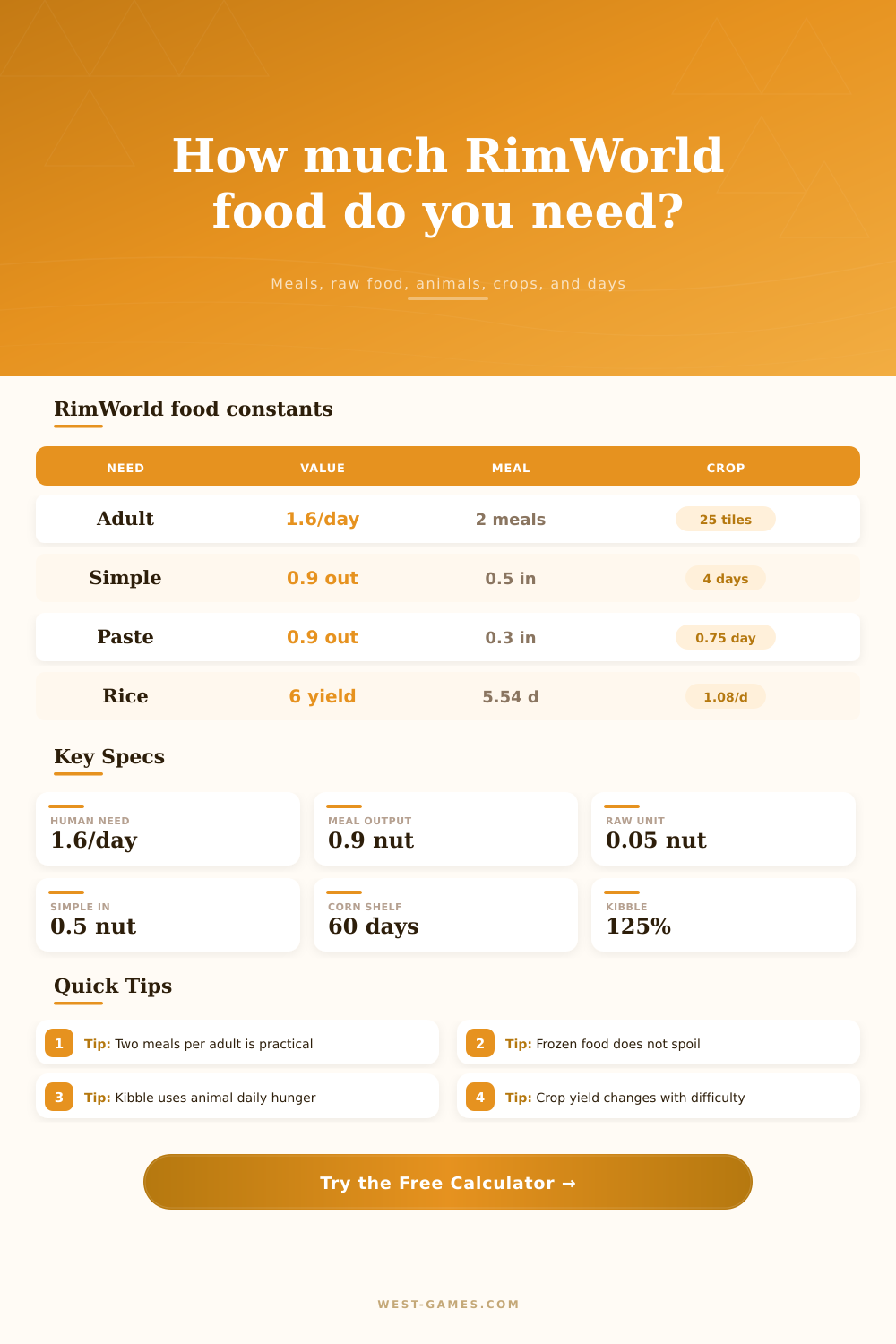
0.5 raw nutrition becomes 0.9 meal nutrition. Practical reserve usually uses 2 meals per adult per day.
0.3 raw nutrition makes a 0.9 nutrition paste meal, but stored paste rots quickly.
1.0 raw nutrition becomes 1.0 meal nutrition, so the stockpile uses more ingredients.
A butcher table turns 2.0 raw nutrition into 2.5 nutrition of kibble for animals.
Frozen food never spoils, so buffer can be set for risk rather than spoil time.
| Food type | Nutrition out | Raw nutrition in | Efficiency | Room shelf life | Calculator use |
|---|---|---|---|---|---|
| Adult human need | 1.6 per day | N/A | N/A | N/A | Base daily colonist demand |
| Simple meal | 0.9 | 0.5 any raw | 180% | 4 days | Default prepared meal reserve |
| Fine meal | 0.9 | 0.25 meat plus 0.25 vegan | 180% | 4 days | Same nutrition as simple, split ingredients |
| Lavish meal | 1.0 | 0.5 meat plus 0.5 vegan | 100% | 4 days | Higher raw demand per meal |
| Nutrient paste | 0.9 | 0.3 any raw | 300% | 0.75 day | Raw stock estimate for paste dispenser |
| Common raw food | 0.05 per item | N/A | 100% | varies | Converts raw stacks into nutrition |
Simple and fine meals can be planned by nutrition, but the practical meal count uses the wiki's rough 2 meals per adult per day baseline.
| Crop | Harvest yield | Soil days | Soil yield/day | Rich yield/day | Hydro yield/day |
|---|---|---|---|---|---|
| Rice | 6 rice | 5.54 days | 1.08 units/tile/day | 1.52 units/tile/day | 3.03 units/tile/day |
| Potato | 11 potatoes | 10.71 days | 1.03 units/tile/day | 1.19 units/tile/day | 1.77 units/tile/day |
| Corn | 22 corn | 20.86 days | 1.05 units/tile/day | 1.48 units/tile/day | N/A |
| Haygrass | 18 hay | 12.92 days | 1.39 units/tile/day | 1.73 units/tile/day | N/A |
| Rice, gravel | 6 rice | 7.91 days | 0.76 units/tile/day | N/A | N/A |
| Corn, gravel | 22 corn | 29.8 days | 0.74 units/tile/day | N/A | N/A |
Yield per day is raw units per plant tile, assuming crop yield multiplier 1.0. The calculator converts crop units to nutrition with 0.05 nutrition per raw item.
| Animal/feed | Daily nutrition | Diet note | Raw units/day | Kibble raw input/day | Calculator note |
|---|---|---|---|---|---|
| Cat | 0.24 | Carnivorous | 4.8 raw units | 0.192 raw nutrition | Pet profile |
| Chicken | 0.22 | Herbivorous | 4.4 raw units | 0.176 raw nutrition | Barn preset |
| Husky | 0.80 | Omnivorous | 16 raw units | 0.64 raw nutrition | Starter pet profile |
| Cow | 0.86 | Herbivorous | 17.2 raw units | 0.688 raw nutrition | Livestock profile |
| Kibble table | 2.5 out | Any except wargs | 50 kibble | 2.0 raw nutrition | 125% output efficiency |
| Grazing mode | 0 stock | Outside reserve | 0 | 0 | Excludes animals from stockpile math |
Animal pages list hunger as nutrition lost per day. Kibble input is animal daily nutrition divided by 1.25 when made at a butcher table.
| Calculation | Formula | Verified constant | Adjustment | Output |
|---|---|---|---|---|
| Human daily nutrition | (colonists + extra humans) x 1.6 + manual nutrition | 1.6 nutrition/day | Manual extra field | Nutrition/day |
| Practical meals | humans x 2 x days | 2 meals/day rough baseline | Buffer and current meals | Meal count |
| Exact meal count | human nutrition reserve / meal nutrition out | 0.9 or 1.0 out | Meal type | Meal count |
| Raw ingredient need | human meals x raw in + animal raw input | 0.5, 1.0, or 0.3 raw in | Subtract current raw | Raw nutrition and items |
| Days covered | current edible nutrition / daily nutrition demand | Meal output and 0.05 raw nutrition | Meal type and animal feed | Stockpile days |
| Crop tiles | needed raw items / (yield per tile per day x grow days x crop multiplier) | Crop yield/day table | Safety margin | Plant tiles |
Source check: Food, Food production, Raw food, Simple meal, Fine meal, Lavish meal, Nutrient paste meal, Kibble, crop pages, and animal pages.
It’s that kind of situation you reach in RimWorld; where the weather turns foul, a raid pillages your crops, and suddenly everyone look up from their jobs and realizes there’s nothing in the larder. This is early-game panic. And most players respond by scurrying about, grabbing any potatoes they see, cramming them into stove… only to store them in a stockpile for later. Hoarding without a plan is just procrastination with extra steps.
What do you actualy need to survive? How many calories (or meals) does each person need to stay alive? What happens if you don’t have enough? If you’ve ever found yourself doing mental math as someone breaks down your door during a raid, this calculator removes all that mental work. Plug in your preferred meals/colony members, and it’ll tell you what you need to survive. Then you can spend less time calculating and more time keeping your people alive.
How to Keep Your Colony Fed
Why? Because RimWorld’s nutrition system is abstract. Nutrition isn’t measured by units of volume or weight; it’s measured in nutrition points. A human consume 1.6 nutrition per day. That doesn’t sound like much, until you consider that one “simple” meal contains 0.9 nutrition. Just to stay the same, everyone requires about two meals per day. Most new players trip on this fact. They’ll make a stack of meals, which looks substantial, and then promptly forget that those meals will be consumed in half the time they anticipate.
The calculator above factors in this difference between perceived fullness and actual food consumption. It converts your sense of how safe you want to be into explicit numbers of items.
Storage also matters. At room temp, raw food goes bad in what feels like minutes. What’s the point of all that effort if it ends up as fertilizer rather than in your pawns bellies? Only freezing can really protect against that (though it takes space and uses energy). But the tool helps you build models of how various modes of storage will affect food over time. If you have limited ability to freeze things (maybe you don’t have a freezer?) it adds safety buffers to account for possible spoilage. What good is a bunch of stuff on paper that looks like enough if you forget about the shelf life? Your reserve could sudden vanish in a cloud of rot. That’s the gap that most folks overlook when they plan to ride out a long winter, the gap between a buffer for short term and a strategic reserve. It is a choice between a freezable pantry and a warm one.
Then there’s the addition of animals. They add another variable to the equation. Having pets is awesome…until they eat part of your emergency stash. Depending on what they eat and how many, a few chickens (or huskies) will burn through your supplies almost as quickly than a human would. The calculator accounts for this. It takes into account how much food they consume, both from things stored in the stockpile and how much they graze. If they’re getting fed kibble, then those efficiency gains apply. But you’ve got to feed them something first.
Raw material. One other mistake people often make is overlooking the animal demand. When you don’t account for that, you end up suddenly running out when you least expect it. If you want an accurate estimate, then you must view your livestock as more than just an asset. They are also consumers.
But this is all long term stuff, which leads me back to crop planning. How can you know how much land you’ll need to replenish if you don’t even know how much food you’re looking at? Rice will grow quickly, but each tile only produces a little bit of rice. Corn is slower, but you get a lot more bang for your buck from a corn tile. To help, the tool calculates how many tiles you would need to restore your supply. It accounts for your growing season and soil fertility. If your goal was to keep a certain amount of food on hand, but the tool tells you that means you need more tiles than you have, you could realize that you won’t have enough space to sustain yourself, so you’ll be better off expanding now while there’s still time. Before it’s too late.
It’s all about matching your consumption with your production: No one wants to be caught out of food. In the end, RimWorld’s food management isn’t really about cooking; it’s about logistics. Your colony is its own supply chain, and each choice (whether conscious or otherwise), takes up time and costs nutrition. The calculator shows those limitations, allowing you to anticipate instead of react to starvation. Instead of surviving the winter, you plan to go into it with your head held high. That assurance brings peace of mind, which is worth more than any amount of food. Because the worst case scenario is something you plan for, you can then excel at the best case. This turns what would of been a disaster into a mere variable.