🎮 Oxygen Not Included Food Supply Calculator
Calculate duplicant kcal demand, Mealwood, Bristle Blossom, Dusk Cap, Waterweed, Sleet Wheat, Mush Bar emergency output, spoilage allowance, and storage buffer cycles.
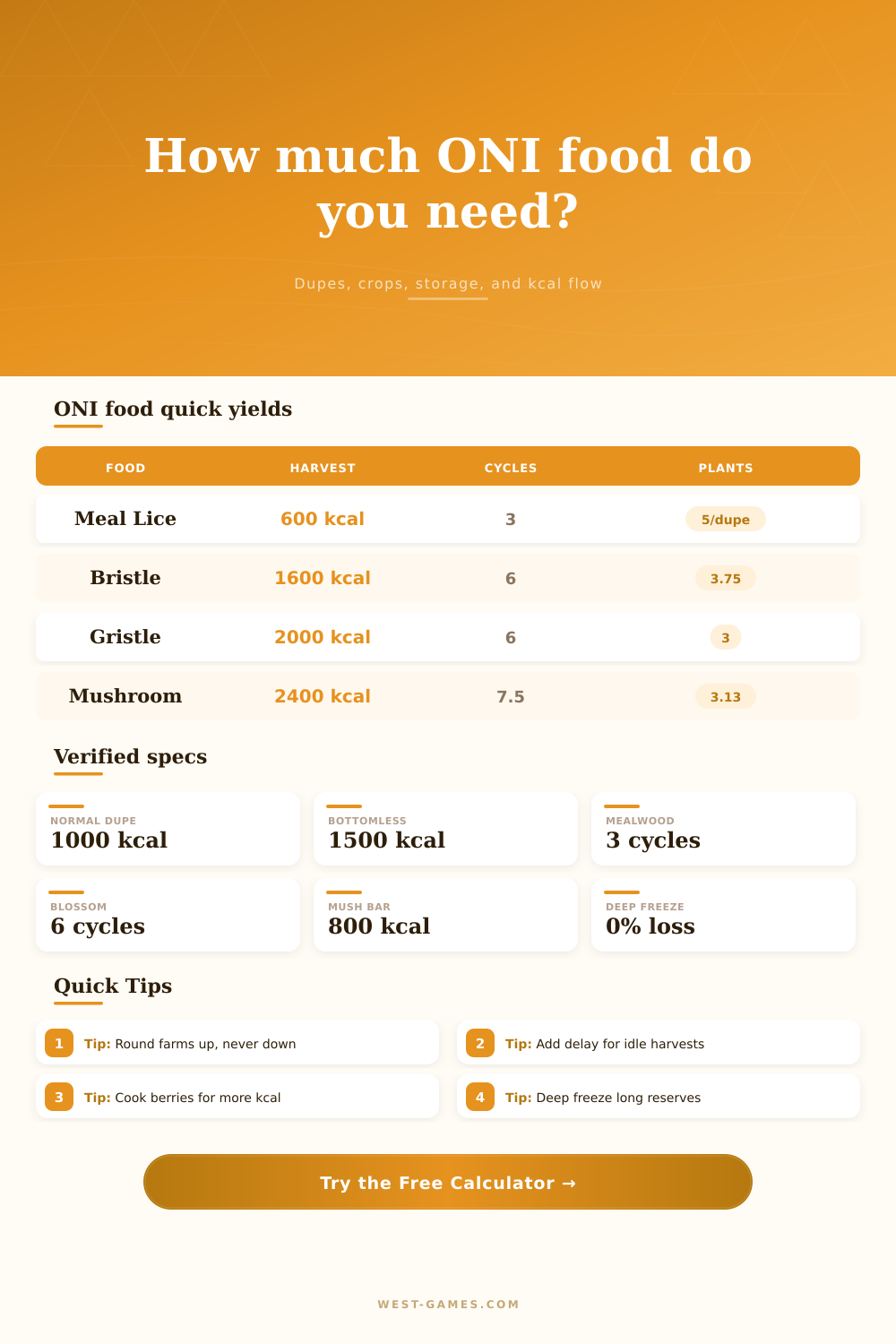
| Food plan | Source | Final kcal per harvest unit | Domestic growth | Base kcal per plant-cycle | Normal plants per dupe |
|---|---|---|---|---|---|
| Meal Lice | Mealwood | 600 kcal | 3 cycles | 200 | 5.00 |
| Pickled Meal | Mealwood, Electric Grill | 600 kcal equivalent per Mealwood harvest | 3 cycles | 200 | 5.00 |
| Bristle Berry | Bristle Blossom | 1,600 kcal | 6 cycles | 266.7 | 3.75 |
| Gristle Berry | Bristle Blossom, Electric Grill | 2,000 kcal | 6 cycles | 333.3 | 3.00 |
| Mushroom | Dusk Cap | 2,400 kcal | 7.5 cycles | 320 | 3.13 |
| Fried Mushroom | Dusk Cap, Electric Grill | 2,800 kcal | 7.5 cycles | 373.3 | 2.68 |
| Lettuce | Waterweed | 4,800 kcal | 12 cycles | 400 | 2.50 |
| Frost Bun | Sleet Wheat, Electric Grill | 7,200 kcal per plant harvest | 18 cycles | 400 | 2.50 |
| Food | Building | Kcal each | Main inputs per ration | Use in calculator | Planning note |
|---|---|---|---|---|---|
| Mush Bar | Microbe Musher | 800 | 75 kg dirt, 75 kg water | Rations per cycle | Emergency food, no plants |
| Mush Fry | Electric Grill | 1,050 | 1 Mush Bar | Rations per cycle | Improves kcal per Mush Bar |
| Meal Lice reserve | No cooking | 600 | 1 Mealwood harvest | Plants per cycle | Low labor after farming |
| Gristle Berry | Electric Grill | 2,000 | 1 Bristle Berry | Plants plus cooking | More food per blossom |
| Fried Mushroom | Electric Grill | 2,800 | 1 Mushroom | Plants plus cooking | Good Dusk Cap upgrade |
| Storage mode | Calculator loss | Best use | Buffer risk | Typical action | Override when |
|---|---|---|---|---|---|
| Deep freeze plus sterile or vacuum | 0% per cycle | Permanent reserve | Very low | Size by demand only | Food warms during shipping |
| Powered refrigerator | 2% per cycle | Short kitchen stock | Low to medium | Keep buffer modest | Using measured freshness loss |
| CO2 or chlorine room | 4% per cycle | Early ration box pit | Medium | Add production margin | Room is also chilled |
| Normal atmosphere | 7.5% per cycle | Temporary pile | High | Do not bank large food | Freshness report differs |
| Polluted or hot storage | 25% per cycle | Emergency warning | Very high | Move food quickly | Food is sealed and cold |
| Colony stage | Dupes | Target food | Buffer cycles | Surplus | Why it fits |
|---|---|---|---|---|---|
| Cycle 1-20 starter | 3 | Meal Lice | 5 | 10% | Simple dirt-fed stability |
| Early expansion | 5 | Meal Lice or Mush Fry | 6 | 15% | Covers harvest delay |
| Water stable base | 6-8 | Gristle Berry | 8 | 12% | Efficient blossom cooking |
| Slime biome farm | 8-10 | Fried Mushroom | 10 | 15% | Strong kcal per Dusk Cap |
| Cold biome kitchen | 10+ | Frost Bun | 15 | 20% | High late-game crop output |
The first twenty cycles in Oxygen Not Included feel like a sprint against starvation. Your colony consist of three dupes, all of whom are starving to death on a rock. There’s no shortage of things to plant. Why not grow it all? I don’t blame you for this impulse.
But what happens next is usualy a waste of space. A stifled farm is a consequence of bad planning and wasted space. The trick isn’t just knowing how much you can produce; it’s also how fast you should be producing. How much do you need? What’s enough? You need enough so that there is never to little (panic), but never too much (rotting food).
Stop Wasting Space with Food
Food is a rate equation. Calorie flow is dynamic, and most players treat it like a static thing. Oh, we have lots of berries. That misses the point: food is either there or it isn’t. But if your plants are making them at a slower rate than they’re being consumed, then you’ll starve even with a fridge full of berries. Why? It isn’t just a static resource. It’s a rate equation.
Every cycle, your dupes burns through calories. Plants produce them at set growth intervals. So unless you have more coming in then going out, you will starve.
The calculator handles that for you. It turns abstract plant numbers into a concrete rate of calories supplied. It factors in things like hidden variables (hidden from new commanders) that can bite you: the exact kcal yield of cooked vs. Raw meals, farm condition uptime, and how long it takes to harvest what grows on your farms.
Imagine cooked gristles berries vs. These are raw bristle blossoms. Cooked gristle berries has more calories per cycle compared to raw bristle blossoms. That’s obvious from the reference table on the page. And it indicates that cooking makes your land more efficienter. For this reason, kitchen planning is as important as agriculture. After all, you’re not simply growing crops. You’re increasing output.
Having a dupe with the Bottomless Stomach trait increase demand by fifty percent per person. If you fail to account for this trait during your early planning, you’ll be forced into an expansion at some point in the late game. And that eats up precious floor space.
Most people don’t realize that there’s another wrinkle on top: storage. Over time, food spoils, and how quickly is entirely dependent based off the conditions under which it’s stored. Under ideal conditions (a vacuum/sterile atmosphere, frozen deep) it will be fine forever. In a normal room, it goes bad in no time at all. If you’re stocking up because you’re planning to work on something long-term (e.g., build a rocket), you’ll want to budget for the fact that it will go bad.
You can specify individual rates of spoilage. That way, what you calculate for your buffer actualy lasts as long as you think it should. It is a little thing, maybe, but it saves you the embarrassment of having your silos filled with nothing when push comes to shove.
Wild vs. These are domestic farms. Because wild crops take much longer to grow (typically 4x as long to harvest), they has much lower yield-per-cycle. If you don’t adjust your number of plant to account for that, you’ll starve slowly if relying on them for food.
The calculator accounts for that by allowing you to specify what type of farm(s) you’re using, and enter in your own crop growth multipliers. That way you can determine if it’s worth the increased yield to use more space on domestic farms. Most of the time it is; however, if space is limited then things change.
The key to good base management is predictability. You don’t want a system where everything depends on you; you want a self-running system. You know how much output your plants are producing and what your daily burn rate is so you no longer have to worry about your next meal. Now you’re able to work on expanding, generating power, and making sure that your people is happy.
When you no longer guess at food, you shift from reactive survival mode into proactive planning mode. Food stops being something you need to worry about. Now, it is just something you manage like a utility. It is a utility, just like water or power, that needs to consistently flow.
When you learn the numbers behind the harvest, the panic will leave you. The colony isn’t a desperate struggle for survival anymore but a machine. That’s when the game really starts.