🎮 Factorio Smelter Ratio Calculator
Calculate Factorio furnace counts, belt compression, ore or plate inputs, steel-chain demand, optional module modifiers, and rounded build blocks for iron, copper, brick, and steel smelting.
| Furnace | Crafting speed | Iron/copper/brick recipe | Plate output each | Steel recipe | Steel output each |
|---|---|---|---|---|---|
| Stone furnace | 1 | 3.2 seconds, 1 input to 1 output | 0.3125 items/s | 16 seconds, 5 iron plates to 1 steel | 0.0625 steel/s |
| Steel furnace | 2 | 3.2 seconds, speed doubles cycles | 0.625 items/s | 16 seconds, speed doubles cycles | 0.125 steel/s |
| Electric furnace | 2 | Same base speed as steel furnace | 0.625 items/s before modules | Same base steel speed as steel furnace | 0.125 steel/s before modules |
| Custom furnace | User input | Base speed divided by recipe time | Speed / 3.2 | Base speed divided by 16 seconds | Speed / 16 |
For module profiles, the calculator multiplies recipe cycles by speed modifiers and multiplies final output by productivity. Input per craft is not multiplied by productivity.
| Belt tier | Throughput | Plate furnaces at speed 1 | Plate furnaces at speed 2 | Steel furnaces at speed 2 | Steel iron-plate input |
|---|---|---|---|---|---|
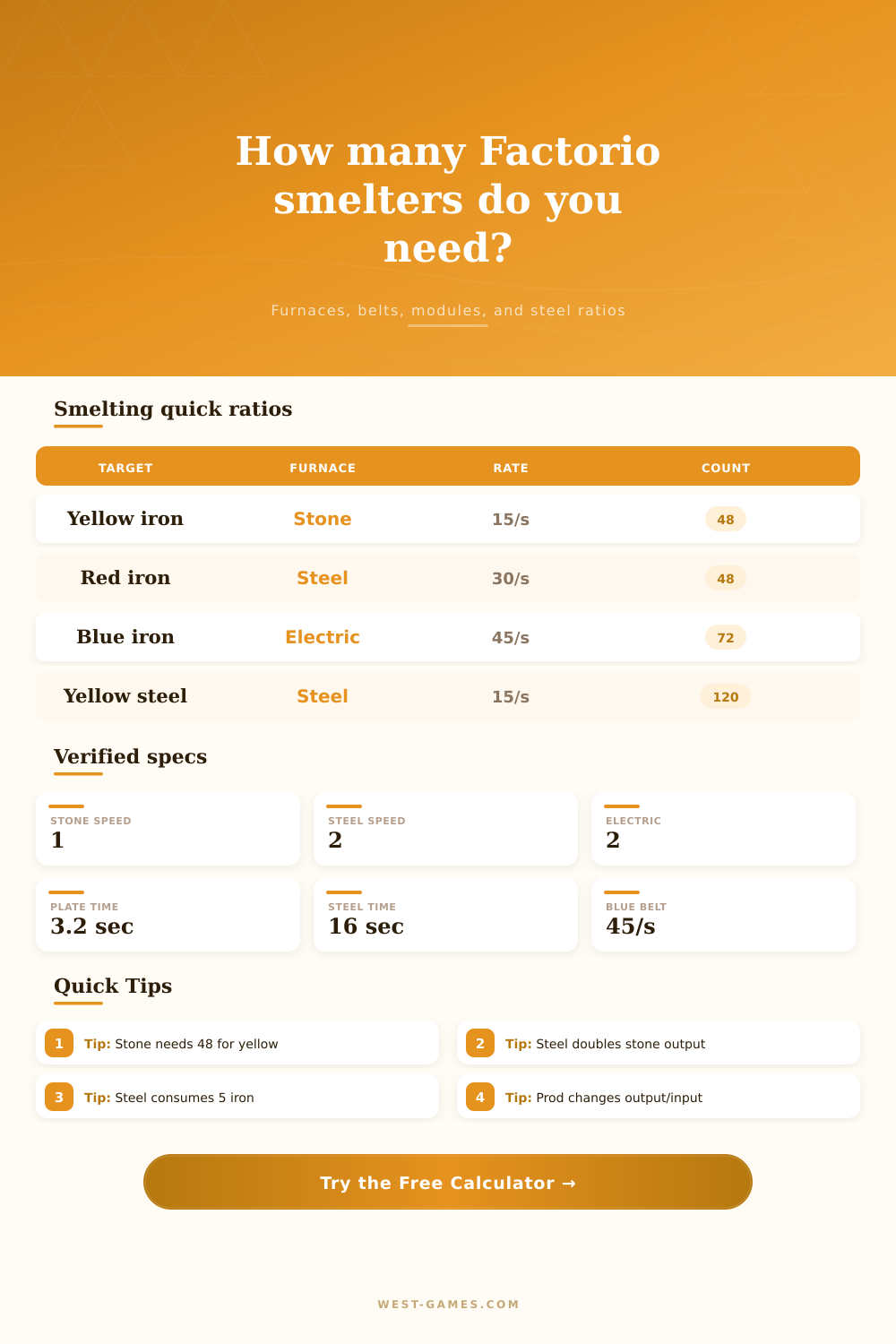
| Transport belt | 15 items/s | 48 stone furnaces | 24 steel/electric furnaces | 120 steel/electric furnaces | 75 iron plates/s |
| Fast transport belt | 30 items/s | 96 stone furnaces | 48 steel/electric furnaces | 240 steel/electric furnaces | 150 iron plates/s |
| Express transport belt | 45 items/s | 144 stone furnaces | 72 steel/electric furnaces | 360 steel/electric furnaces | 225 iron plates/s |
| Half yellow target | 7.5 items/s | 24 stone furnaces | 12 steel/electric furnaces | 60 steel/electric furnaces | 37.5 iron plates/s |
Steel output compresses five iron plates into one steel plate, so steel builds usually require more input belts than output belts.
| Profile | Speed modifier | Productivity modifier | Applies to | Per-furnace plate rate | Planning note |
|---|---|---|---|---|---|
| No modules | 0% | 0% | All furnace types | 0.625/s in speed-2 furnace | Baseline vanilla ratio |
| 2 speed module 1 | +40% | 0% | Electric/custom | 0.875/s before uptime | Fewer furnaces, same input per output |
| 2 speed module 2 | +60% | 0% | Electric/custom | 1.000/s before uptime | Clean one plate per second target |
| 2 speed module 3 | +100% | 0% | Electric/custom | 1.250/s before uptime | 36 furnaces fill a blue plate belt |
| 2 productivity module 3 | -30% | +20% | Electric/custom | 0.525/s before uptime | Less ore per output, more furnaces |
| 1 productivity 3 + 1 speed 3 | +35% | +10% | Electric/custom | 0.928/s before uptime | Balanced speed and productivity |
Speed module 1/2/3 use +20%, +30%, and +50% each. Productivity module 1/2/3 use +4%, +6%, and +10% each with speed penalties of -5%, -10%, and -15% each.
| Calculation | Formula | Iron/copper example | Steel example | Why it matters |
|---|---|---|---|---|
| Cycles per second | Effective speed / recipe seconds x uptime | 2 / 3.2 = 0.625 | 2 / 16 = 0.125 | Base machine work rate |
| Output per furnace | Cycles per second x output x productivity | 0.625 x 1 | 0.125 x 1 | Furnace count divisor |
| Input per second | Cycles per second x input per craft x furnaces | 0.625 ore per furnace | 0.625 iron plates per furnace | Sizes ore or plate belts |
| Furnaces needed | Target output / output per furnace | 45 / 0.625 = 72 | 15 / 0.125 = 120 | Rounds into build rows |
| Belt count | Rate / selected belt throughput | 45 / 45 = 1 blue | 75 / 15 = 5 yellow input | Highlights bottlenecks |
When furnace-count mode is selected, the calculator reverses the target step and forecasts output from the entered machine count.
For example, many players begins with a couple stone furnaces and hope it’s enough to carry the load. The ore begin to pile up, the belts slow down and eventually stall. Every player has this bottleneck.
This is why manufacturing isn’t something you can do using only intuition. The math are straightforward but unforgiving. A single miscalculation in furnace count can starves your entire production chain or flood your output with unneeded plates.
Why You Need Math in Factorio
The next point is how fast your furnaces are. There are three type of furnace in Factorio; stone (speed 1), steel (speed 2), and electric (speed 2). It affects the belt/furnace machine to belt capacity ratio based off speed.
For example, forty-eight stone furnaces will fill a yellow belt with iron plates. Twenty-four steel furnaces can does that job as well. It isn’t just the materials cost but the power cost and the space cost. Get this ratio correct early on so you don’t have to rebuild later if your base becomes too small.
You don’t need to guess at the coefficients; the page do that for you in its calculator. But you will still need to know what those numbers translate into for your setup.
Using productivity modules results in less speed and more volume. Each craft take longer, but you produce more plates per craft. Often this means you require more furnaces rather than fewer to maintain the same output. Players see the increased output and mistakenly assume they can reduce their hardware. The result? They end up with a slower, larger smelter array that is harder to wire and manage. You end up with a larger, harder-to-manage array.
Making steel isn’t so easy since it consumes other products. To make one steel plate, you need five iron plates. This means your steel smelters must be much smaller than your iron smelters if they are directly connected. To put it another way: No matter how big your belts are, you can’t simply match them… You also has to factor in the compression.
According to table on page, five yellow belts full of iron plates require only one yellow belt filled with steel. If you don’t have iron smelters large enough, your steel furnaces won’t operate. A minor mistake in ratios set off a chain reaction.
Keep your module planning as simple as possible. Generally speaking, speed modules is good in the early to mid-game because space may be limited. These modules reduces the number of machines required by making each furnace work faster.
Late game, productivity modules are better since they’ll save you resources which becomes important when there’s no iron around. You might want to mix them together, but the speed penalties tend to cause more trouble then they resolve. A combination of a productivity module and a speed module is good if you have sufficient room for slightly slower furnaces.
The math is expected, and it gives you confidence to build. The ratios teaches you how to blueprint your factories. You don’t guess when you’re running copper through a blue belt. You don’t guess when you’re juggling an entire array of steel. The math is the same.
Determine the size based off the bottleneck. You must account for input demand. Round them up into manageable groups. Build systematically. Be precise; the game rewards precision.
When the math works, the belts will flow smoothly and none of your machines will sit idle. Efficiency transforms a messy layout into a clean system.
You should of used more furnaces to avoid this. The amount of furnitures needed is high. Actually it is quite simple if you use the calculator for better results naturaly. It makes things much more comfortabley too.