⛏ Minecraft Tool Durability Calculator
Estimate uses left from max durability, current wear, Unbreaking level, durability cost per action, repair target, and Mending XP sharing.
| Gear | Max durability | Typical cost | Notes |
|---|---|---|---|
| Wood tool or sword | 59 | 1 | Lowest non-gold tool tier |
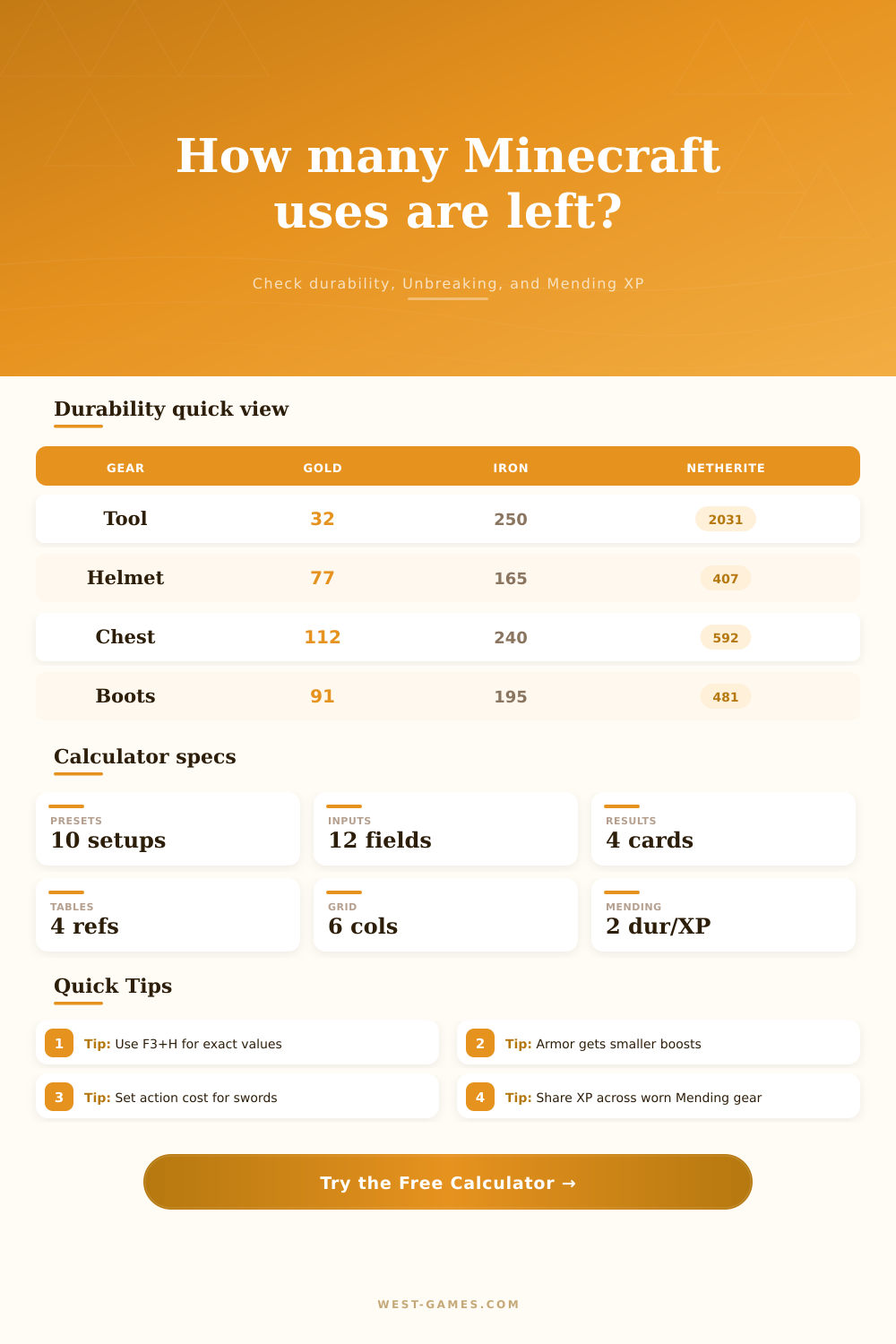
| Gold tool or sword | 32 | 1 | Fast but least durable |
| Stone tool or sword | 131 | 1 | Early mining tier |
| Iron tool or sword | 250 | 1 | Common midgame tier |
| Diamond tool or sword | 1561 | 1 | Long mining sessions |
| Netherite tool or sword | 2031 | 1 | Most durable tool material |
| Bow | 384 | 1 | One durability per arrow fired |
| Crossbow | 465 | 1-9 | Fireworks and Multishot can cost more |
| Trident | 250 | 1 | Attack or throw |
| Mace | 500 | 1-2 | Mob hit or block break |
| Material | Helmet | Chestplate | Leggings | Boots |
|---|---|---|---|---|
| Turtle shell | 275 | N/A | N/A | N/A |
| Leather | 55 | 80 | 75 | 65 |
| Golden | 77 | 112 | 105 | 91 |
| Chainmail | 165 | 240 | 225 | 195 |
| Iron | 165 | 240 | 225 | 195 |
| Diamond | 363 | 528 | 495 | 429 |
| Netherite | 407 | 592 | 555 | 481 |
| Level | Tool chance to lose dur | Tool multiplier | Armor chance to lose dur | Armor multiplier |
|---|---|---|---|---|
| None | 100% | 1.00x | 100% | 1.00x |
| I | 50% | 2.00x | 80.0% | 1.25x |
| II | 33.3% | 3.00x | 73.3% | 1.36x |
| III | 25% | 4.00x | 70.0% | 1.43x |
Unbreaking is random in game; these are expected averages, not guaranteed exact break points.
| Action | Cost | Applies to | Calculator use |
|---|---|---|---|
| Break normal block | 1 | Pickaxe, axe, shovel, hoe | Mining or terraforming |
| Hit mob with pick, axe, shovel | 2 | Block tools | Accidental combat wear |
| Hit mob with sword, mace, trident | 1 | Weapons | Combat planning |
| Break block with sword or mace | 2 | Sword, mace | Webs or unusual use |
| Fire bow, crossbow, or trident | 1 | Ranged weapons | Shot count estimates |
| Multishot firework crossbow | 9 | Crossbow | High-wear burst setup |
| Yank mob with fishing rod | 5 | Fishing rod | Rod durability drain |
| Fly one second | 1 | Elytra | Flight route time |
That’s the feeling you get when your pickaxe bar goes red in the middle of some important mining expedition. You’re down below in the dark, covered in ancient debris or obsidian. You are three blocks away from safety, and now you’ve got nothing. Your pickaxe is going to break. All you have left is your pair of bare hands and your sour disposition.
At this point, durability isn’t a gameplay mechanic, it becomes part of your survival plan. And it’s not only a matter of longevity. When will I decide to turn back, resurface and fix my gear? When must I do that before I am completely vulnerable?
How to Plan Your Gear Life
That’s where the calculator on this page comes in: You plug in the details of your equipment, is it made from netherrack? How much wear do you expect? Do you use Java or Bedrock edition? It does all the math for you. What’s the current state of Unbreaking enchantments? Are the Mending XP shares active? The calculator cranks those numbers out so that you don’t have to guess if that netherite pick will last until the end of the next cave system. It converts what was a loose feeling of wear into an exact count of how many more actions can be done. And that makes the difference between playing worried and playing planned.
Durability is just a tick-counter for most players: it goes down by one every time a block gets destroyed. That is very dangerous thinking. Not all action weigh the same. Destroying a normal block uses one durability point. Attacking a mob with a pick does use two. Shooting an arrow from a crossbow will take 9 points if it’s on multishot with fireworks. Terraforming? You’re going through tools much quicker then what the defaults will tell you.
Those reference tables within the tool explain exactly how many points each action uses. They explain why a sword lasts you a week of raids and an axe dissapears after a morning of felling trees. Knowing the cost per action helps you make accurate plans. You need to match your plan to your usage profile.
The other part that most folks miss is enchantments. While Unbreaking doesn’t just quadruple your durability, it’s also random on every usage. A tool with Unbreaking III has a 75% chance to avoid durability loss per use. That means it’ll last, on average, four times longer, but there’s some luck-of-the-draw involved. Occasionally, you get super lucky and it survives two times longer than usual. Occasionally, you get extra unlucky and it dies sooner. The calculator takes these averages into account; it provides an estimated value based off expectations. By averaging over all outcomes, it removes the random component, allowing you to rely on the figure.
That’s what makes the tool distinguish between armor and tools. Armor follow a different equation and provides lesser bonuses that still matter when wearing a complete set of netherite. Resource management is also evened out with mending. Instead of requiring resources to fix an item, mending does so with experience points.
There’s a hitch: All the items you’re wearing that are damaged share the same XP pool. So when the next orb of XP comes through, it could be healing your pick or maybe just your boots, depending on what needs the most help (which in turn depends on what else you’re wearing). To account for this, the calculator lets you know how many items you’re equipping, so you can enter that into the formula. That way you don’t overestimate how fast your gear will replenish itself. Sure, you may have oodles of XP, but if it’s being spread too thin, your pickaxe is still sitting at half-health.
But the meat of this is actualy the safety reserve. So if you want to set a 5% reserve, it’ll display how many uses are remaining on your pickaxe until it enters the dangerous zone. This removes some of the randomness from Unbreaking because now you get a buffer. If you check the calculator and see you’re at five-hundred uses away from breaking, you can go ahead and mine four-hundred blocks without worry and then go home. It replaces anxiety with a schedule. Dig until the number reaches zero, then fix it. Don’t wait for the bar to go red. Manage the resource before it becomes one.
That’s what makes Minecraft a game of resource loops. You gather resources to craft, then craft stuff so you can explore, then explore to find even better resources. There’s a bit of friction here: durability. When you have good tools, they eat away at this friction. But only when you take care of those tools! If you don’t pay attention to the math, you’ll end up with broken tools at just the wrong moment. Pay respect to the math, however, and it’ll keep your gear nice and shiny while keeping your stress level down.
Next time you’re staring at a wall of stone, you won’t guess about how much farther you can go. You should of known.