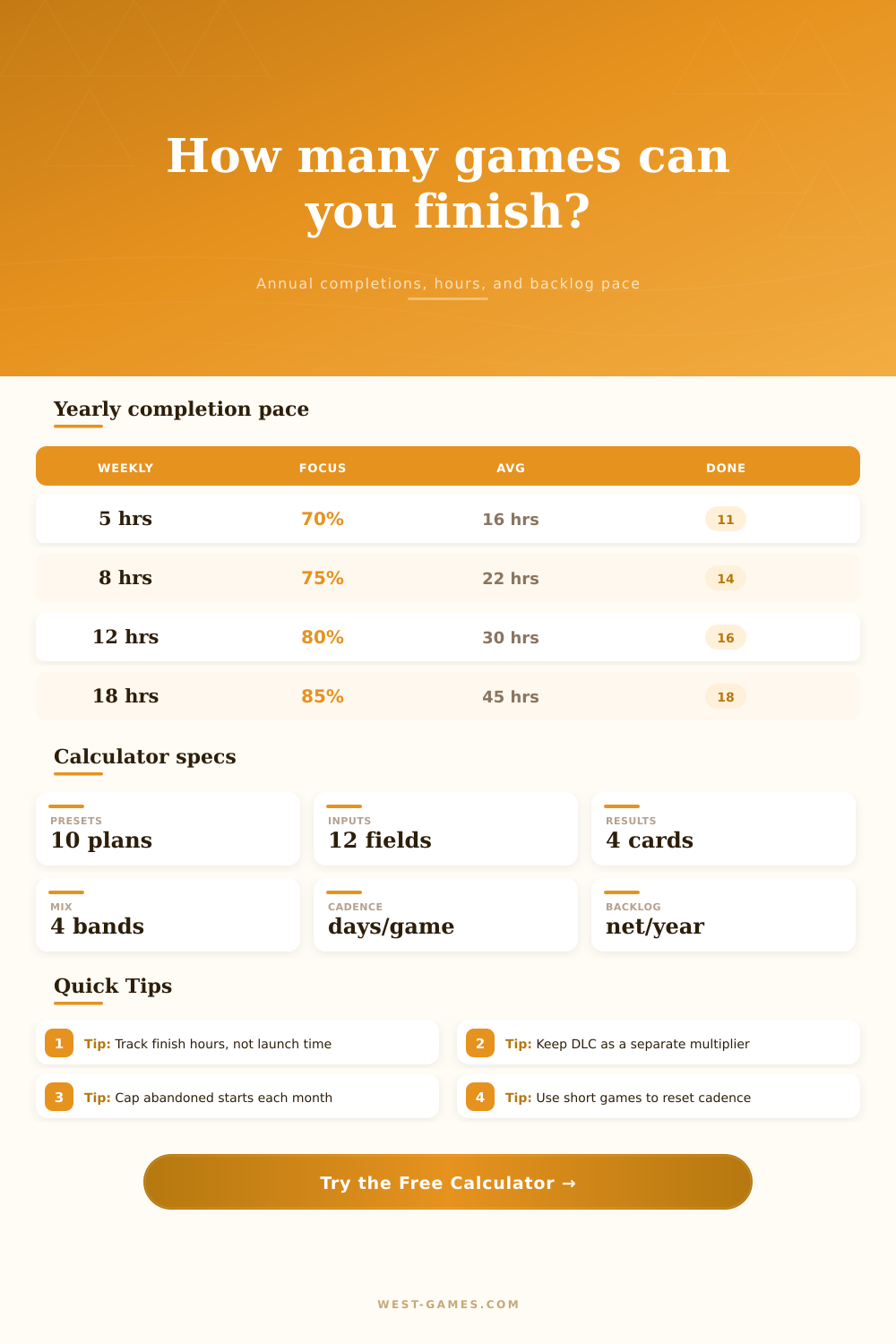
🎮 Games Finished Per Year Calculator
Estimate how many games you can finish in a year from weekly hours, focused completion time, average game length mix, DLC or achievement scope, abandoned starts, and backlog inflow.
High short-game mix, light extras, and low abandonment can clear a large number of smaller campaigns.
Standard campaigns plus some longer games usually produce steady monthly or bimonthly finishes.
Long-form role-playing, strategy, and open-world games make cadence slower even with solid weekly hours.
Expansion content increases hours per finish, so annual totals drop unless weekly completion hours rise.
Achievement cleanup and full clears can more than double the time needed for each finished entry.
| Band | Planner hours | Common finish type | Effect on yearly count |
|---|---|---|---|
| Short | 6 hours | Compact campaign, puzzle path, focused indie | Raises annual finishes quickly |
| Standard | 16 hours | Action campaign, adventure, moderate story route | Good baseline for monthly cadence |
| Long | 38 hours | RPG, strategy campaign, open-world main path | Often halves a short-game finish rate |
| Epic | 75 hours | Large RPG, sandbox clear, multi-route campaign | Can dominate the whole yearly plan |
These bands reflect common time-to-beat planning categories. Replace them mentally with exact known game lengths when a specific title has reliable playtime data.
| Scope | Multiplier | What it counts | Planning use |
|---|---|---|---|
| Main credits only | 1.00x | Critical path through credits | Best for story-finish cadence |
| Main plus selected extras | 1.25x | Some side quests, optional stages, light cleanup | Default mixed backlog estimate |
| Most side content | 1.45x | Major optional arcs and post-game tasks | Good for explorer style finishes |
| Achievement cleanup | 1.85x | Challenge tasks, collectibles, replay cleanup | Use when achievements define finished |
| Full completionist route | 2.25x | Everything practical in the game | Use sparingly for annual estimates |
| Major DLC included | 1.25x to 1.40x | Expansion campaigns and extra endings | Stack with scope only when DLC is planned |
Completion categories vary by game and player. The multiplier approach keeps the calculator honest when the finish target moves beyond credits.
| Weekly hours | Raw annual hours | 70% completion factor | 85% completion factor | At 25h per finish |
|---|---|---|---|---|
| 5 hours/week | 260 hours | 182 finish hours | 221 finish hours | 7.3 to 8.8 games |
| 8 hours/week | 416 hours | 291 finish hours | 354 finish hours | 11.6 to 14.1 games |
| 12 hours/week | 624 hours | 437 finish hours | 530 finish hours | 17.5 to 21.2 games |
| 18 hours/week | 936 hours | 655 finish hours | 796 finish hours | 26.2 to 31.8 games |
| 25 hours/week | 1,300 hours | 910 finish hours | 1,105 finish hours | 36.4 to 44.2 games |
Formula: annual completion hours = weekly hours x 52 x completion factor. Abandonment and DLC scope are not included in this benchmark table.
| Backlog | New games/year | Finished/year | Net change | Years to clear |
|---|---|---|---|---|
| 20 games | 6 added | 14 finished | -8 games/year | 2.5 years |
| 40 games | 10 added | 12 finished | -2 games/year | 20.0 years |
| 60 games | 18 added | 15 finished | +3 games/year | Growing |
| 80 games | 8 added | 22 finished | -14 games/year | 5.7 years |
| 120 games | 24 added | 18 finished | +6 games/year | Growing |
Throughput is finishes minus new annual additions. A negative net change means the backlog shrinks; a positive net change means it grows.
Your digital library has plenty of games on your list to play, but in real life, that translates into an expanding list of unfinished games. You buy games with high hopes, only for work, life, or other games to get in the way. When you try to estimate how many games you will complete in a year, it’s hard to know exactly what you’re measuring.
Is it all time spent playing games? Or do you want to count only the time you spend actualy playing? How long are these games? And whats your abandonment rate?
How to Plan Your Gaming Time
Confusion #2: Players mix up their time playing something and finishing it. For example, maybe you have 20 hours each week for games, but how much of that time is actually spent making progress toward finishing the game you are playing? How do you distinguish “raw leisure time” from “focused effort“? That’s what the calculator does, since hopping from one title to another, or sitting at a menu, doesn’t tend to get anyone closer to the end of a game.
What’s your completion factor (i.e., how much of your available playing time each week are you focusing on moving forward)? If you spend more time exploring different genres, that figure will be lower. If you’re intending on completing a certain title, it will be higher. People often mistake all time spent for time invested, but time spent aimlessly, without direction, is just time spent.
But once you know what your targeted hours are, you need to think about which games you’ll select. Next, it classify games by their lengths: short, standard, long, and epic. Why does this matter? Two years of 30-hour RPGs will get you roughly the same number of play hours as two years of six-hour indie narratives, but the experience are completely different.
Your pace is determined by your weighted average game length. If you’re aiming for backlog clearing, adjusting your mix towards shorter games will allow you to hit higher yearly counts with fewer total play hour. The page has a reference table detailing the effect of varying length bands on your yearly totals.
Finally, how much do you consider “finished”? Do you only need to find the main credits, or will you pursue all achievements? That’s where things can get very different in terms of time. For one game alone, going the completionist path can make it take twice as long (or even more!).
What gets you satisfied? Going for 100 percent completion on all your games might sound great, but it really isn’t sustainable. You’ll end up burned out, with many games left unfinished. If you set a reasonable scope (like just the main story plus a few extras), then you’ll be able to finish many games in that way. And you’ll feel like you’re making good progress.
Finally, consider abandoning games. There are games you begin but never complete. Enter an abandonment rate into the calculator and realize that you lose time playing games you don’t like. It’s an adjustment. If you ignore this, you’re setting yourself up for unrealistic estimates. Include how likely you are to abandon a game and you’ll have a realistic idea of your backlog throughput. Can you shrink it? Or do you just shuffle around titles from one pile to another?
Ultimately, this is all about fun. This isn’t about checking off a list. Playing with awareness makes for better gameplay. It removes the shame from having a pile of unfinished games. It also allows you to create a sustainable game plan. Whether it’s building up to new releases or knocking out previously unplayed titles, knowing these numbers will allow you to play smart.
You stop guessing and get a manageable plan for progress. The backlog doesn’t need to be intimidating. It simply requires strategy.