Tournament Prize Pool Split Calculator
Plan in-game event point or token payouts by pool size, event reserve, paid places, payout curve, roster size, and fixed awards.
Calculated Tournament Split
| Place | Weight Share | Team Award | Per Member | Notes |
|---|---|---|---|---|
| Run the calculator | - | - | - | Placement awards appear here. |
Flat
Balanced
Top-heavy
Champion
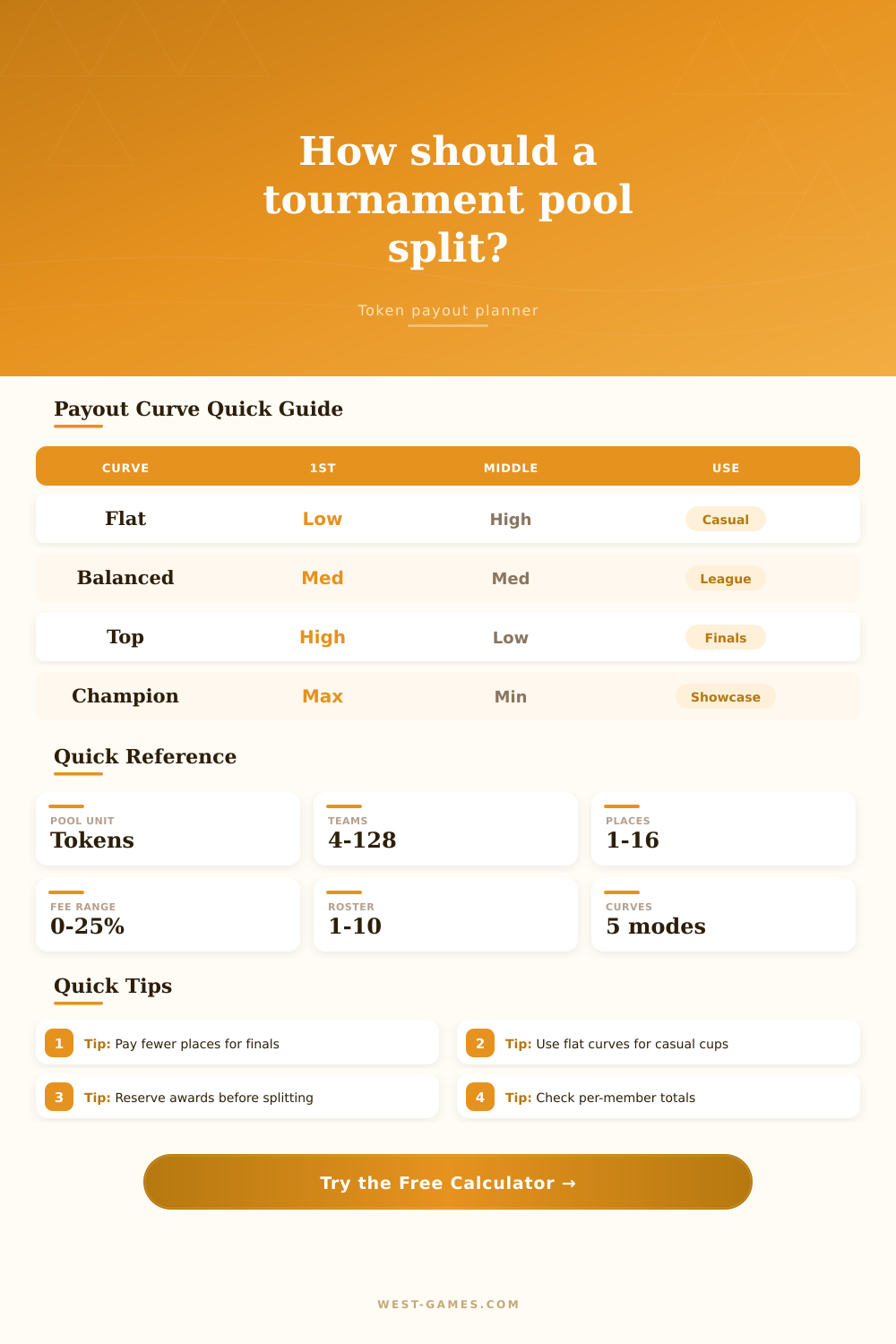
| Curve | Typical Use | Champion Feel | Lower Place Feel |
|---|---|---|---|
| Flat curve | Casual nights, training cups, community events | Modest lead over second | Strong support for every paid place |
| Linear drop | Small brackets with clear placement steps | Simple and predictable | Steady step down each place |
| Balanced curve | Leagues, regular cups, mixed-skill brackets | Noticeably rewarding | Still useful for roster morale |
| Top-heavy curve | Playoffs, finals, elite lobbies | High first-place emphasis | Lower places mainly recognition |
| Champion focused | Showcase finals or special title matches | Maximum spotlight | Very thin lower-place pool |
| Team Size | Best Fit | Split Check | Planning Note |
|---|---|---|---|
| Solo | 1v1 ladders, racing, speedruns | Team award equals player award | Fixed awards can matter more than roster split |
| Duo | Arena pairs, co-op challenge runs | Divide each place by 2 | Balanced curves keep second place meaningful |
| Squad | 4 or 5 player competitive teams | Divide each place by roster count | Check champion per-member value before posting |
| Large roster | Guild raids, relay teams, club events | Per-member share can become small | Consider flatter curves or more fixed awards |
| Preset | Teams | Places | Curve | Why It Works |
|---|---|---|---|---|
| Weekend Cup | 16 | 4 | Balanced | Simple short bracket with a clear top-four finish. |
| Ranked Finals | 32 | 8 | Top-heavy | Rewards a hard final stage while keeping lower awards visible. |
| Guild League | 24 | 6 | Flat | Good for long-running groups that value participation. |
| Creator Showmatch | 8 | 3 | Champion focused | Places attention on the winner without ignoring finalists. |
| School Club Cup | 12 | 4 | Linear | Easy to explain to players and organizers. |
| Community Open | 64 | 12 | Balanced | Wide field with enough paid placements for larger turnout. |
| Squad Royale | 40 | 10 | Top-heavy | Strong top rewards with squad-size member splits. |
| Speedrun Relay | 10 | 3 | Linear | Short podium structure for timed team attempts. |
| Season Invitational | 48 | 8 | Champion focused | Showcase style distribution for a season-ending event. |
When you realize that money in your tournament’s prize pool won’t cover the promises in its invite, it instills a certain sort of dread. You’ve recruited players, set up servers, and build the hype for weeks. Now all you have to do is divide 5,000 tokens by eight spots, while leaving some aside for yourself as an organizer. There isn’t much left over to give away.
Once you plug in parameters, the numbers becomes concrete. You can use this calculator if you don’t want to do math yourself. This spares you from posting something that looks like a generous payout, only to find out somebody checked the math on there phone. It replaces abstract generosity with concrete numbers, making sure each token has a place long before first match starts.
How to Plan Your Tournament Prize Money
Figuring out what shape to use is trickiest aspect of running a tournament. It has nothing to do with figuring out who wins and everything to do with how expensive losing will be. Different tournaments is going to have different levels of competitiveness. For something like casual community night, a flat distribution makes sense; people participate because they’re there, not because they expect to win. But for the final bracket, high stakes tournament feel empty without a distribution that favors the winners. The reference table show how each of these distributions make players feel. I can tell you from experience that middle of the pack will get discouraged by one, but they will keep playing all the way through semi-finals if things is balanced.
It’s not just about distributing money, but about managing peoples’ expectations. If third place isn’t any better than fourth place in a serious league, then why bother working hard enough to make it that far? Teams need team awards to translate into personal income, but most organizers overlook that rosters also has a number of players. Giving a thousand tokens for your five-person squad may sound great, but those players goes home with two-hundred apiece, maybe they don’t feel all that rewarded, after hours of grinding.
The tool allows you to instantly change roster size. So instead of seeing only the big number on team total, it shows the per- member reality. That helps avoid a common error: an organizer offering up a huge team award, without realizing that individual cut may be too small to get anyone excited. You want winning player to feel celebrated, not lessened. Check the member split early; if the payouts appear stingy, you’ll save yourself the hassle of having to redesign the bracket.
Another break in a clean budget model is fixed awards. While you may want to reward the best support player or MVP performance with additional tokens, failing to account for those expenses up front means they’ll come from main pot. By reserving some value for special recognitions ahead of time, the calculator helps ensure you keep your promises by dividing the leftover across placement rewards. Yes, this is a small detail, but when you’re looking to keep your player base’s trust, it matters. Advertise bonuses and go MIA because numbers didn’t work out? Lose their trust quicker then you can gain it back.
These presets are time-saver for typical situations, everything from season-invitational showcases to weekend cups, encapsulating years of experience with tournament design; what curve+team count+payout place combos have been found to perform well while minimizing headache-inducing logistics. You should of used these sooner. Starting with a preset isn’t “cheating” (it’s borrowing wisdom), saving your brain power for the competition instead of the accounting. From there, all variables are open for changing as desired. But kicking off with a proven structure lowers the risk of accidently leaving something out.
So in conclusion, a decent payout structure feels good even if you didn’t win first place. It recognizes effort and awards excellence. It also provides space for special recognition while avoiding breaking the bank. The tool removes the guessing out of things, allowing you to see exactly how your choices ripple throughout the prize pool before making any decisions. Everyone knows what they’re playing for when you drop that final table, right down to the very last token. And when people know what they’re playing for, they come back again and again for next one. Trust creates that environment.