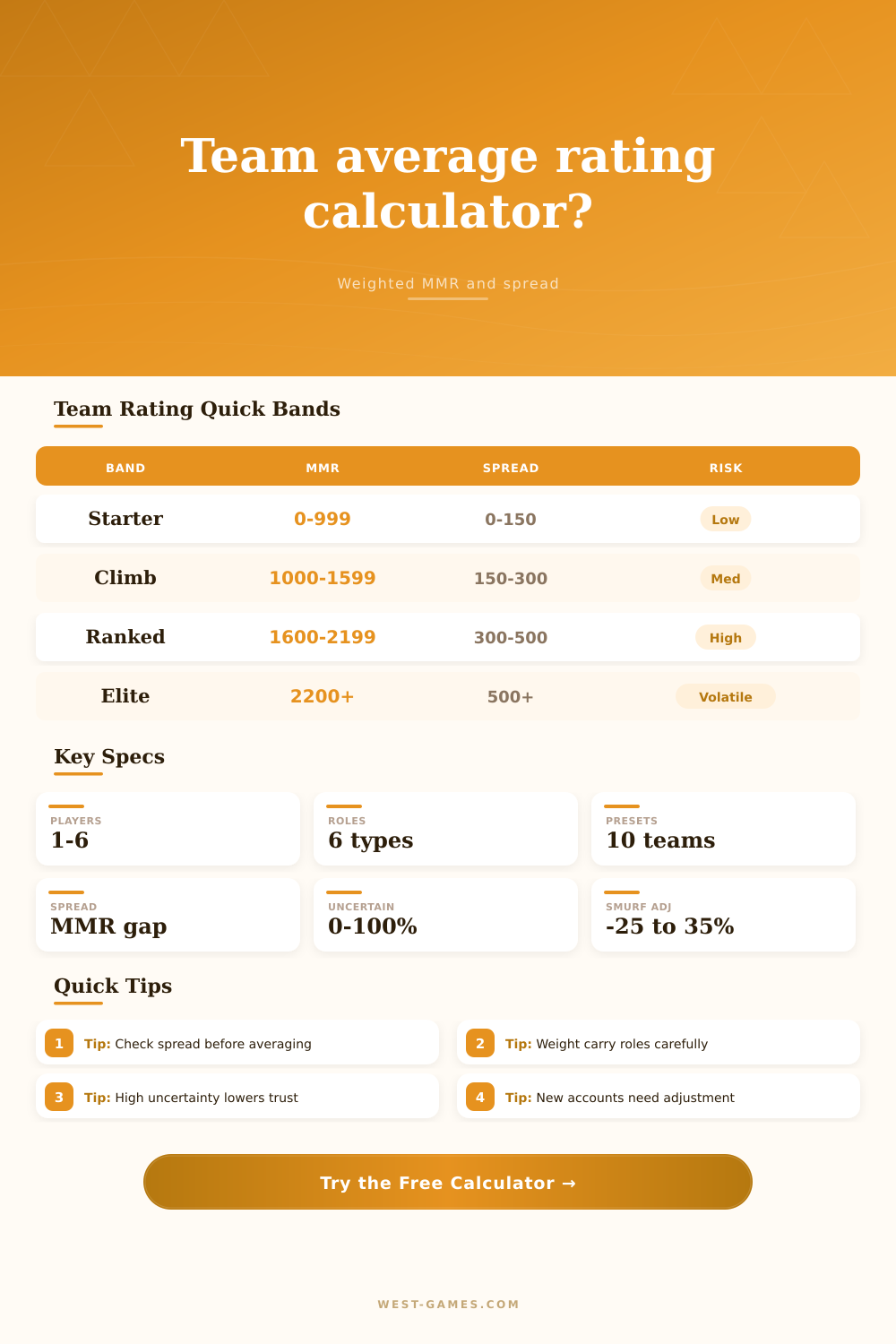
Team Average Rating Calculator
Calculate weighted team MMR from player ratings, role weights, party size, uncertainty, smurf or new-account adjustments, and rating spread.
🎯 Named Team Presets
⚙ Rating Inputs
📊 Current Spec Grid
📘 Role Weight Reference
| Role | Balanced | Carry Profile | Support Profile | Use In Calculator |
|---|---|---|---|---|
| Carry | 1.08x | 1.18x | 1.02x | Raises average when top frag or damage matters most |
| Flex | 1.00x | 1.00x | 1.00x | Neutral role for mixed or unknown responsibilities |
| Support | 0.96x | 0.92x | 1.14x | Weights shot calling, healing, utility, or economy roles |
| Tank | 1.02x | 0.98x | 1.04x | Useful when space making controls fight quality |
| Objective | 1.01x | 0.96x | 1.06x | Captures non-damage value in objective modes |
🔬 Team Comparison Grid
| Team Type | Player Ratings | Weighted MMR | Spread | Matchmaking Read |
|---|---|---|---|---|
| Balanced ranked five | 1500 to 1650 | 1550 to 1600 | Low | Stable queue estimate with few correction penalties |
| Carry duo core | 1300 to 1900 | Role dependent | High | Average hides a large skill gap between lanes |
| New account stack | 900 to 1700 | Uncertain | Very high | Confidence drops until placement data settles |
| Elite scrim team | 2200 to 2500 | 2300 plus | Medium | Role weighting matters more than raw average |
| Friends night party | 800 to 2100 | Volatile | Extreme | Spread penalty protects against misleading averages |
📈 Rating Spread Table
| Spread | Penalty | Confidence Effect | Queue Meaning | Adjustment Note |
|---|---|---|---|---|
| 0 to 150 | 0% | Very small | Players are close in rating | Plain average is usually reliable |
| 151 to 350 | 1% to 3% | Small | Normal ranked party variation | Role weights explain most differences |
| 351 to 600 | 3% to 8% | Moderate | One lane or role may be overmatched | Use weighted MMR instead of simple mean |
| Over 600 | 8% plus | Heavy | Mixed skill party or calibration issue | Review new player and smurf settings |
🧪 Uncertainty and Account Adjustment Table
| Input Signal | Typical Range | Calculator Effect | Best Use | Risk |
|---|---|---|---|---|
| Established account | 0% to 20% | Small trust penalty | Normal ladder history | Low |
| Placement account | 30% to 70% | Lower confidence | Early season or first ranked run | Medium |
| New player role | -5% to -25% | Rating estimate drops | Learning accounts or unfamiliar roles | High |
| Smurf suspect role | 10% to 35% | Rating estimate rises | Low games played but strong impact | Volatile |
💡 Practical Calculation Tips
It’s your turn to play: You’re sitting in the lobby waiting for the match, and you’re already worried that your team will be lost. Most of the time, it won’t be due to pure bad luck; rather, it’ll have something to do with spread of skills among teammates and whether that spread align with your strategy. Sometimes, it’s possible for a lone player to take on the statistical load, which skews a team’s ratings. In such cases, a team’s mean rating isn’t as informative than its weighted team dynamics.
Once you assign roles to players and enter their ratings into the calculator above, it crunches the numbers for you. That way you don’t have to guess at implications of having players in different role. Competitive games will typically value some roles over others. In most cases, a player who gets kills will be worth more to a team’s outcome than a player who controls space, supports, or heals. The tool factors that in with multipliers per position according to the profile you choose. If you want to stack up objective controllers, go for it. What about damage dealers? What about tanky units? It will account for those factors and change your team’s effective strength to match.
How the Team Calculator Works
Keep in mind that role weighting matter, while many believe each rating point carries equal weight towards winning, this isn’t necessarily true. A 1600-player who has a primary carry role will be more decisive during fights compared to a 1600-player with a secondary utility role. Look at the reference table on the page for examples of carry-weighted vs. These are balanced teams. If your team is skewed toward a certain playstyle, tweak accordingly. Raw averages will skew either too high (you’re resilient to well-coordinated pushes) or low (you’re more threatening than you think).
In addition, spread is an important factor in determining match stability. If players’ ratings differ substantialy, they will be at vastly different levels of awareness. Because of this coordination among teammates becomes almost impossible. To account for this fact, the calculator heavily punishes wide spreads. For example, it lowers the confidence score if there is a large gap between highest and lowest rated players. Teams that are mismatched often experience communication problems under pressure situations.
These estimates are further refined by the uncertainty factors, which take into account new players or suspected smurfs (those without a good history). Because they have never been proven, fresh accounts begins with large margins of error. Tuning for uncertainty avoids overconfidence in untested lineups and helps manage expectations until enough data is available to reveal their true skill levels. The same is true for smurfs, though with the reverse effect. Some low-rated players are actualy hidden veteran players who fell to a lower tier to destroy the lower-level competition. If you don’t consider this fact, you would of underestimated the risk when facing what looks like an easy opponent. Tweaking those percentages ever so slightly change your perception of the likelihood of beating a specific player. So take time to evaluate the numbers and look back at their recent play.
Another wrinkle in pre-made bonuses is recognition that a group of people working together can be more effective than a random grouping, even if they’re all equally skilled individually. There’s something to be said for being able to communicate, understanding the timing mechanics, having common knowledge of the map, etc. It’s a bonus based off the fact you’ve repeatedly practiced with these players and built up some sort of teamwork beyond what mere addition of player skills might achieves.
Evaluating teams involves many things to consider at once. You also need to keep in mind what matters most when competing. You’re looking for good measures of relative power, and real estimates of how likely things are to go wrong. They shine light on some of the unseun stuff so you can make better-informed choices about which queues to roll into. It’s largely just about knowing what’s being calculated, not taking simplistic summaries as truth. Best of luck outsmarting everyone this time, with your eyes open.