Rank Points Needed Calculator
Estimate the games, net LP pace, streak impact, demotion shield buffer, and play sessions needed to hit a ranked target.
🎯Climb Presets
⚙Rank Point Inputs
Climb Estimate
📊Live Climb Specs
🏆Rank Band Reference
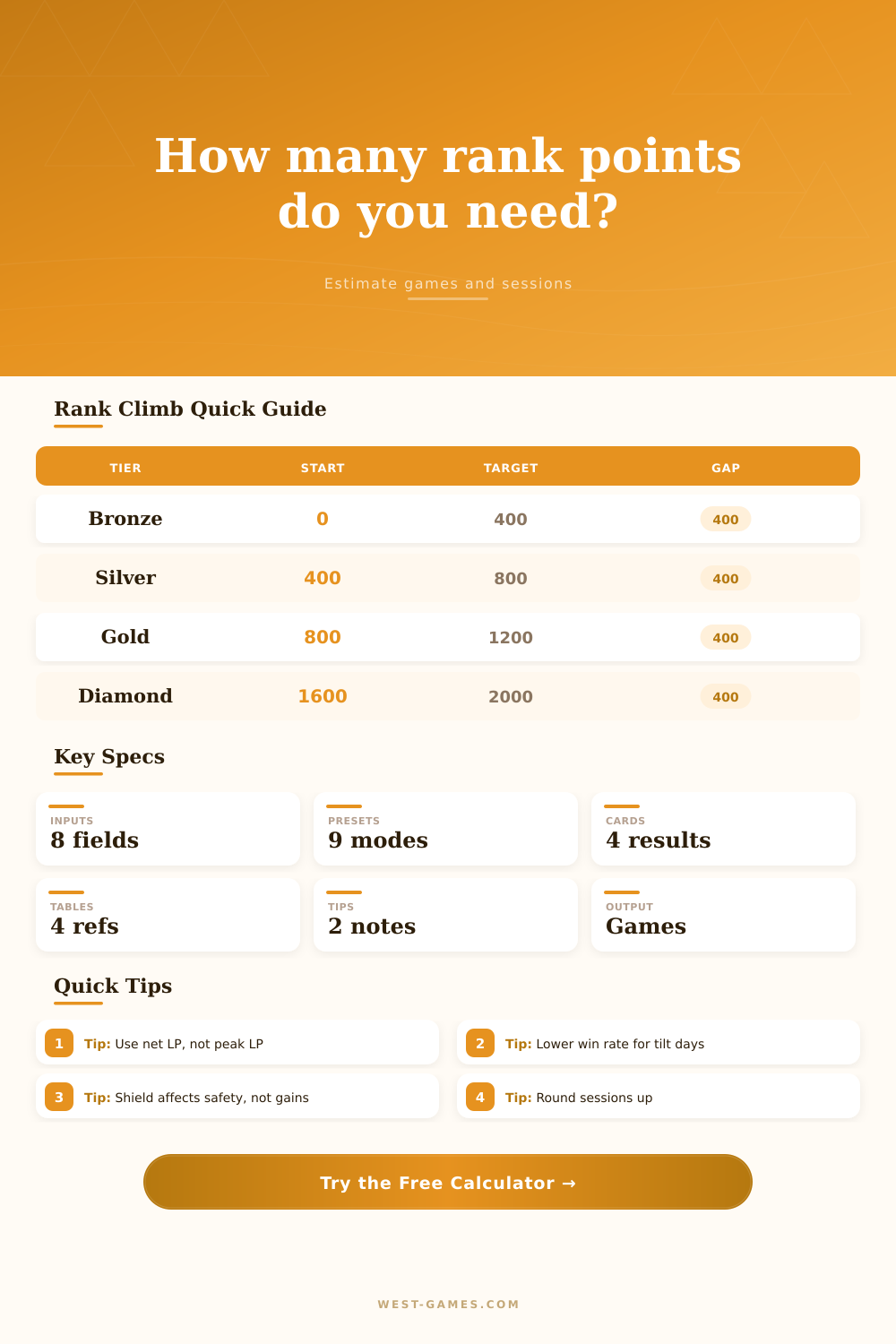
| Rank band | Typical point span | Common target | Planning note |
|---|---|---|---|
| Bronze to Silver | 0–800 | 400 or 800 | Fast gains matter more than streak timing. |
| Silver to Gold | 400–1200 | 800 or 1200 | Use a buffer when stopping near promos. |
| Gold to Platinum | 800–1600 | 1200 or 1600 | Net LP shrinks quickly below 52% wins. |
| Platinum to Diamond | 1200–2000 | 1600 or 2000 | Session limits help protect win rate. |
| Diamond and higher | 1600+ | 2000+ | Small streak modifiers can shift many games. |
📈Win Rate Impact Table
| Win rate | 24 gain / 18 loss | 22 gain / 20 loss | Use case |
|---|---|---|---|
| 50% | +3.0 per game | +1.0 per game | Slow climb, long sample needed. |
| 53% | +4.3 per game | +2.3 per game | Reliable if game volume is steady. |
| 55% | +5.1 per game | +3.1 per game | Good default for confident planning. |
| 58% | +6.4 per game | +4.4 per game | Strong climb pace over a weekend. |
| 62% | +8.0 per game | +6.1 per game | Hot streak territory; add caution. |
⚡Streak and Shield Table
| Modifier | Calculation effect | Best used for | Risk note |
|---|---|---|---|
| No streak | Base net points | Normal ladder sessions | Most conservative estimate. |
| Small streak | Net gain × 1.03 | Two or three wins in a row | Only a light planning boost. |
| Hot streak | Net gain × 1.07 | Strong form and stable duo play | Recheck after a loss chain. |
| Promotion surge | Net gain × 1.12 | Bonus LP or visible streak systems | Can overstate games saved. |
| Demotion shield | Safety buffer only | Stopping near rank floor | Does not raise net gain. |
🗂Session Comparison Grid
Short Queue
Three games per sitting works well when win rate drops after losses or late nights.
Standard Block
Five games per session balances volume and focus for most ranked point climbs.
Weekend Push
Eight games per session can compress the climb but magnifies tilt swings.
Promo Hold
Stop after reaching target plus buffer when the next loss would erase the shield.
📝Planning Benchmarks
| Point gap | Net +3/game | Net +5/game | Net +8/game |
|---|---|---|---|
| 100 points | 34 games | 20 games | 13 games |
| 250 points | 84 games | 50 games | 32 games |
| 400 points | 134 games | 80 games | 50 games |
| 600 points | 200 games | 120 games | 75 games |
💡Rank Climb Tips
Looking at that ranked ladder thinking ‘can I make it up? Can’t I do it?” That’s hardly a matter of skill anymore. After you get out of beginning brackets, it’s all a matter of organization.
How much variance in your win rate can you afford? How many matches can you play and still feel fresh enough to perform? And how many more points is there between you and the next tier? How many match is that?” The beauty of this calculator is that it turns that into hard number. I want to know how long I have to play.
How to Plan Your Ranked Climbing
The mistake most players fall into are simply staring at the raw number of points needed to catch up. I am three hundred points behind. So I just need about twenty wins because each win worth fifteen points.” Except that fails to account for losing. Because the point where you gain the most isn’t what matters. What matters is your net gain per game, which is how much you makes progress. This tool does account for that because it allows you to enter both the points you would gain from a win, as well as the points you would lose from a loss.
You may find that you’re slowly climbing even though you expect to be doing much better. Maybe you’re playing 55% of your games, but when you win you get twenty-four points, yet when you lose, you drop eighteen points. That’s going to put you at a solid pace of catching up, but not as quick as you’d think. People miss that and they’ll plan based on their best case scenario rather than realistic average.
That’s especially true with the streak modifier field. A lot of systems gives out bonus points for being on a winning streak and essentially increase your efficiency. You can dial down that modifier in the calculator and knock some games off final guess. In the opposite case when you’re feeling like things aren’t going well or you’re getting into tilt, dropping that streak modifier accounts for the way that will drag you down. This isn’t just about numbers, it’s about managing your emotions. Sixty more games until gold, okay, I’m tilted right now. Taking a break doesn’t mean you failed. It means you’re purposely protecting your win rate.
And finally, there’s the demotion shield. You know that the demotion shield act as a safety net, allowing you to dip below your current rank floor without dropping a visible tier. But this doesn’t help you rise, it just stops you from sliding down. For promo series like this where crossing the line isn’t enough, you have to feel safe above it. The calculator distinguishes those two things neatly. It figures out how many points are required to get you to your goal with a margin so you won’t instantly fall right back down once you clear it. Twenty or thirty points might be all that stands between feeling excited about a promotion and spending the next hour grinding just to avoid being demoted. The calculator also helps you factor in a buffer to ensure you don’t immediately drop back down after hitting your goal.
You might feel like you’re doing well when you play eight games at once, but eventually, your reaction times slows down. Your decision making take longer. Your win rate flattens out. Often breaking the eight games up into two sessions of four will result in a better outcome over time because it keeps you sharp. How many matches? But also how many sittings is this likely to take across a week or two?
So in conclusion, ranked climbing isn’t so much a series of flashes of brilliance as it is an exercise in controlled exertion over time. Knowing your net point velocity, combined with knowing how many sessions you’ll need allows you to convert nebulous goals into an achievable schedule. Numbers are the map, but ultimately it’s up to you to drive the car.
Stay focused during each session. Honor your win rate limits. Know that each loss is simply a new piece of information for the next calculations. You should of played smarter, not necessarily longer, and you’ll get there.