Jump Height Calculator
Estimate game jump height, initial vertical velocity, gravity-scaled apex time, jump buffs, double jump reach, air control, and horizontal clearance.
🎮Movement Presets
⚙Jump Inputs
📊Current Movement Specs
🔬Jump Profile Reference
| Profile | Typical Height | Gravity Feel | Best Use |
|---|---|---|---|
| Platformer | 2.2 to 3.4 m | Readable arc | Tile gaps, ledges, collectible routes |
| Shooter hop | 0.8 to 1.4 m | Fast and grounded | Combat peeks and cover hops |
| Action RPG | 1.3 to 2.2 m | Moderate weight | Vaults, dodge jumps, traversal checks |
| Floaty mascot | 3.0 to 5.0 m | Low gravity | Air steering and exploration |
| Hero ability | 4.0 to 8.0 m | Ability-driven | Cooldown leaps and vertical escapes |
⚖Gravity And Apex Table
| Gravity Multiplier | Acceleration | Feel | Apex Effect |
|---|---|---|---|
| 0.35x | 3.43 m/s² | Moon map | Long hang time and wide gaps |
| 0.65x | 6.38 m/s² | Floaty arcade | Higher apparent control window |
| 1.00x | 9.81 m/s² | Standard physics | Balanced height and fall speed |
| 1.20x | 11.77 m/s² | Heavy action | Shorter apex and tighter timing |
| 1.40x | 13.73 m/s² | Precision heavy | Snappy rise and fast landing |
🧮Buff And Double Jump Table
| Layer | Input | Applied To | Design Read |
|---|---|---|---|
| Jump buff | -50% to 200% | Base height impulse | Perks and powerups should stay measurable |
| Charge boost | 0% to 150% | Base height impulse | Good for variable button-hold jumps |
| Double jump | Extra height | Airborne second impulse | Use delay to test late saves and early chains |
| Landing offset | Up or down | Clearance time solve | Raised platforms shorten usable gap reach |
| Air control | 0% to 150% | Horizontal speed | Changes feel without changing vertical height |
📈Preset Comparison Table
| Preset | Height | Gravity | Double Jump | Air Control | Gameplay Role |
|---|---|---|---|---|---|
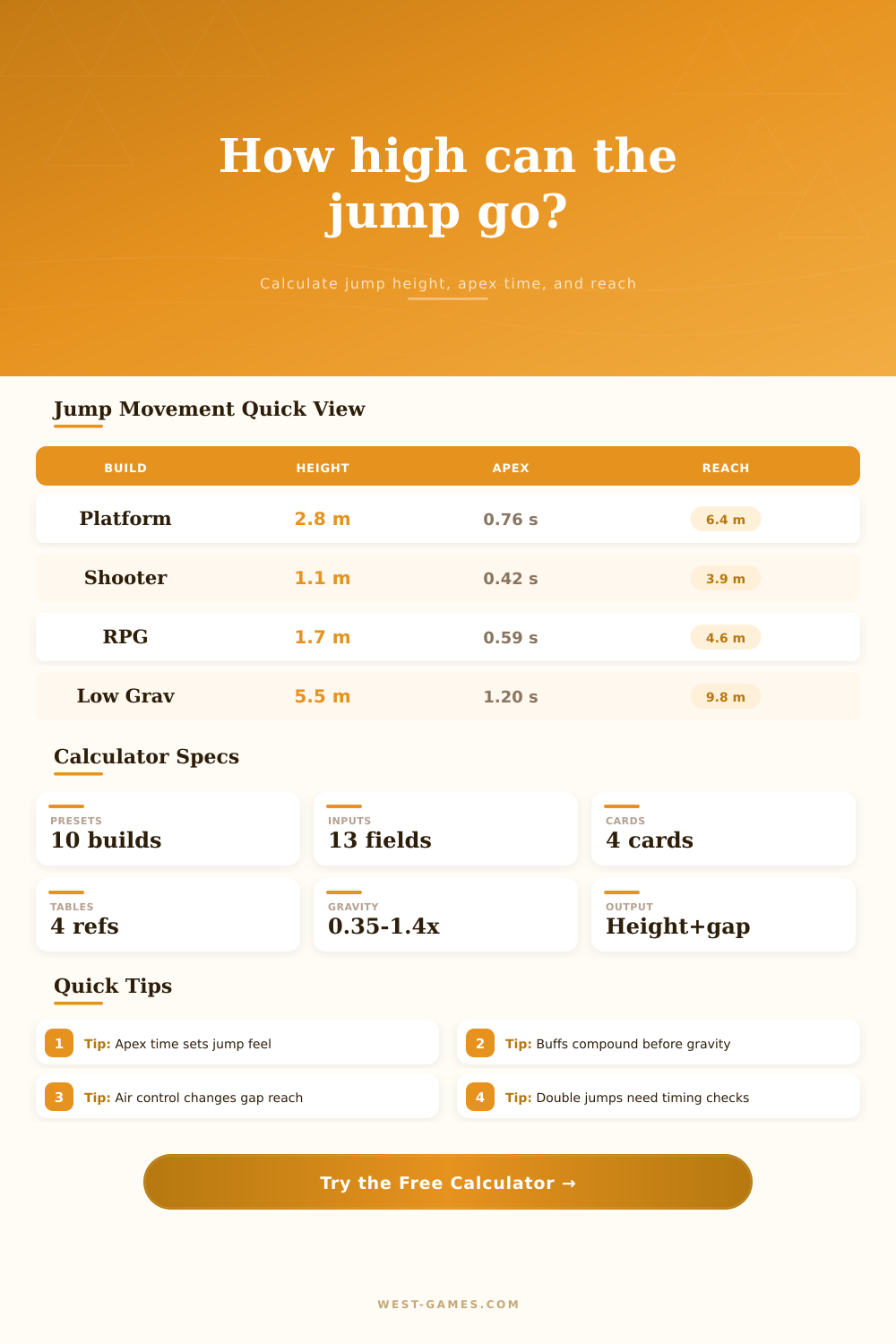
| Classic Platformer | 2.8 m | 1.00x | 1.4 m | 85% | Readable gaps and ledges |
| Arena Shooter Hop | 1.1 m | 1.25x | 0 m | 65% | Combat strafing and cover |
| Metroidvania Double | 2.4 m | 0.95x | 2.1 m | 95% | Route unlock and backtracking |
| Floaty Mascot Jump | 3.6 m | 0.65x | 1.8 m | 110% | Air correction and exploration |
| Action RPG Vault | 1.7 m | 1.10x | 0.4 m | 55% | Weighty movement with small saves |
| Low Gravity Moon Map | 2.9 m | 0.35x | 1.2 m | 80% | Long hang-time platforming |
| Speedrunner Buff Stack | 2.2 m | 0.90x | 2.5 m | 125% | Sequence break routes |
| Hero Shooter Leap | 4.8 m | 0.85x | 0 m | 70% | Ability burst and rooftop entry |
| Precision Tile Jump | 1.35 m | 1.40x | 0.7 m | 45% | Strict input and tile timing |
| Battle Royale Mantle | 1.6 m | 1.05x | 0.3 m | 60% | Traversal over cover and rocks |
🗂Comparison Grid
Initial Velocity
Jump height maps to launch impulse through v = sqrt(2gh). Raising gravity needs more initial velocity for the same maximum height.
Apex Time
Apex time is the main feel metric. Short values feel snappy, while long values make midair reads and steering more forgiving.
Double Jump
The second impulse can add height, extend hang time, or save a missed ledge. Delay is useful for testing early versus late activation.
Gap Clearance
Horizontal reach combines usable airborne time with speed and air control. A high jump still fails if lateral control is too low.
💡Tuning Tips
Seeing someone defy gravity in a video game feels magical. The character glides over an obstacle like it’s nothing. Then you learn there is no magic at work, just math. Gravity scaling and initial vertical velocity determine whether your jump will be floaty or responsive. Players generaly don’t think about those numbers, yet they’re responsible for every moment of that character movement in the game.
Height are the starting point for the main equation. It’s the maximum height at which you want the character to reach during their jump. From there we work out the impulse required to propel player upwards, against gravity. If you choose an overly tall jump, then you’ll need to make adjustments elsewhere to balance it correctly. Otherwise, the character will appear unnatural. This is because it doesn’t match how long they spend in the air.
The Math Behind Game Jumps
The calculator take this desired peak and converts it into an exact velocity number. No more guessing when it comes to matching height and speed. It’s a very tactile experience, and it feels like you’re being pulled along by an unseen force called gravity.
The higher your gravity multiplier, the snappier the feeling… You’ll land faster. The lower the multiplier, the longer it takes before you peak on your jump leaving more time to adjust your direction or correct course. That’s the genre definition in a nutshell. If you want precise control over a jumping character, you want him to float a little longer between hop. If you’re playing a shooting game, you want him falling fast enough that he doesn’t get in the way too much. Tweaking those sliders will show just how much changing the rate of acceleration shift the sensation of what you’re carrying around with you.
Add depth with modifiers. Powerup buffs build on the base impulse. An increase in jump height of 20% doesn’t add a specific number of inches to the jump, instead, it multiplies the whole jump profile by that factor. This amplifies entire jump profile. Double jumps compound this with an additional push during air phase.
The timing of that second input matter just as much as the height it provides. Get the timing right and it feels like you’re really connected to what’s happening. Too short and the mechanic lose its strategic weight and becomes spammy. Too late and the feeling of disconnection persists.
The last piece of the puzzle here is the horizontal clearance. Jumping really high vertically doesn’t help if you have no air control or if you steer poorly over large gaps. This input simulates how much lateral speed are retained once the character is airborne. A high value means he is like a rocket that keeps its forward momentum during flight. At a low value, he feel like he’s pushing into some imaginary drag in the air, fighting to keep going straight ahead. From there it determines based off your settings if what you have will get up and over distance you put for the gap. It depends on both how long it has and how much forward speed it keeps.
There isn’t one magic number that’s perfect; it’s a question of designing motion in a way that creates a reliable language for the player. When you settle on how something feels under your feet, each jump conveys the same expectation. Altering these rules in the middle of gameplay disrupts muscle memory and shatters immersion.
Adjusting jumps is simpler than rewriting the underlying physics by which characters interacts with their world. Imagine the worst case scenario and see how you can tune for it. If a player is off by even a tiny bit, do they still has to make those tight jumps? Does the double jump become a solution or an additional issue? Answers to these questions will indicate if your tuning supports the desired game play loop.
If the math matches the feel, players won’t notice the math at all. They’ll simply start jumping.