Healing Per Second Calculator
Model direct heals, cooldown gates, overheal loss, crit scaling, haste, HoT ticks, and effective HPS for RPG, MMO, hero shooter, and raid-style healing builds.
⚙Named Healing Presets
🩹Healing Inputs
Calculation Breakdown
📊Current Spec Grid
🧪Healing Style Reference
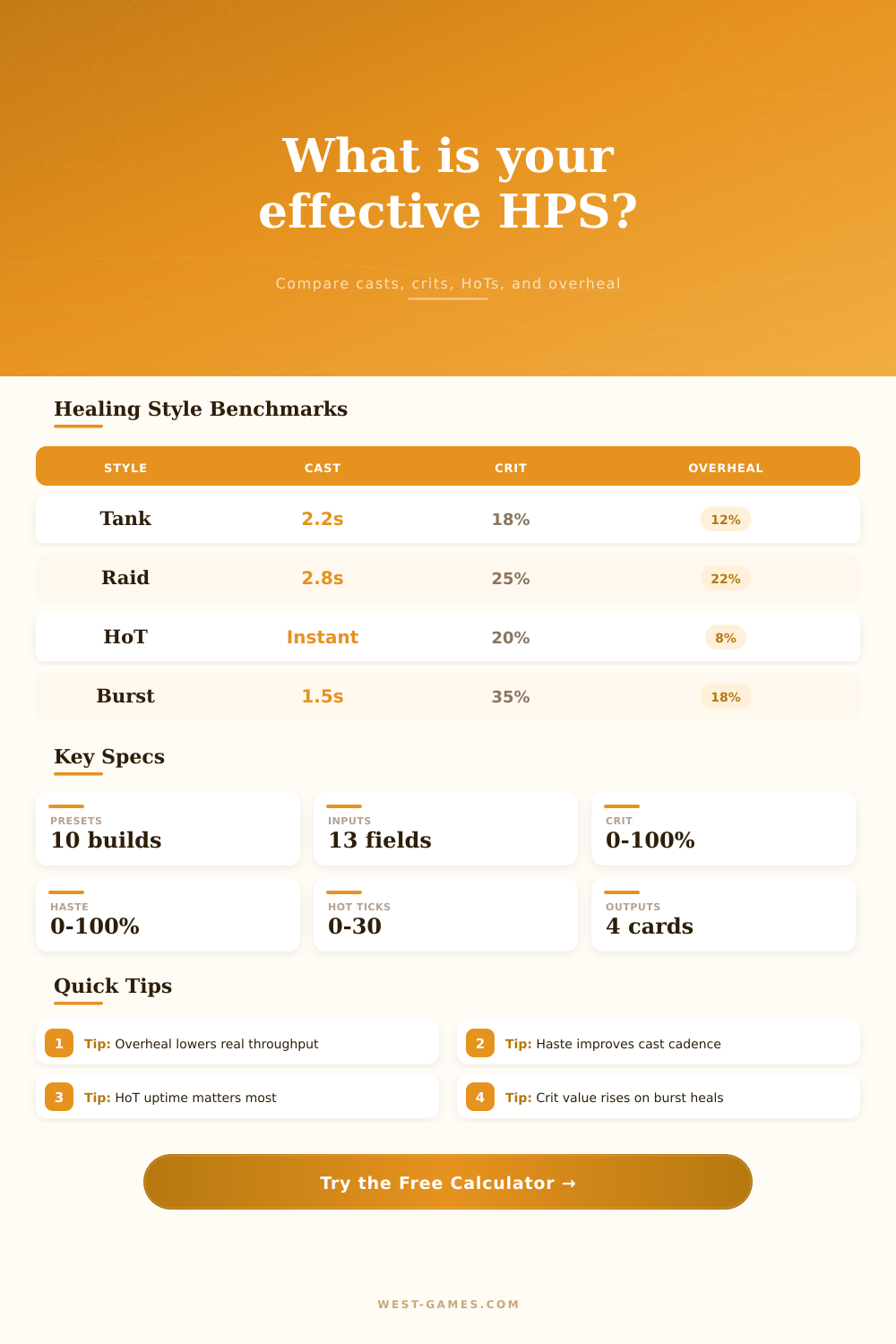
| Healing style | Best use | Typical strengths | Common HPS risk |
|---|---|---|---|
| Tank Anchor | Single target stabilization | High direct heal, low target count, moderate crit value | Cooldown downtime can hide weak sustained HPS |
| Raid Blanket | Group-wide damage pulses | Multiple targets and repeated HoT ticks compound quickly | Overheal rises when targets are not actually injured |
| Arena Burst | Short PvP windows | Fast cast timing, high crit, and strong immediate recovery | Resource efficiency can collapse during panic casts |
| HoT Weaver | Movement-heavy encounters | Uptime and tick interval keep healing active while moving | Low uptime makes listed healing look better than reality |
| Cooldown Burst | Scripted boss events | Huge healing packets during predictable damage spikes | Long recharge lowers average HPS across the fight |
⚔Preset Comparison Grid
| Preset | Direct heal | Cast / cooldown | Crit / haste | HoT profile |
|---|---|---|---|---|
| Tank Anchor | 18,500 to 1 target | 2.4s / 0s | 18% / 8% | 1,200 x 5 ticks at 75% uptime |
| Raid Blanket | 7,200 to 6 targets | 2.8s / 0s | 25% / 18% | 900 x 8 ticks at 85% uptime |
| Arena Burst | 21,000 to 1 target | 1.5s / 6s | 35% / 22% | 600 x 4 ticks at 40% uptime |
| HoT Weaver | 4,800 to 4 targets | 0s / 0s | 20% / 30% | 1,350 x 10 ticks at 95% uptime |
| Boss Cooldown | 42,000 to 5 targets | 0s / 45s | 28% / 10% | 2,400 x 6 ticks at 65% uptime |
⏱Timing and Haste Table
| Haste | 2.5s base cast | 2.0s tick interval | Practical note |
|---|---|---|---|
| 0% | 2.50s | 2.00s | Baseline timing with no throughput acceleration |
| 10% | 2.27s | 1.82s | Noticeable cast smoothing for sustained healing |
| 25% | 2.00s | 1.60s | Strong value when overheal remains controlled |
| 50% | 1.67s | 1.33s | Great throughput, but resource drain increases |
| 100% | 1.25s | 1.00s | Often limited by global cooldown or resource supply |
📝Input Sensitivity Table
| Input | Raises HPS when | Lowers HPS when | Best comparison use |
|---|---|---|---|
| Heal amount | The same timing delivers a larger useful heal | The spell also becomes slower or more wasteful | Compare rank upgrades, talents, or scaling buffs |
| Cast time | Haste or instant casts shorten the cycle | Long channels delay the next heal window | Check whether big heals beat faster smaller heals |
| Cooldown | Short recharge allows repeated casts | Long recharge spreads healing across many seconds | Average burst cooldowns over a whole encounter |
| Overheal | Lower waste turns listed healing into real healing | Targets are topped before the spell lands | Estimate practical raid logging performance |
| Crit heal | Crit multiplier and chance are both high | Crit overheals or arrives after danger has passed | Value burst talents and temporary crit windows |
| HoT ticks | Uptime stays high and tick interval shrinks | Effects expire early or targets leave range | Compare healing-over-time builds and maintenance buffs |
💡Calculation Tips
You have probably seen a healing chart that looks impressive on paper but fails in practice. “The numbers say I’m pumping thousands of health points per second into the raid, yet my tank keeps screaming and dying during a split-second pause between casts.” That’s the disconnect. Effective healing isn’t the same as raw throughput. Raw throughput is measured by what leaves your cursor; effective healing is measured by what actualy sticks to target.
Most players don’t understand this distinction until it cost them a clear shot at boss mechanic. That’s typically when the catch comes in: How do you weigh burst potential vs. Cast time? Sure, it might heal for a giant number, but what does that mean if it costs three seconds to cast (and has a six second cooldown)? In reality, youre producing very little during that period of time.
Why Effective Healing Matters More Than Big Numbers
That means there’s an opportunity cost. You’ve left yourself vulnerable, allowing the enemy to stack up even more damage while you wait for your own. In high pressure scenarios, then, you don’t want raw tooltip strength as much as you need to be able to time things properly.
The math gets complicated (which is why the calculator above lets you punch in your own numbers, saving you from having to average out short cast time vs. These are long recharge windows. But that’s where haste comes in. Haste decreases the gap (it doesn’t just make you cast faster), it makes your safety net go up. Instead of two seconds to cast, now you’ve got a second and a half, allowing for more casts per minute.
The trick here is that you are often stabilizing someone under constant damage instead of massive burst. You want to be able to catch them before they hit 0 HP every time, especially when using major heals. This is why the page has a reference table showing how smaller gaps due to haste reduce tick intervals for any heal-over-time effect. Fewer gaps mean a smoother curve and less chance of someone dropping below health between major heals.
And then there’s overheal, the silent throughput killer. Overheal is healing that lands on players who are already at full health. It looks great on your personal logs because the total number is high, but it doesn’t actualy help anyone. Wasting twenty percent of your healing on full health bars means your effective output go down by precisely that much. You’re wasting your time and mana and getting nothing back.
The tool accounts for all of this waste with each calculation. It lets you see what your actual build do in combat instead of the theoretical numbers shown in game menus. There’s more than that with critical heals. Having a high chance to crit sounds great until you realize all those criticals is landing on people who barely need them and are therefore wasted. Maybe you’ll be lucky one time and save the wipe, but I don’t want to rely on my luck.
The average consistently heals better then the occasional big number heals because you can plan around the average heal amount. It’s impossible to plan around a random roll of the dice. And it’s even more true in raids where damage patterns tend to be sustained. Direct cast heals are one thing; Heal-over-time is another.
Your healing must be up. Apply a heal which ticks every two second and your target dies after four? You’ve wasted those ticks. To account for this, the calculator allows you to enter your expected uptime percentage. It will then adjust for these percentages to show you how much value you’re actually getting. What this means is that you need to consider your ability to keep effects up while moving around or when a target go out of range.
High tick power with high uptime tends to outclass huge burst numbers with low uptime because they keep a target alive longer without having to babysit them constantly. Knowing what to expect in the fight will also help determine which build is appropriate. For example, if it’s a constant grind fight, you’re going to want high uptime, low cost heals, like heal-over-time effects. If it’s a boss who has a big hit every 30 seconds, you want to have some burst healing so you can clear that damage fast.
Not all fights are best healed by the same person. All fights is best healed by whoever has the right tool for the job. You need the specific tool that solves the problem of that particular fight. Effective healing makes that chaotic raid feel like a doable puzzle. It removes the guesswork of whether your gear is enough or not. Suddenly, you have an idea of where all of your throughput are going.
You begin to appreciate efficiency instead of flash. Now you understand how much of your healing is being wasted on long cooldowns or full health bars. With that knowledge, you’re able to make better decisions. These decisions will save lives.
Math doesn’t lie. It merely demonstrates where the gaps in healing are. And then you plug it up before someone dies from lack thereof.