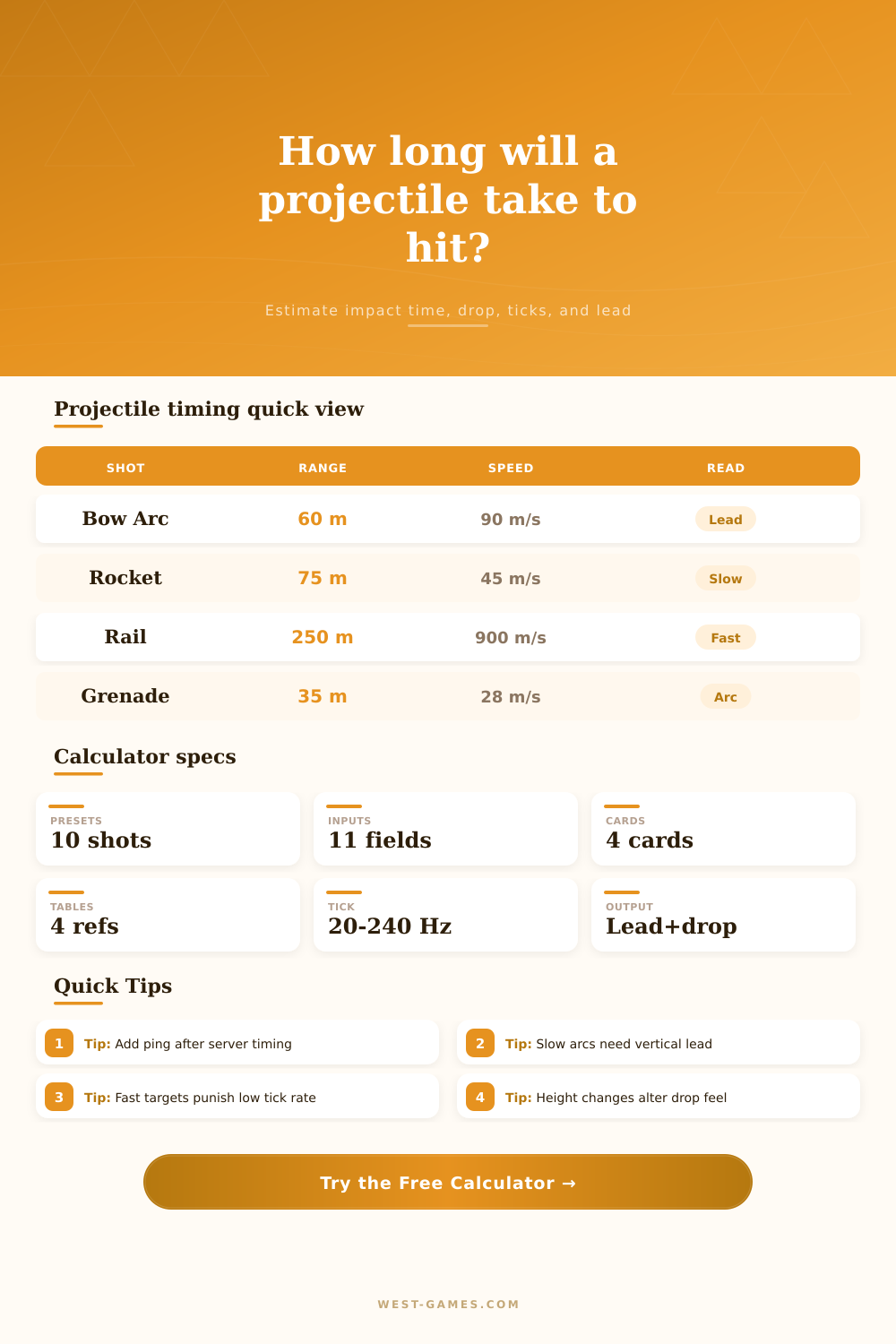
Projectile Travel Time Calculator
Estimate in-game projectile impact time, gravity drop, server tick alignment, latency-added feel, and moving target lead from practical combat inputs.
| Projectile type | Typical speed | Drop style | Timing read |
|---|---|---|---|
| Rifle tracer | 700 to 900 m/s | Low to none | Mostly latency and tick feel |
| Arena rocket | 35 to 55 m/s | Low to medium | Visible travel, strong lead |
| Heavy bow | 70 to 120 m/s | Medium | Drop becomes obvious past mid range |
| Plasma orb | 18 to 40 m/s | None to low | Prediction matters more than recoil |
| Thrown grenade | 18 to 35 m/s | High | Arc and height dominate |
| Siege mortar | 22 to 45 m/s | High | Long hang time, vertical correction |
| Tick rate | Tick interval | Best use | Projectile effect |
|---|---|---|---|
| 20 Hz | 50.0 ms | Large casual worlds | Impacts feel chunkier |
| 30 Hz | 33.3 ms | Console and large modes | Short shots may round late |
| 60 Hz | 16.7 ms | Common ranked matches | Balanced timing fidelity |
| 120 Hz | 8.3 ms | Competitive servers | Cleaner peek and trade timing |
| 240 Hz | 4.2 ms | Practice and lab tools | Very low quantization delay |
| Movement pattern | Example speed | Cross angle | Lead behavior |
|---|---|---|---|
| Slow crouch strafe | 2.0 to 3.0 m/s | 70 to 90 degrees | Small but consistent lead |
| Standard run strafe | 4.5 to 6.5 m/s | 80 to 90 degrees | Use full lateral lead |
| Sprint diagonal | 6.0 to 8.5 m/s | 35 to 60 degrees | Only part of speed crosses aim |
| Dash or slide | 9.0 to 14.0 m/s | 60 to 90 degrees | Lead spikes during the burst |
| Airborne drift | 3.0 to 7.0 m/s | 20 to 80 degrees | Lead changes with arc and fall |
| Setup | Range | Speed | Practical correction |
|---|---|---|---|
| Close rocket duel | 20 to 35 m | 35 to 55 m/s | Lead body width, aim low for splash |
| Mid bow pressure | 45 to 90 m | 70 to 120 m/s | Blend horizontal lead with drop holdover |
| Long tracer lane | 150 to 300 m | 700 to 900 m/s | Net delay can exceed raw flight time |
| Grenade balcony clear | 25 to 45 m | 18 to 35 m/s | Height offset changes the landing point |
| Plasma zoning shot | 25 to 70 m | 18 to 40 m/s | Predict route commitment, not cursor position |
Arc Shots
Best represented by launch angle, gravity multiplier, and height offset. Small angle changes can create large vertical differences at long travel times.
Slow Projectiles
Lead distance grows directly with travel time. A 1 second rocket into a full strafe often needs several meters of side correction.
Fast Projectiles
Raw flight time may be tiny, so latency, interpolation, and server tick rounding can become the bigger practical timing cost.
Moving Targets
The important speed is lateral movement across the sight line. Running toward you may barely change lead even at high movement speed.
In any competitive shooter game, we’ve all had this experience: You pull the trigger and feel as if you nailed your opponent but the bullet landed three feet short of them. That’s because raw speed is only half the story. Time is the other half, and time adds human error, network delay, and even gravity into the mix. This projectile travel time calculator measures these unseen variables so your corrections to aim is measurable, not guesswork.
In fact, most players are completely overlooking the time spent in flight, fixated only on muzzle velocity or range to target. But it’s all right there: that fraction of a second. In just under a second, a low-velocity rocket could still travel sixty meters… which to an enemy strafing away from you is like forever.
How to Aim Better in Shooter Games
It gives them time to fall towards you. The server has enough time to register the shot tick by tick. Your own latency, even if minimal, adds another noticeable lag that slow the experience down. This calculator does that math for you, converting those theoretical values into real-world measurements of meters and seconds; a handy thing when you want to calibrate your crosshairs.
Imagine comparing a tactical grenade to a high-velocity rifle tracer. A grenade arcs over while a tracer moves so quickly that its flight time is negligible. Instead of worrying about the path of a shot, you need to worry about server tick rate and network jitter. If you are playing on a sixty hertz server, the game update the world state roughly every sixteen milliseconds. For instant hitscan weapons, that doesn’t matter as much, but for arcing shots, it makes all the difference in terms of where they land.
Knowing that will change your approach to training. It’ll help you understand why a certain shot missed, instead of assuming it was bad luck. Most aim trainers employ stationary dummies and neglect this additional dimension: target movement. You’re still lining up a shot when your real opponent is jumping, strafing or even dashing around the map.
The amount of lead needed depends on the angular direction in which they move from your line of sight. Maximum compensation is needed for a perpendicular strafe but nearly none with high speed running directly at you. Directionality is often overlooked by those who simply memorize generic offsets without regard for this geometric detail.
If you compare it to something with a noticeable vertical drop, like plasma orbs or bow arrows, it’s hard to overlook the vertical arc. Anything that stays up for even a split-second is subject to gravity’s constant tug. A longer flight duration mean a greater angle. Compensate by hovering higher over long shots, yes, but also anticipate where your target will be when the projectile finally arrives, because she won’t remain stationary.
Predict their next move (what you expect, how fast) so you can aim accordingly. Network conditions make this even trickier. You don’t just incur some extra delay. Your local perspective becomes out-of-sync with what’s happening on the server. By the time you see something on screen, it might already be several ticks old, meaning your shots look early (or late) relative to when they actualy hit.
It’s annoying until you understand this isn’t a bug but simply mathematically certain. Once you accept that fact, you can develop patterns that fits the expected variation without resisting the unavoidable ping spikes.
To conclude, Getting good at projectiles is mostly about learning to shoot where targets will be instead of just reacting. You also need to understand how gravity, speed, and distance affects timing, as this applies differently than each weapon. If you’re missing a lot in your games, try to observe why you’re missing with the hit marker on. Take intentional shots where you miss because you were leading too much or not compensating for enough drop. Identify trends in what you’re doing wrong and then do it better next time.
This page will help smooth out that learning curve a bit so you can have some reference numbers for each scenario. However, real skill in projectiles is applying that knowledge as muscle memory while fighting. The difference is you no longer view misses as random luck; rather, they’re something you could of solve with math, specifically a moddern math equation that involves motion, space and time. Each miss describes which variable you got wrong, and if you know how to read between the lines, each miss becomes a data point that helps refine your overall gameplay approach.