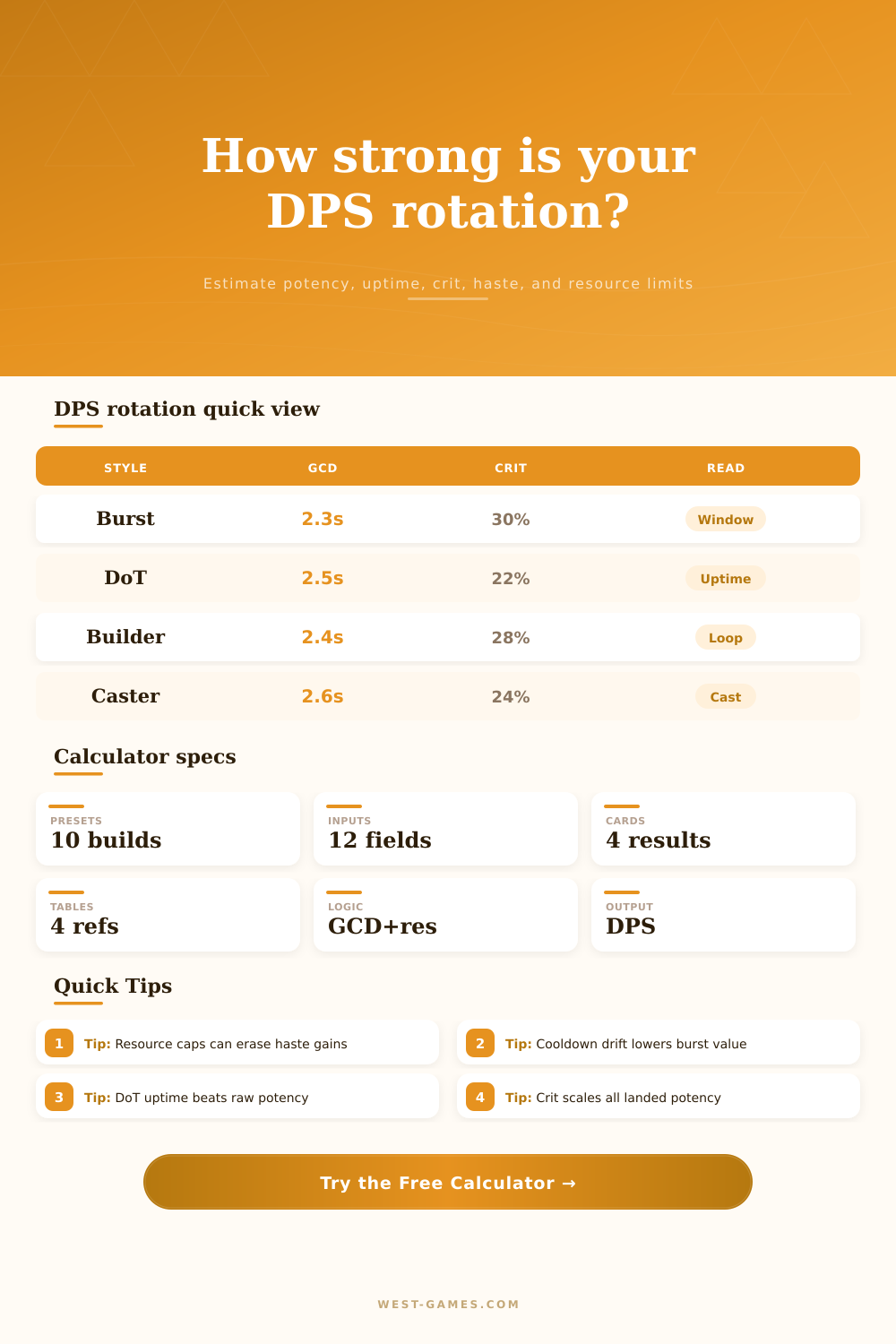
DPS Rotation Calculator
Estimate sustained and burst DPS from skill potency, cooldown timing, cast time, haste-adjusted GCD, uptime, crit expectation, and resource constraints.
Rotation model: the calculator chooses the slowest limiter among cooldown, cast lock, and haste-adjusted GCD, then applies uptime, quality execution, expected crit damage, burst modifiers, and resource sustain.
Rotation Breakdown
Limiter Read
Current Build
Uses your cooldown, cast, GCD, haste, crit, uptime, and resource settings.
No Resource Cap
Shows the result if the rotation can spend freely for the whole fight duration.
Plus 10% Haste
Adds ten haste points, then recalculates the GCD, cast lock, and spend rate.
Plus 10% Crit
Adds ten crit chance points, capped at 100%, to isolate crit scaling.
| Archetype | Burst mod | Sustain mod | Resource behavior |
|---|---|---|---|
| GCD Weaver | 1.10x | 1.00x | Minor clipping risk |
| Burst Cooldown | 1.35x | 0.94x | High spend windows |
| DoT Maintainer | 1.02x | 1.08x | Uptime dependent |
| Builder Spender | 1.18x | 0.98x | Cycle constrained |
| Channeled Spam | 1.06x | 1.03x | Drains steadily |
| Proc Chain | 1.22x | 0.96x | Variance heavy |
| Support Hybrid | 1.00x | 0.90x | Lower damage focus |
| Stationary Turret | 1.08x | 1.10x | Strong when planted |
| Quality | Damage factor | Clipping factor | Typical read |
|---|---|---|---|
| Low | 0.82x | 1.18x delay | Missed GCDs and drift |
| Medium | 0.92x | 1.10x delay | Playable but uneven |
| High | 1.00x | 1.00x delay | Clean planned loop |
| Ultra | 1.07x | 0.92x delay | Tight burst windows |
| Custom | 1.00x | 1.00x delay | Manual assumptions |
| Haste | 2.5s GCD | 2.0s GCD | Common issue |
|---|---|---|---|
| 0% | 2.50s | 2.00s | Baseline pacing |
| 10% | 2.27s | 1.82s | Cooldown alignment |
| 20% | 2.08s | 1.67s | More resource drain |
| 35% | 1.85s | 1.48s | Weave clipping risk |
| 50% | 1.67s | 1.33s | Often resource capped |
| Sustain | Meaning | DPS effect | Adjustment |
|---|---|---|---|
| 100%+ | Regen covers spend | No resource loss | Add potency or haste |
| 85-99% | Small deficit | Minor downtime | Trim low value casts |
| 65-84% | Noticeable drain | Rotation throttles | Add builder actions |
| 40-64% | Heavy starvation | Major DPS loss | Lower spend rate |
| Under 40% | Unsustainable | Short burst only | Rebuild the loop |
| Scenario | DPS | Casts/min | Limiter | What changed |
|---|
Rows recalculate from the active inputs so haste, crit, potency, cooldown, and uptime can be compared without changing the form.
A lot of times, you think you has a great looking damage number on paper, but it fails in the midst of raid mechanics. Why? It is raw potency, not effective output. Higher theoretical damage rotations don’t always outperform those that respect resource limits and uptime. The DPS rotation calculator makes those unclear idea clear: what is the burst and sustained estimate? It’s the connection between tooltip theory and practice. It connects the idea of DPS to it’s application in-game.
The tool forces you to consider friction of game itself. Stop stacking things that won’t come off cooldown simultaneously. Without double-checking whether it fuels rotation, most people stack either haste or crit chance. Maybe you even stack speed so your global cooldown is less than two seconds and then you’re sitting around waiting for mana to fill up halfway through the fight. It is a waste of gear slot.
Why Calculator Helps You Do More Damage
The tool does this by measuring how many resources it take to cast versus how quickly you gain them throughout length of an entire encounter. When your sustain falls under eighty-five percent, the throughput throttle back. Meaning: You just can’t spend as quick as you’d like. Which highlights where disparity lies between making yourself look good for five seconds vs. Sustaining four minutes.
Another silent killer is Uptime. While a DoT maintainer with 97% uptime and three damaging effects going could be outdoing a burst class most of the time. The burst class can line up the perfect opener but goes dark to do so. This is what archetype settings take into account when adjusting their modifiers.
Does your style depend more on proc chains? Long channels? Or maybe tight weaves? Rotations that is spammed over time have different risks for being clipped than a builders-spenders loop. Knowing where you fit helps you understand why changing one stat impacts you different from your friend playing a totally different character class.
My next point is execution quality. I don’t think enough people realize how important this is. They assume they execute perfect rotations, however swapping targets causes drift while moving around interrupts their casts. With the calculator, you can set your execution anywhere from low to ultra. Going for ultra means cleaner timing without as many missed global cooldowns. Medium adds in some realistic delays.
This isn’t an attempt to shame your skill level. It’s about setting expectations. Don’t project that you’ll perform at a top level if you’re just starting to learn the rotation. That’ll lead you down the road of false hope, it’ll also provide you with inaccurate gearing advice. Make sure you’re honest with your inputs. That way, the results will actualy reflect what you can do during a chaotic fight.
So, the page has some very nice reference tables. They nicely break out the modifiers for each of these terms. We have a table showing how haste affect various base global cooldowns. There are tables showing how your actual damage floor is dictated by resource starvation bands. If your potency isn’t high enough to make a difference then a 10% critical strike chance doesn’t necessarily mean 10% increased damage.
The comparison grid isolates those variable. It will tell you what happens when you add additional haste or remove the resource cap. That lets you test those trade-offs without having to risk it with your actual gear setup. You get to see exactly where you are being held back.
In conclusion: while it’s tempting to focus on the most powerful spell possible, in practice it’s more important to stay in rhythm. That means using the tool you have available. It means determining what rotation works for you based off how many spells you can cast without going dry. It also involves clipping abilities you don’t need. Run your numbers through it.
Feed it your current stats, then adjust the uptime according to how you move around during intense mechanics. Where do you get the biggest bang? Quite often, just plugging a little hole in your resource management can help out a lot. Focusing on marginal improvements to pure speed wouldn’t of helped as much. Let the numbers show you where you’re spending your time. It will allow you to stop guessing and start improving with precision.