🐾 Grow a Garden Pet XP Calculator
Estimate pet age progress from rarity, current and target age, passive XP rate, feeding boosts, helper pets, plot activity, events, offline time, and evolution goals.
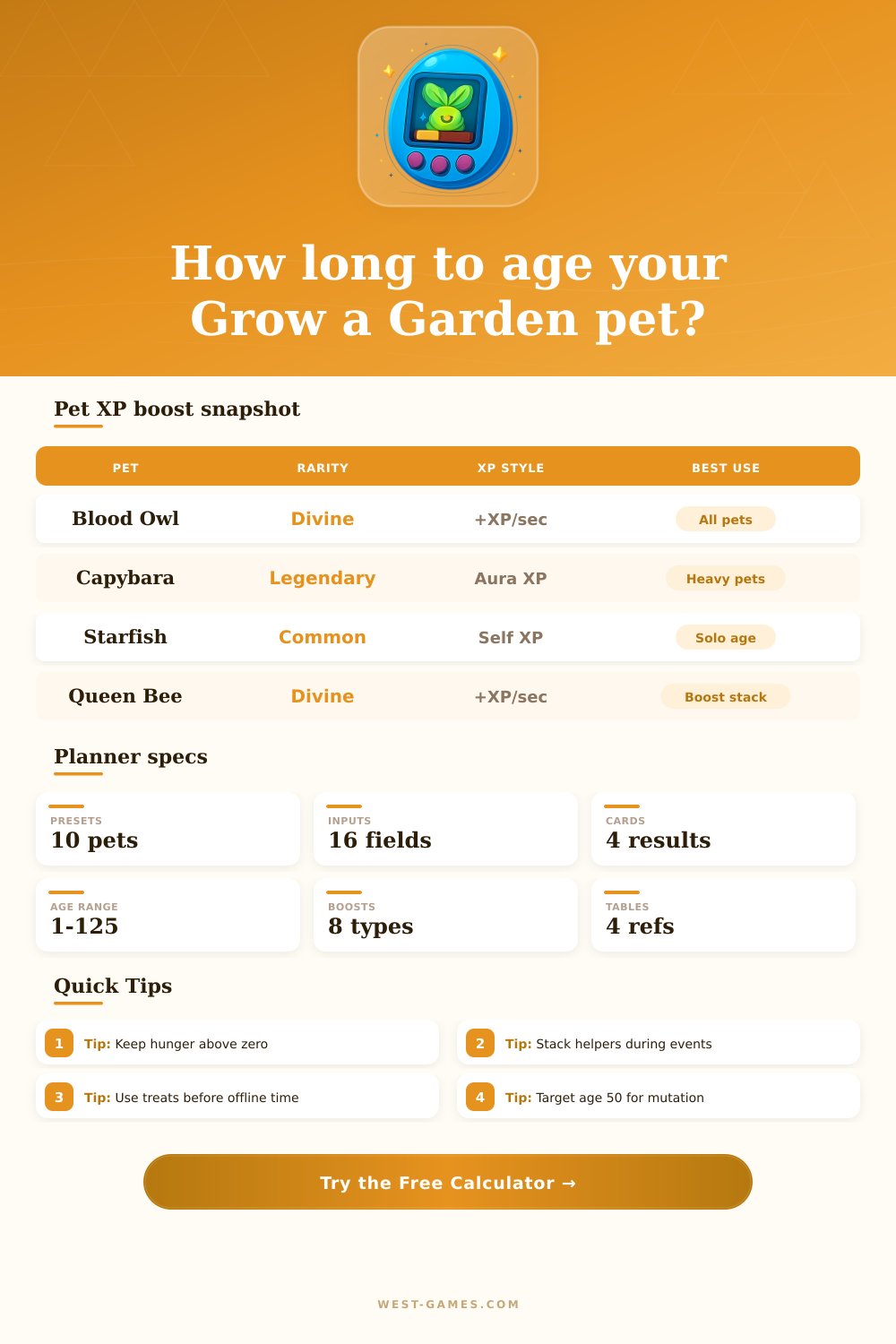
| Preset pet | Rarity | Modeled XP/sec | Planning role |
|---|---|---|---|
| Blood Owl | Divine | 1.10 | All-pet helper stack |
| Capybara | Legendary | 1.00 | Weight-scaled aura setup |
| Starfish | Common | 6.36 | Self-leveling benchmark |
| Queen Bee | Divine | 1.05 | Flat helper boost pair |
| Dragonfly | Divine | 0.85 | Age 50 mutation push |
| Disco Bee | Divine | 0.95 | Event sprint target |
| Mantis Shrimp | Mythical | 0.90 | XP punch planning |
| Firefly | Mythical | 0.80 | Midgame utility growth |
| Red Fox | Mythical | 0.78 | Offline age catch-up |
| Kitsune | Prismatic | 0.70 | Late high-rarity target |
Preset XP rates are practical starting points. Replace them with your observed in-game XP/sec when you have a stable garden layout.
| Target age | Total curve XP | Use case | Plan pressure |
|---|---|---|---|
| Age 10 | 2,095 | Early trait check | Light |
| Age 25 | 13,382 | Trait ramp target | Moderate |
| Age 50 | 54,069 | Mutation planning | High |
| Age 75 | 121,821 | High-age utility | Very high |
| Age 100 | 219,295 | Showcase pet plan | Extreme |
| Age 125 | 344,212 | Max-age planning | Long grind |
The calculator computes exact values with floor(20 x age^2.02), then subtracts current age XP and current progress.
| Boost source | Modeled effect | Best timing | Planner input |
|---|---|---|---|
| Queen Bee style helper | +0.35 XP/sec | Low-slot stack | Helper setup |
| Blood Owl style helper | +0.53 XP/sec | All-pet leveling | Helper setup |
| Capybara aura | 3 + 0.3 x kg | Heavy pet focus | Weight field |
| Full helper stack | Combined estimate | Event window | Helper setup |
| Feeding uptime | Percent bonus | Before idle time | Food bonus |
| Treats or XP items | Direct XP | Final level gap | Treat fields |
Use custom helper XP/sec for new pets, mutations, or stack interactions that are not represented by the default choices.
| Activity profile | Multiplier | Good for | Risk |
|---|---|---|---|
| Idle plot watch | 1.00x | Low-effort sessions | Slow age gain |
| Active harvest route | 1.15x | Normal farming | Missed helper range |
| Dense crop garden | 1.30x | Steady pet growth | Needs layout care |
| Mutation farming loop | 1.45x | Focused active play | Uptime varies |
| Event crop loop | 1.65x | XP event stacking | Short window |
| Compact helper circle | 1.80x | Pet XP training | Range dependent |
Activity multipliers are planning weights for uptime and range quality, not fixed official modifiers.
Eventually, you’ll have one pet and as it ages, you’ll harvest some crops. It sounds harmless enough. But then, long wait times becomes a problem once you reach higher rarity tiers. Going up a tier means going from waiting a day versus a week just because of how much XP gets stacked by being active vs. You are just sitting there idle.
And now that you’ve invested resources, you want to know what’s gonna happen. For example, this calculator does that math for whatever you have set up now. That’s so you don’t have to keep track of contradictory modifiers.
How to Level Up Your Pets Faster
Exponential growth drive the core mechanics here. Age 50 requires far more XP than age 10. Most player overlook that reality. They overestimate their forward momentum as if it were straight along a line, instead, the curve steepens. Unless you’ve got an optimized helper stack, you can no longer just sit back and passively gain enough points for mutation targets around age 50.
The tool plots that curve using a standard formula. It tells you how many hours offline or spent actively playing will close gap between your present level and your target.
Rarity changes the math entirely. Common pets levels up fast since they need less XP. A Divine or Prismatic pet require a big commitment. Enter the rarity inputs and the planner will tweak priorities to match.
Helper pets also count; they make your other pets more effective. A Queen Bee or Blood Owl parked alongside your target pet add flat XP/second. An Aura pet like a Capybara throws off an aura that increases in power based off weight. This is where garden layout comes into play. Helpers beyond range don’t trigger bonuses. Your projected time elongates unwisely. Enter those bonus types into the planner, and it’ll reflect your current garden setup instead of some theoretical best case scenario.
Another key factor is feeding uptime. When a pet’s hunger bar reaches empty it will not continue gaining XP. In practice, this means you might play a lot but then be away for long periods (offline) when they don’t eat anything. For instance if you have the game on for ten hours but only feed them once then you’ll probably find your efficiency is under half. There’s also a field for feeding uptime that allows you to be realistic with your approach.
Direct XP items/treats is included too. These come into play to fill tiny gaps at the tail-end of a leveling run. Feeding a treat just beforehand means that the pet remains full until your next offline session, allowing them to recieve passive XP while offline.
Temporary changes in events: Double and triple XP weekend raises your actual rate significantly. This multiplier can be applied using the calculator. Use it to determine if there’s any chance of reaching a milestone during the event period. Compare what time you have active vs when the bonus applies. In some cases, waiting for an event will work better for you different than grinding normally.
The page has reference tables that show this information. They show the net efficiency of various activity pattern (from light watch to intensive crop looping).
Grow a Garden, About Time and Attention: The key to leveling your pets is all about managing their attention & time. How do you get them as much time as possible? How do you know when to collect off-line vs actively farm? Knowing these numbers helps you nail down your exact mileage towards high ages. Everything starts to feel more structured once you know the dynamics of events, feeding, and helpers. Less waiting, would of been more like: this is a system I’m building for myself.