⛏ Minecraft XP to Levels Calculator
Convert Minecraft experience points into levels, plan level progress, mix mob farms, furnace banks, bottles o' enchanting, grindstone XP, and reserve levels for enchanting or anvil work.
Reliable and easy to build, but the rate is limited by spawn cycles and mob handling.
Higher XP per kill makes these strong when the kill chamber and item handling are stable.
Purpose-built End or Nether farms can refill level 30 repeatedly for heavy enchanting.
Furnace banks, bottles, and grindstone books are useful when you want XP on demand.
| Level range | Total XP formula | Example | Use |
|---|---|---|---|
| 0-16 | L^2 + 6L | Level 16 = 352 | Early tools |
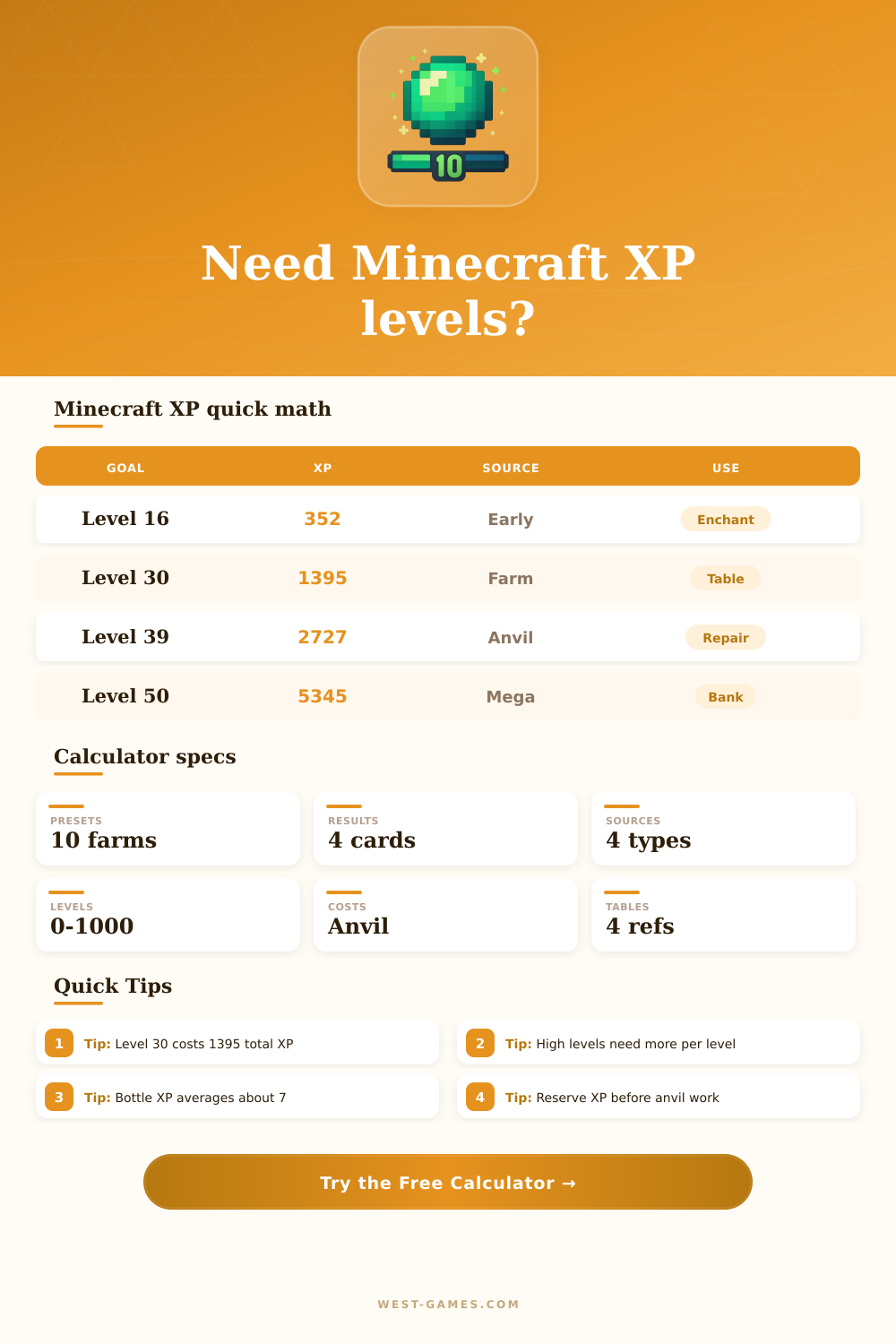
| 17-31 | 2.5L^2 - 40.5L + 360 | Level 30 = 1395 | Enchanting |
| 32+ | 4.5L^2 - 162.5L + 2220 | Level 50 = 5345 | XP banks |
L is the displayed Minecraft level. The calculator adds progress within the current level using XP-to-next-level.
| Current level | XP to next | Example | Why it matters |
|---|---|---|---|
| 0-15 | 2L + 7 | Level 10 needs 27 | Cheap early levels |
| 16-30 | 5L - 38 | Level 24 needs 82 | Enchant ramp |
| 31+ | 9L - 158 | Level 39 needs 193 | Costly banking |
A 3-level enchant at level 30 consumes more raw XP than 3 levels at level 10, so cost reserves are calculated around your target level.
| Source | Typical XP | Calculator lane | Planning note |
|---|---|---|---|
| Zombie, skeleton, spider | 5 per kill | Mob | Classic spawner baseline |
| Blaze | 10 per kill | Mob | Strong Nether farm value |
| Guardian | 10 per kill | Mob | High output when automated |
| Bottle o' enchanting | 3-11 each | Bottle | Average is about 7 XP |
| Grindstone disenchant | Variable | Grindstone | Depends on enchantments |
Mob XP assumes player-credit kills where XP orbs are actually created and collected.
| Smelted item | XP each | Good use | Input field |
|---|---|---|---|
| Cactus | 1.0 | XP bank arrays | Furnace XP |
| Cooked food | 0.35 | Passive survival XP | Furnace XP |
| Dried kelp | 0.1 | Fuel loops | Furnace XP |
| Stone | 0.1 | Builder storage | Furnace XP |
| Ore smelts | Variable | Manual mining haul | Furnace XP |
Stored furnace XP is released when items are removed manually or by eligible collection behavior in your edition and setup.
| Use case | Displayed cost | Raw XP behavior | Calculator handling |
|---|---|---|---|
| Level 30 enchant | 3 levels | Consumes levels from your current position | Enter 3 levels and the number of enchants |
| Book combine | Variable anvil levels | Higher displayed levels are more expensive at high XP levels | Enter average anvil level cost and count |
| Rename only | Usually low | Small but still level-based | Use 1 level if planning many renames |
| Too expensive | 39+ in survival anvil | Cannot complete in normal survival | Use 39 as a warning threshold |
The reserve estimate calculates raw XP needed to pay level costs around the target level, then adds it to the grind target.
With just some stone tools and a healthy fear of dark, you stand in front of a freshly built enchanting table. You’re aware that you must reach level thirty to acquire any good books, but the tiny number hovering over your head might as well be a mountainside without a trail map to guide you. No one seems able to tell you exactly how quickly you’re progressing or how high ascent will be, which can make it feel like an endless grind. Kill zombie after kill zombie, and before you know it, its all been for nothing. You’re still sitting at level twelve and have wasted half an afternoon.
Most people gets thrown off by the non-linear scaling of their Minecraft experience points. Levels start coming fast and easy early on, creating a deceptive illusion that they’re making headway. You think every mob you kill advance you equally, but the game actualy changes the math as you go. As soon as you reach level sixteen, the leveling process begin costing more. The cost keeps rising until you pass level 30, at which point progress becomes entirely vertical. This explains why many players feel like they’re doing nothing productive late in the game, even though it was so productive early on.
How to Get More XP in Minecraft
Spamming your sword till the bar fills up is boring and inefficient though. Instead, balance out your different sources of XP like they’re individual income streams. While mob farms are a reliable source of steady cash, they will eventualy hit a cap due to the number of kills per hour based off chunk loading and spawn rate. Furnace banks, however, hold potential energy. They allow you to smelt hundreds (or even thousands) of coal/wood/cactus/etc. You can smelt blocks over a few days before needing to use that XP during a large enchanting session. It’s this storage mechanic that allows you to differentiate between active grinding vs passive farming.
No need to figure out conversions or draw curves. The calculator does that for you. Just enter in what you’re farming from your farm(s), and what your current situation is. It will look across all of those lanes of inputs at the same time and break them out based on your individual situation. Not only that, it takes into account the value of every input source relative to one another, so it tells you not just “kill x number of mobs,” but how much that contributes relative to other sources. Why? Because if you rely on one thing, say a mob farm, you’ll bottleneck yourself. Sometimes you might be able to use an old piece of gear on a grindstone, or make a few bottles of enchanting material, which gets you there quicker than waiting around for more mobs to spawn.
Of special note are bottles of enchanting. On average, they grant about seven XP each, though they can range from three to eleven. That doesn’t sound like much, but when you’re carrying a pile of them from exploring abandoned portal ruins or mining diamonds, it becomes a quick way to level up. The tool calculates that variability into the equation for you; no need to calculate the variance yourself.
And speaking of variance, most people mess up here by spending valuable hard-earned levels at an anvil. Combining books and repairing gear cost you levels straight-up (and the more experienced you become), the higher that price is. Avoiding wasted effort by going three levels down only to lose them all when you get enchanted is easy if you plan for it. Going one level over what you intend to hit lets you take the damage without slipping back down a level. That’s why I suggest aiming one level above. The curve becomes vertical and here are the precise numbers (on the page) in tables so you can see exactly how much more it takes to get to level 50 versus level 20. You can adjust your goals accordingly, setting realistic expectations rather than blindly farming as if there were no resource constraints at all. You manage a budget pool of resources with defined spend thresholds.
The last limitation that few guides consider is time. It’s one thing to know you need 500 XP; it’s another to realize it’ll require 40 minutes of game play to earn it. Some farms produce at higher rates different than others. Some include downtime for when you have to walk away from the keyboard for real life reasons (or because you’re AFK). The plan becomes possible when you account for these realities. Pair a blaze farm that requires little effort but produces at a high rate with a bottle stash that only takes up a small amount of space.
We’re no longer chasing numbers. Instead, we are improving our approach. XP becomes a reasonable budget instead of an arbitrary score on a number line. This means you can see the trail and know where you need to go. From the bottom of the mountain, it’s still plenty high (but there’s a path now).