Pokemon Level Calculator
Plan a mainline Pokemon grind with species growth rate, current total EXP, target level, EXP Share behavior, traded and Lucky Egg bonuses, battle yield, candies, evolution timing, and a full team leveling estimate.
Training Breakdown
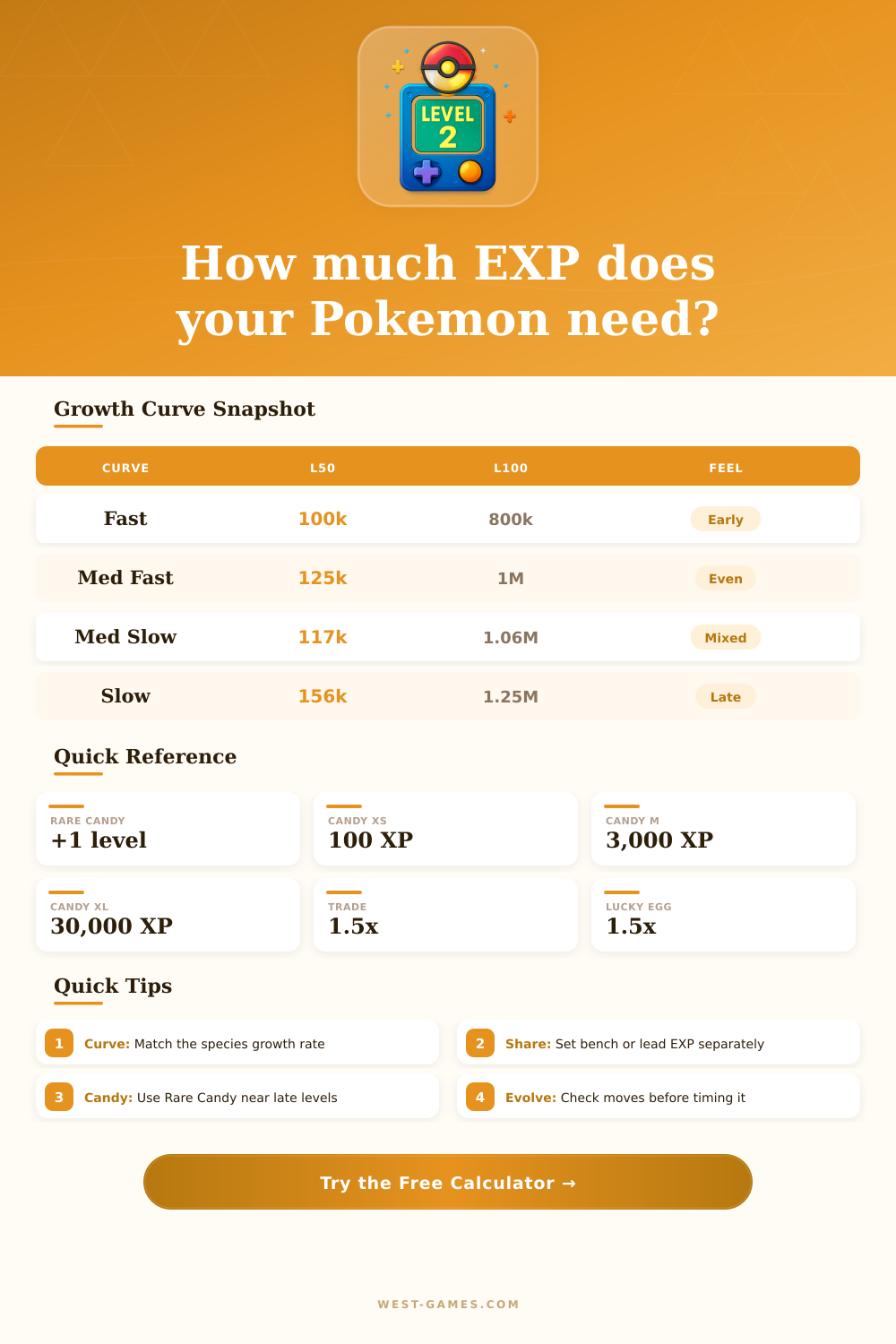
| Growth Rate | Total EXP at Level 50 | Total EXP at Level 100 | Training Meaning |
|---|---|---|---|
| Erratic | 125,000 | 600,000 | Awkward middle stretch, extremely efficient finish to 100. |
| Fast | 100,000 | 800,000 | Low total requirement; candies go a long way at every stage. |
| Medium Fast | 125,000 | 1,000,000 | Straight cubic curve used by many familiar mainline species. |
| Medium Slow | 117,360 | 1,059,860 | Friendlier near mid-game, then climbs sharply late. |
| Slow | 156,250 | 1,250,000 | Heavy late training curve for many strong or rare Pokemon. |
| Fluctuating | 142,500 | 1,640,000 | One of the toughest level 100 plans; save big candies for late. |
| Item | EXP Value | Best Use | Calculator Treatment |
|---|---|---|---|
| Exp. Candy XS | 100 EXP | Fresh catches, early route captures, and tiny cleanup gaps. | Flat EXP added before battle count is calculated. |
| Exp. Candy S | 800 EXP | Low-level bench Pokemon and short move checkpoint pushes. | Flat EXP applied to the selected growth curve. |
| Exp. Candy M | 3,000 EXP | Mid-game team balancing before a gym, trial, or rival fight. | Flat EXP applied after current total EXP. |
| Exp. Candy L | 10,000 EXP | Late-game gaps where wild battle yield starts feeling slow. | Flat EXP, useful before estimating remaining battles. |
| Exp. Candy XL | 30,000 EXP | Postgame grinding, level 100 plans, and slow growth species. | Flat EXP; the calculator subtracts it from target need. |
| Rare Candy | One level | Late levels, evolution timing, or moving past a steep EXP gap. | Simulates level jumps from the current post-candy level. |
| Opponent Preset | Base EXP | Why Trainers Use It | Planning Note |
|---|---|---|---|
| Blissey | 635 | Very high base yield when available in the chosen game. | Excellent for Lucky Egg or traded Pokemon calculations. |
| Chansey | 395 | Classic high-yield target in several mainline routes. | Strong for repeatable route loops and catch-up work. |
| Audino | 390 | Known training target where shaking grass encounters exist. | Good preset for Gen V style leveling estimates. |
| Dragonite | 324 | High-evolution opponent with a strong battle yield. | Use for elite trainer rematch style calculations. |
| Raichu | 270 | Solid evolved opponent for mid and late-game routes. | Moderate yield when high-EXP targets are unavailable. |
| Gyarados | 194 | Common evolved opponent in many games and rematches. | Useful for water route or trainer rematch approximations. |
| Mechanic | Typical Multiplier | Use in This Calculator | Training Implication |
|---|---|---|---|
| Battled directly | 100% | Full selected battle EXP before optional bonuses. | Best for the Pokemon that must reach a checkpoint first. |
| Bench via party EXP Share | 50% | Half-rate estimate for passive leveling plans. | Great for team leveling, slower for one urgent evolution. |
| Traded Pokemon | 1.5x to 1.7x | Applied after the base battle yield is estimated. | Can cut repeated battles dramatically on catch-up projects. |
| Lucky Egg | 1.5x | Stacks with trade and affection multipliers in the estimate. | Use during high-yield loops, not tiny low-level battles. |
| Evolution timing | Level based | Checks whether the plan crosses your chosen checkpoint. | Delay only when you are intentionally waiting for a move. |
Sometimes you’ll find yourself in this postgame routine without even knowing what to expect: How many battles will I have to fight? You think to yourself that grinding mean standing there and battling until your experience bar is full. If you had unlimited time, that would be fine. But if you’re trying to evolve something before your phone dies or if you want to improve your six-Pokemon team for competitive play, thats just not going to cut it.
Planning… Not clicking. Is where all the work come into play. That brings us back to equation: the most important thing is your species’ growth rate. One hundred thousand total experience points will get you to level fifty if it’s on a Fast curve; more than one hundred and fifty thousand if it’s on a Slow curve. And the difference grows pretty dramaticer the closer you are to level one hundred. To cap out, Slow curve take a little under one point two five million total experience, while some Bug and Ghost types has changing curves that can ask upwards of one point six million.
Plan Your Training Time
And remember, it doesn’t just grow at a linear pace. High-curve late-game grind are exponentially worse. Knowing the difference helps you avoid picking the legendary that grows slowly when what you need is an early gym badge-getting utility monster.
Defeating enemies in battle is not the sole way to obtain experience points. There’s also a complex combination of passive share mechanics, item use, and battle yield. Rare Candies are the nuclear option here. It completely ignores the curve, instead giving players a complete level jump. This means it’s extremely efficient for filling small gaps around level one hundred. At this point, each level cost thousands of experience points. But it’s inefficient earlier on. You’re wasting a powerful resource on a tiny gain if you use a Rare Candy to boost from level five to six.
A better compromise is found with Medium and Large Exp Candies. These items gives flat gains that can help smooth out the jagged edge of inconsistent battle yields. All of this gets plugged into calculator which does all the work and spits back an expected result. Does your Pokémon have a lucky egg on? That increases your experience bonus even more. Was it traded in? There is an even bigger experience bonus there. In most games these days, those bonuses multiply one another. So what would be a moderate amount of experience from a fight becomes a decent chunk over time.
Want to level up some bench Pokémon with the EXP Share? The calculator takes that into account too since they only get a portion of the experience compared to whoever’s actualy fighting. Now you can determine if it makes sense to throw that Pokemon into the fight immediately, or continue training them while they’re on the bench.
Another strategy often forgotten by trainers involve evolution timing. Certain evolutions gains key moves only when they evolve, and some keep strong abilities up to final seconds before their transformation. Evolving prematurely or waiting too long can cause you to miss out on a crucial move. Having a clear stopping point in your plan means you’ll know exactly when to halt the process. That’s particularly valuable for technical competitive teams which rely on a single unique move that makes them viable.
It gets more complicated when you’re playing as a team. Suddenly it’s no longer about leveling a single monster, but juggling six different growth curves that start at different levels. With the tool, you can see how many fights it will take to get everyone to the same level. From there you can determine if you want to spend all your resources getting your primary attacker to max level ASAP or thin out experience points evenly and passively share it around. It takes something that is overwhelming and turns it into a step-by-step process that’s doable.
At the end of the day, then, grinding isn’t as much about stamina as it is about making the most of your time. If you’re after something, whether it’s a handful of levels for that last stretch to finish off a Pokédex, or a final push before a competitive tournament, what you don’t need to do is waste time wandering around unsure if the next battle will get you where you want to go. Knowing exactly how many battles away from your goal you are is what takes the wild guessing out of the equation. It’s the line between stumbling through the grass and sticking to a carefully planned strategy. And all it takes is understanding those numbers behind that progress bar.