🃏 MTG Power Level Calculator
Score a Commander or decklist by format pressure, commander profile, fast mana, tutors, combo speed, interaction, curve, consistency, proxies, and table fit.
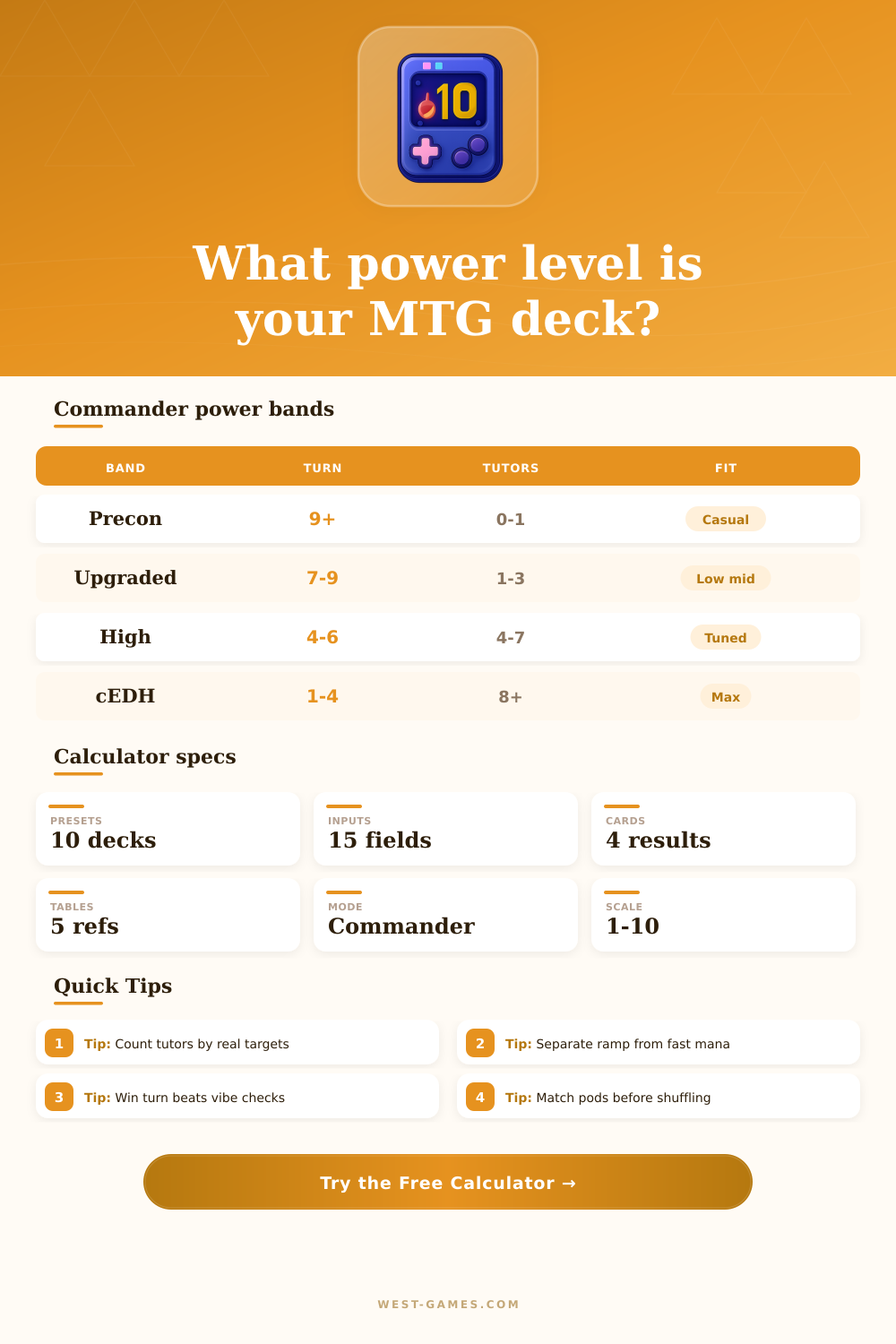
Precon Night
2-4Theme-first lists, slow wins, few tutors, forgiving interaction, splashy turns welcome.
Upgraded Casual
4-6Cleaner mana, real removal, some tutors, engines matter, wins usually after setup.
Tuned High Power
6.5-8Efficient ramp, compact wins, strong recursion, protection, and proactive answers.
cEDH Practice
8.5-10Fast mana, dense tutors, free interaction, turn-three pressure, resilient stacks.
| Band | Typical Score | Win Window | Common Profile |
|---|---|---|---|
| Precon plus | 2.5 to 4.5 | Turn 9+ | Theme-first, low search, board-driven wins. |
| Casual upgraded | 4.5 to 6.2 | Turn 7 to 9 | Better ramp, several answers, limited redundancy. |
| Focused high power | 6.3 to 8.2 | Turn 4 to 6 | Compact win lines, efficient interaction, clear mulligans. |
| cEDH table | 8.3 to 10 | Turn 1 to 4 | Fast mana, premium tutors, free stack interaction. |
| Tutor Count | Quality | Power Signal | Pod Meaning |
|---|---|---|---|
| 0 to 1 | Narrow | Low | Games vary heavily by draw order. |
| 2 to 4 | Mixed | Medium | Deck can find engines but not always wins. |
| 5 to 8 | Flexible | High | Win lines or silver bullets appear often. |
| 9+ | Premium | Extreme | Deck behaves like a redundant combo shell. |
| Mana Package | Examples | Score Effect | Watch Point |
|---|---|---|---|
| Casual rocks | Signets, Talismans, Cultivate | Stable | Good fixing but not explosive. |
| Early burst | Sol Ring, Vault, Grim Monolith | Strong | Creates turn-two engine starts. |
| Zero-mana starts | Crypt, Moxen, Lotus Petal | Very high | Raises mulligan and combo pressure. |
| Commander engine | Kinnan, Selvala, Magda | Stacking | Command zone can double ramp value. |
| Pieces | Deck Feel | Stack Role | Table Signal |
|---|---|---|---|
| 0 to 5 | Proactive only | Rare answers | May fold to faster combo. |
| 6 to 10 | Casual balanced | Some removal | Normal mid-power protection. |
| 11 to 17 | High power | Frequent answers | Can stop engines and fight combos. |
| 18+ | cEDH dense | Stack battles | Free counters and hate define games. |
| Archetype | Power Pattern | Common Bottleneck | Table Conversation |
|---|---|---|---|
| Battlecruiser | Mana into large threats | Slow recovery after wipes | Ask if haymaker games are welcome. |
| Aristocrats | Incremental drain with recursion | Graveyard hate and exile effects | Explain combo loops if present. |
| Spellslinger | Cantrip chains and storm pivots | Rule of Law and hand pressure | Declare if storm turns can win at once. |
| Stax | Stops resources while advancing board | Threat density and pod tolerance | Name the lock pieces before shuffling. |
| Turbo combo | Fast protected win attempts | Card disadvantage after failed pushes | Belongs at high-power or cEDH tables. |
Opening a brand-new Commander deck in front of your buddies at your LGS induces a certain type of social awkwardness. Sure, you’re eager to bust out your new favorite commander, but god help you if you end up being that guy who steamrolls three opponents before turn six. And good luck if you don’t have the cards to follow through on your initial lead, because then you get to look like an idiot with a thematically awesome list that just doesn’t quite finish games.
The MTG power level calculator allow you to measure the social tension between interaction density, fast mana, tutors, and deck speed. This transforms vague gut-feeling assessments of your lists strength into real measurements you can bring up with your pod before anybody shuffles things up.
Why You Need a Deck Power Calculator
The first thing most players will do is eyeball the commander and attempt to find its relative power level. That’s a trap. Ninety-nine cards can be filled with filler. Having a precon face doesn’t mean it’s going to be a slow game, any more than having a cEDH staple means it’s going to be a fast one. The calculator makes you look beyond the command zone and instead at what’s actualy driving your wins: the actual engine behind your decks.
Why? It wants specific numbers of fast mana, such as Mana Vault or Sol Ring (zero or one cost artifacts that allow you to do things ahead of curve), and tutors, because those are the real tell-tale signs of consistency. Land ramp is another beast altogether. Knowing the difference is important because one ramps up your early game and the other merely fuels your late game.
Even more should go to tutors. Most people forget that the tool weight tutors by their quality. Four skinny tutors that just look for certain creatures aren’t the same thing as four versatile tutors that can find any land or artifact. One guarantees reliable execution of one win condition. The other gives you options if your plan doesn’t work out. Quality tutors adjust the consistency index based off how broad and inexpensive their search effects are. That mirrors actual play in which being able to be flexible tend to save the game far more often than pure power.
There’s also the element of speed. People perceive certain decks as slow when in fact they is not very interactive (and yes, “winning on turn ten” counts as fast). How does the calculator take that into account? Well it takes into account how many answers you have and what turn you tend to win on. Sure a deck might be able to win on turn six without any answers for counterspells but having more protection and removal density increases its effective power level substantialy. The extra layer of defense helps it survive against metagame threats that decks focused on a single theme just can’t handle.
This is also true about proxy access. You’ll note that some staples won’t fit into your list depending if you run proxies or not. To account for this, the calculator assumes that having complete proxy access increase your consistency limit. Your game plan could be identical to someone else who has budgetary concerns. However, they may not get a necessary piece of tech because it’s out of reach financially. That doesn’t mean one person is superior to the other. It simply takes into account that people have different resources when it comes to card selection.
At the end of the day, understanding your deck’s power level isn’t really about competing with anyone; it’s about respecting your fellow players. It’s about having a good time at the table. And sometimes that involves going all out in a cEDH pod. Other times that involves scaling back so that everyone gets their turn. These metrics allow you to have those conversations on an objective basis. Are you looking at the numbers? Do they fit the vibe? Does this deck get you there? Because if not, then you avoid any mismatched expectations before the first coin has been flipped.
Good decks aren’t only powerful. Good decks fit the environment. Casual pods are dead to a turn three win condition. High-speed pods gets boarded over and over. Eventually, the slow value engine is silenced and goes nowhere. Hitting that sweet spot is a process of honest self-reflection, and that’s where the calculator comes in. Breaking your deck down into measurable metrics like interaction, speed, and consistency takes the guesswork out of it so you can focus on what really matters (playing well with others).
You should of used this earlier.