💎 D2R Crafting Calculator
Plan Blood, Caster, Hitpower, and Safety crafts with crafted ilvl, affix level, required level, expected attempts, and material counts.
| Crafted ilvl | Random affix odds | Expected affixes | Planning use |
|---|---|---|---|
| 1 to 30 | 40% one, 20% each two to four | 2.20 | Low-level crafts with controlled affix pool |
| 31 to 50 | 60% two, 20% each three to four | 2.60 | Mid-level crafts with lower required level |
| 51 to 70 | 80% three, 20% four | 3.20 | Strong crafts without guaranteed four affixes |
| 71 to 99 | 100% four random affixes | 4.00 | Endgame Blood, Caster, Hitpower, and Safety rolls |
| Step | Formula | When it matters | Output |
|---|---|---|---|
| Craft ilvl | floor(clvl / 2) + floor(input ilvl / 2) | Every craft | Item level used for affix checks |
| Quality floor | effective = max(crafted ilvl, qlvl) | High qlvl elite bases | Prevents low effective level on elite items |
| Magic level | alvl = effective + magic level, cap 99 | Circlet, coronet, tiara, diadem bases | Raises affix access directly |
| No magic level | If effective < 99 - floor(qlvl / 2), use effective - floor(qlvl / 2); otherwise use 2 x effective - 99 | Most gloves, belts, boots, rings, amulets, and shields | Final affix level, minimum 1 |
| Family | Popular target | Rune | Perfect gem | Fixed craft identity |
|---|---|---|---|---|
| Blood | Heavy, Sharkskin, or Vampirebone Gloves | Nef | Ruby | Crushing Blow, life leech, and life on gloves |
| Blood | Ring or Amulet | Sol or Amn | Ruby | Life leech plus life-oriented fixed stats |
| Caster | Amulet | Ral | Amethyst | 5 to 10% Faster Cast Rate, mana regen, and mana |
| Caster | Light, Sharkskin, or Vampirefang Belt | Ith | Amethyst | Faster Cast Rate, mana regeneration, and mana |
| Hitpower | Chain Gloves, Heavy Bracers, or Vambraces | Ort | Sapphire | Knockback, Frost Nova chance, and attacker damage |
| Safety | Amulet, shield, helm, or boots | Thul, Nef, Ith, or Ort | Emerald | Damage reduction, magic damage reduction, and defense-style fixed mods |
| Source | Input ilvl model | Best use | Risk note |
|---|---|---|---|
| Known drop | Use the exact monster, area, or mule-tracked ilvl | Controlled low and mid-level crafting | Wrong stored ilvl changes both affix level and affix count |
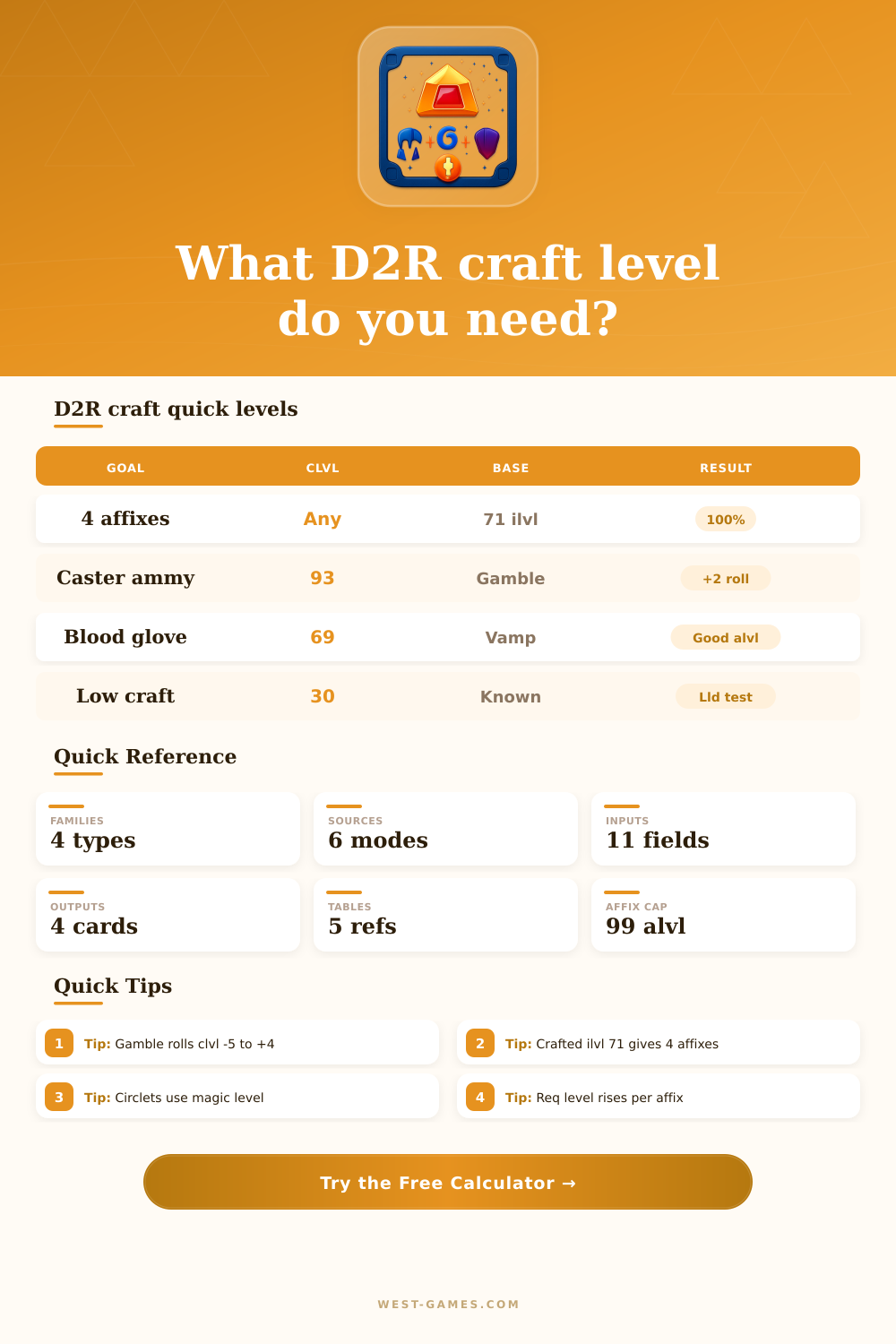
| Gambled worst roll | Character level - 5 | Guaranteed amulet planning | Requires higher clvl to guarantee top affixes |
| Gambled average roll | Character level | Bulk expectation estimates | Individual gambles still vary from -5 to +4 |
| Vendor item | Character level + 5, capped at 99 | Shop-able magic bases | Normal difficulty vendors can be act-capped |
| Base example | qlvl | Magic level | Calculator effect |
|---|---|---|---|
| Amulet or ring | 1 | 0 | Affix level tracks crafted ilvl closely |
| Vampirebone Gloves | 63 | 0 | Elite qlvl affects low and mid crafts |
| Vambraces | 69 | 0 | High qlvl can lift effective level before alvl math |
| Diadem | 85 | 18 | Magic level pushes affix level to 99 very easily |
With bloodstones, magic amulets, and standing on top of Lazarus, you look at your rolls. Will this one be it? Will I get that plus two skill I’m rolling for? This roller coaster of dread and hope connect with all those who play end game content. The math behind those rolls feels opaque until you actualy break it down.
You are throwing it at the wall hoping something sticks, that’s not how you manage resources in Diablo II Resurrected, and it shouldn’t be. So, who cares? That’s what the calculator up top is for. You plug in the info: what is your source of magic gear? What is a base item? And it tells you if you can gets the affixes you want. It even lets you know if you’re burning materials for nothing.
How to Use the Crafting Calculator
Why do I say that? People don’t understand basic math behind this system. It’s actualy very straightforward. During crafting, there’s no number shown inside for your internal levels. Instead, your character level and the magic base item level is averaged together. Then that number are rounded down to a new value. That becomes the crafted item level and that determine how many random mods you’ll get. It will even determine what kinds of stats might be on final item.
This is where most people screw up. They assume that if they hit the correct gem and rune, it’ll be good to go. Nope. I have often seen people get what looks like a great lucky roll, only to end up with low-tier affixes because their input levels were too low. It doesn’t matter how good it look on paper.
With the tool you can play around with various sources. Do you want to gamble at a certain character level? Maybe you’ve got some stuff stashed away on a mule? What about using stored items from a mule? All of that becomes clear when you run an example through and see exactly where your effective item level falls. Are you in the sweet spot for four random affix? Or are you only going to get three? That makes a huge difference different than the odds of getting any given combo.
Just as much care should of been given to planning your materials as you do your rolls. Before you click away you’ll want to know what bases, jewels, gems, and sets of runes you have in hand. The calculator will give an estimate of how many times you are likely to get what you’re after. That’s based off your hit chance for the affixes you want. So no more running out of perfect amethysts midway through a go. And it allows you to gauge whether or not it’s even worth grinding up more materials. Or maybe switch to another recipe that fit what you have lying around.
This is laid out well in the reference tables on the page. For those interested, they show the raw data behind the scenes. They break down the item levels and range of items and how it affect affix counts. They describe the details of circlets having magic level bonuses. That’s behind the scenes stuff that isn’t really necessary to use the tool well.
To use it well, you only have to know what you’re optimizing for. Do you want to get a specific amount of skill bonus on an amulet? Or maybe you want to max out your resistances on a helm. Depending on what you’re after, the inputs vary a bit. The calculator will adjust to those changes accordingally.
Crafting can make it all too easy to go down a rabbit hole. “Oh, I’ll get those plus two skills.” But you forgot you need a certain level. And now that item will be locked away from another character. Or maybe you overlooked the fact that gambling introduces some variability to your outcomes. Your worst case scenario could be worse then you think. The tool makes you face those variables beforehand. Before you drop one bloodstone.
What was once a random process becomes an ordered experiment. Each click yields a known outcome. It’s math. But that’s only part of the craft. There’s also the psychology of it that no calculator will ever fully convey. When an item misses, you must still be able to let go of it. Letting go of a nearly perfect roll isn’t easy. But holding onto it means wasting both hope and space. Knowing your odds ahead of time allows for distance with each individual attempt. Hundreds of rolls later, you’re playing the percentages. You’re not gambling on a miracle in one instance.
So, before you race off to town, do some quick calculations. Check your stockpile against your expectations. If the numbers tell you you’re not ready, make adjustments now. You may save yourself an hour of aimless grinding. Or perhaps it will allow you to snag that perfectly suited bit of equipment without spending too much.
In Diablo II, skill is often as good as luck. Knowing precisely what you seek before seeking it out can be the deciding factor.