⚒ Mortal Online 2 Crafting Calculator
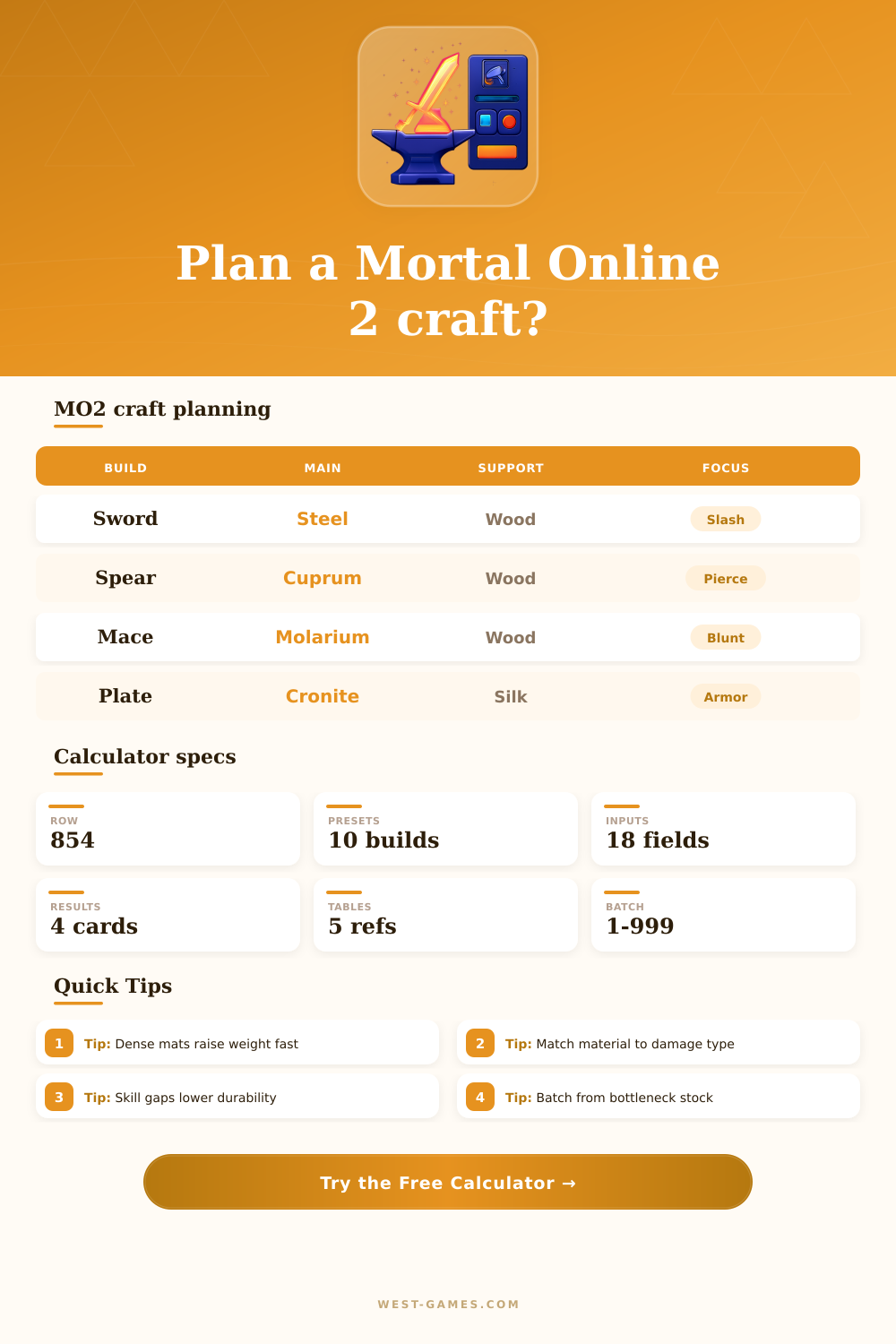
Estimate MO2 weapon and armor part composition, material density, skill quality, durability, weight, damage or protection output, resource totals, and batch limits from your stockpile.
| Material | Relative density | Strong use | Planning note |
|---|---|---|---|
| Steel | 4.6 | Slash, plate | Good all-round weapon and armor baseline, but not light. |
| Cronite | 3.7 | Hybrid armor | Lighter high-grade metal profile for builds that care about weight. |
| Tungsteel | 5.8 | Heavy damage | Strong but dense; check stamina and carry implications. |
| Cuprum | 3.9 | Pierce | Useful starter metal for thrusting profiles and experiments. |
| Molarium | 4.9 | Blunt heads | Dense animal material that suits mace-style impact planning. |
| Silk / ironsilk | 0.6-0.9 | Support | Light support materials help keep armor pieces wearable. |
The calculator uses relative density numbers so you can compare builds quickly. Replace them with your own observed weights when precision matters.
| Pattern | Main part | Support | Core or handle |
|---|---|---|---|
| Longsword | Blade material drives slash | Small binding share | Wood handle controls weight |
| Spear | Tip material drives pierce | Low support share | Long shaft matters |
| Mace | Head material drives blunt | Small wrap share | Handle weight matters |
| Greatblade | Large main part | Moderate fittings | Core tunes final mass |
| Bow | Wood body dominates | Little or none | Stave/core quality matters |
MO2 weapon crafting is shape and material dependent. Use part units to mirror your chosen blade, head, hilt, or bow recipe.
| Armor type | Main material | Support material | Best check |
|---|---|---|---|
| Plate | Metal shell | Silk, wool, leather | Weight versus protection |
| Brigandine | Scales, metal, leather | Padding or textile | Mixed mitigation |
| Soft armor | Leather or textile | Silk or wool | Low weight movement |
| Hybrid set | Light metal blend | Light support | Magic and stamina room |
| Skill grind set | Cheap main mat | Cheap support | Units per skill gain |
Armor support can shift mitigation, density, and durability. Keep support units visible when planning full sets.
| Effective skill | Quality band | Expected outcome | Use case |
|---|---|---|---|
| 0-39 | Rough | Low quality, low durability | Learning or disposable tests |
| 40-64 | Serviceable | Usable but inconsistent | Starter gear and skilling |
| 65-84 | Reliable | Good output and durability | Routine guild crafting |
| 85-100+ | Specialist | High quality with less loss | PvP and premium orders |
The effective skill score blends crafting skill, relevant material lore, finishing skill, station bonus, and recipe complexity.
| Resource check | Formula used | What it catches | How to improve |
|---|---|---|---|
| Main stock | Stock / waste-adjusted main units | Blade, armor shell, head, or body shortage | Farm or reduce main part units |
| Support stock | Stock / waste-adjusted support units | Padding, binding, textile, or backing shortage | Switch support or lower batch count |
| Core stock | Stock / waste-adjusted core units | Handle, shaft, grip, stave, or core shortage | Use lighter core or gather more wood |
| Risk buffer | Waste plus quality push | Failed rolls and experimental slider losses | Raise skill or choose standard finish |
Batch possible uses the lowest material stock limit, then compares it with your planned craft count.
Mortal Online 2 makes it so that you frequently end up with the materials for a single worthwhile sword but instead make three weak swords. That’s because the game doesn’t reward your gut instinct. Instead, it penalizes it by punishing you if skill levels doesn’t align with difficulty of recipe and heaviness of the materials. It’s all about planning here rather than guesswork. This isn’t a game where you wait out progress bars. Crafting is a mathematical formula hidden behind old-timey production lines.
Before you spend those precious Tungsteels and Cronites, you should of had an idea of what you’re getting into: what are the stats? How much can I get from it? How will it affect my final gear? That’s the heart of the balancing act: How much do you want your gear to help versus how much does it weigh? A weapon made off dense materials like Tungsteel will deal lots of damage, but its weight are huge. Once that gets too hefty, you swing around in combat at a rate where stamina deplete and the extra damage isn’t worth it. On the flip side is lighter materials such as copper or wood-based bow, which give a speed bonus but stop short in terms of PvP, especially when facing off against someone with better gear in later game.
How to Plan Your Crafting Success
Plug in your skills and materials, and let the calculator take care of the rest. No more guesswork about whether replacing silk support pad with Ironwool would make your end result significantly heavier. Simply understand what all these variables can really translate into in terms of keeping you alive. The thing most players don’t consider are the support materials. They are not where the stats are, which is on the blade or the armor plate. But the support and core materials determines the durability and weight threshold. You could slap a dense Tungsteel head on your sword and be like “ooh look at me,” but then use a really light wood for the handle and now the balance go haywire.
The system fixes that with the ability to change each part independently. Why? Cause having a super-heavy head on a really light handle makes the thing feel awkward, and breaks more easly when stressed. That’s what folks mess up on: optimizing for damage and ignoring the structure of the entire object. But it’s not just about what you have; it’s also about how good you are at using them. If your craft skill isn’t matched by your material knowledge, you’ll get poor rolls and waste a lot of tries. The tool factors in your crafting and lore skills (along with finishing) to give an effective quality score estimate. This allows you to determine whether to roll something standard or try for a masterwork finish.
If your lore is low, do NOT attempt to make a masterwork item. That’s a sure-fire way to break off a bunch of your precious shards while wasting a pile of pricey mats. Instead, take some time grinding out those relevant sub-skills on lower-value items. Once you’re confident that you’ve got the right skill profile, you can start tackling more ambitious builds. The tool indicates the estimated quality band so you know if you can pull it off or not.
Casual crafters also get stuck in batches. Sometimes you’ll have 10 swords worth of main material but only 5 worth of support padding. Your real output isn’t limited by what you have lots of, just the bottleneck. That’s the frustration of coming back to your workbench and realizing you’re halfway done with something because you used up all your silk binding. If you check batch limits before beginning this won’t happen. Little things like this matter when each individual unit counts.
All that said, Mortal Online 2’s crafting is ultimately a matter of compromise. There isn’t a recipe that provides max damage with no penalty or max defense without any added bulk. Your character needs something? It has to make sacrifices to match. Take the weight penalty if you need to put down an enemy fast enough to avoid getting hit first. Optimize for stamina efficiency and wear lightweight armor if you plan to outlast someone in a long fight. Learning these tradeoffs makes crafting more than a rote grind. It becomes a tactical edge.
It makes you think about materials less as loot drops and more as variables to experiment with. When you finally cross that mental threshold, you’re no longer making guesses; you’re designing solutions. And that’s how the living distinguish themselves from the dead in Aeterna.