⚒ AoC Crafting Calculator
Plan Ashes of Creation artisan recipes, raw and refined materials, processing quality, station tier, trade buffers, roll chance, and batch output.
No Buffer
0Maximum output if every processed material is spent at the station.
Your Buffer
0Output after holding back caravan, market, and guild trade stock.
One Tier Higher Station
0%Quality chance if you craft the same recipe at the next station tier.
Quality Push
0%Quality chance with 10 extra points from gear, mastery, or catalyst.
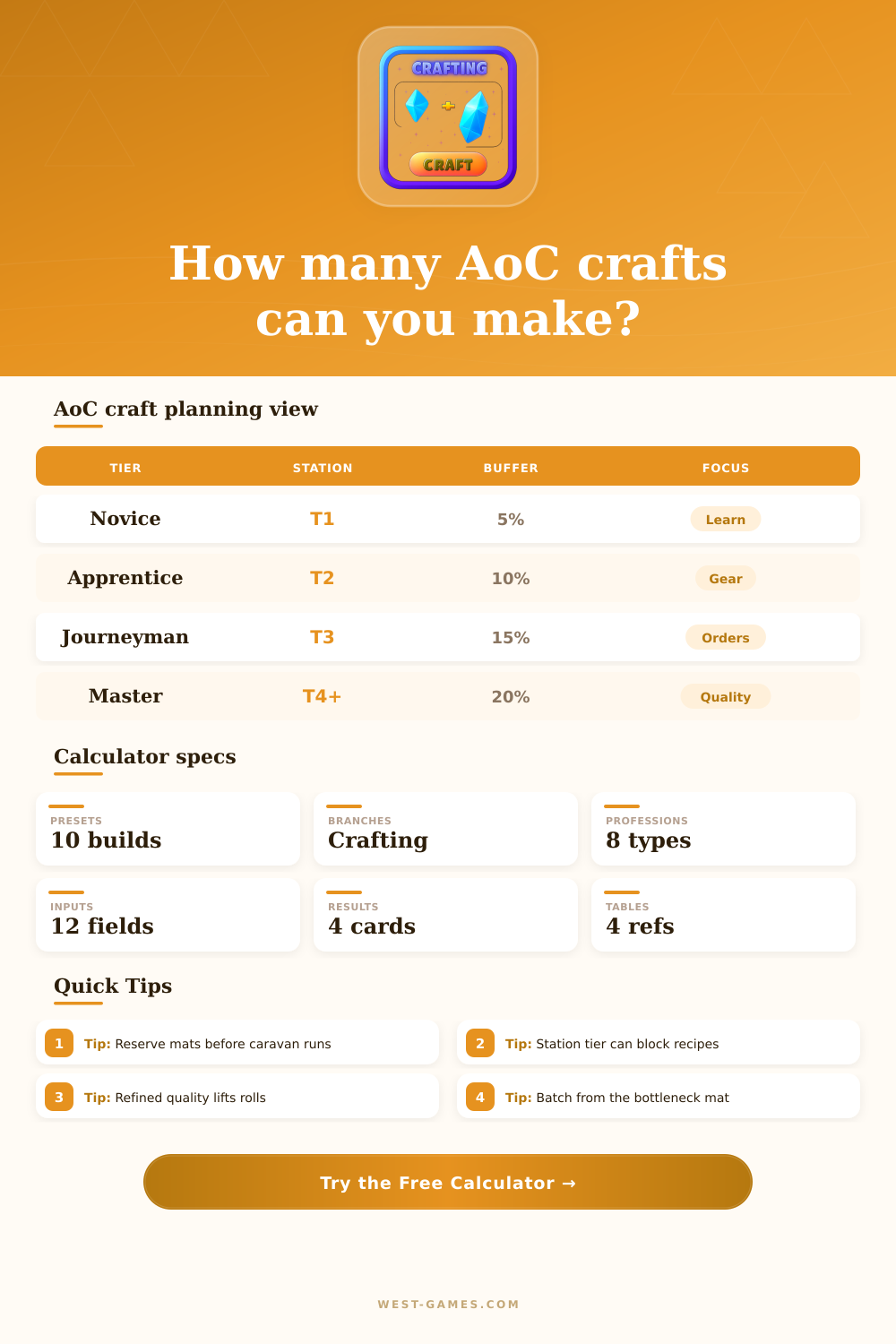
| Recipe tier | Station target | Buffer range | Planning focus |
|---|---|---|---|
| Novice / T1 | T1+ | 5% to 8% | Leveling crafts and first tools |
| Apprentice / T2 | T2+ | 8% to 12% | Early armor, weapons, and consumable runs |
| Journeyman / T3 | T3+ | 12% to 18% | Guild orders and multi-profession inputs |
| Master / T4 | T4+ | 18% to 25% | Quality rolls and caravan-linked logistics |
| Grandmaster / T5 | T5 | 25%+ | Rare catalysts, commissions, and node access |
| Profession | Primary input | Support input | Common batch use |
|---|---|---|---|
| Weapon Smithing | Ingots | Planks / leather | Weapons and fittings |
| Armor Smithing | Ingots | Leather / thread | Plate and mail pieces |
| Carpentry | Planks | Ingots / resin | Bows, tools, and parts |
| Jewel Cutting | Cut gems | Metal settings | Jewelry and sockets |
| Scribing | Paper | Ink / dust | Scrolls and contracts |
| Arcane Engineering | Essence | Ingots / crystals | Focuses and devices |
| Quality | Yield factor | Roll bonus | Best use |
|---|---|---|---|
| Crude | 0.92x | -6% | Fast leveling or salvage stock |
| Common | 1.00x | 0% | Baseline recipes |
| Fine | 1.06x | 6% | Reliable work orders |
| Heroic | 1.12x | 12% | Quality gear attempts |
| Legendary | 1.18x | 18% | Rare commissions |
| Station state | Craft access | Roll effect | Action |
|---|---|---|---|
| Below recipe | Blocked | 0% | Move to a better node station |
| Meets recipe | Allowed | Normal | Use for bulk or leveling work |
| +1 station | Allowed | +4% | Good default for valuable gear |
| +2 station | Allowed | +8% | Save for catalyst or masterwork runs |
| +3 station | Allowed | +12% | Best for scarce materials |
| Gathered stock | Processing output | Crafting destination | Buffer reason |
|---|---|---|---|
| Ore | Ingots | Weapon and armor recipes | Metal is often shared across guild orders |
| Logs | Planks | Carpentry, weapons, tools | Caravan repair and siege parts may compete |
| Hides | Treated leather | Leatherworking and armor support | Reserve for alternate armor weights |
| Fiber | Thread or cloth | Tailoring, armor support, scribing | Light gear batches consume stock quickly |
| Crystals | Essence or dust | Arcane Engineering and Jewel Cutting | Rare drops benefit from larger safety buffers |
The table names are planning examples. Update the input quantities to match the exact AoC recipe you are crafting.
Then there’s the issue of dragging a caravan full of timber and ore back into town, only to discover that your station isn’t high enough level to make those specific recipes. You stare as your junk sits in your bag, gaining useless value as you debate processing it now or waiting until the next milestone. For most artificers, this is a classic example of early game: It’s not so much a shortage of resource then it is an unwillingness to factor secret mathematics of crafting into your gameplay.
When crafting, most people plays a mental game of subtracting 10 from 5 to get two, but once you bring variable quality rolls, stations, and processing returns in the mix, that arithmetic breaks down. But when you feed your station details and stock levels into this complicated math, this handy little tool spits out an answer and eliminates all the guessing about whether to use up your materials now or wait until a caravan comes along.
How to Plan Your Crafting Better
And although the end result number’s cool, understanding what goes into it is also super valuable, especially if you’re talking about processing quality. Most newbie crafters don’t give two craps about processing quality because it seems like such a small detail. However, turning something from raw ore into common ingots versus legendary ingots completely changes your yield curve and roll chance.
The thing folks tend to get confused by is: if you’ve got a recipe where you need heroic quality stuff, but you’re using crude materials, it’s going to tank your success rate regardless of how much gear bonus you have stacked. They think “I’ll just save my materials and upgrade my processing later,” but they fail to see how that lowers their yield.
Most people don’t consider station tiers until they finds themselves unable to complete a recipe. The calculator has an option for this. If you select that checkbox, it will only show what your production would be based off the stations you have now to make sure you can produce with them first. Then, it will tell you how much better you’d do if you moved up a station.
There is also a small chance for a better quality roll, which increases every time you craft at a higher-tier station than the recipe requires. It doesn’t seem like a lot on paper, but it does make a difference over time. Crafting is a mix of materials and time, which you pay for whether you are at home or at work. If you want to make money, you should of increase your chances by doing it somewhere where the odds are slightly in your favor.
Another thing is material buffers. Because Ashes of Creation is an economy game, having reserve stock of things is very important, as otherwise, in a vacuum, you’d craft away every single ingot down to nothing. You can set a trade buffer percentage to reserve some amount of your materials, which you’ll need for caravan routes, guild orders, and emergency repairs. And it will force you to think beyond simply producing items: It forces you to think like a logistics manager and prevents you from accidentally crafting yourself all the way out of inventory.
So if increasing your buffer results in less output, don’t expect this to be a bug. That’s reality letting you know you didn’t acquire enough raw resources to meet both your crafting objectives and your trade commitments.
Last but not least, let’s talk about how masterwork and equipment bonuses figure into this since those aren’t useless stats either… They do affect the odds of rolling higher quality tiered results on your final items. In addition to commissions and catalysts, the calculator takes all this into account so you can see realisticly what you’ll be able to put out given your existing setup. By adjusting these percentage values, you’re also able to model upgrades going forward and plan accordingly for status adjustments.
For example, if you’re near completing another artisan certificate, you can immediately know how much more efficienty you’d be spending materials after acquiring the new bonus, making otherwise unclear progression goals real in terms of material cost savings.
In Ashes of Creation, crafting isn’t about pushing buttons. It’s about minimizing risk. Each craft is a gamble regarding quality, quantity, and market demand. The process of modeling those factors ahead of time eliminates guesswork and allows you to plan out your crafting runs. Rather than reacting to scarcity, you can anticipate it. It stops the stressful scramble for supplies. Instead, you get a planned production run where everything are accounted for.