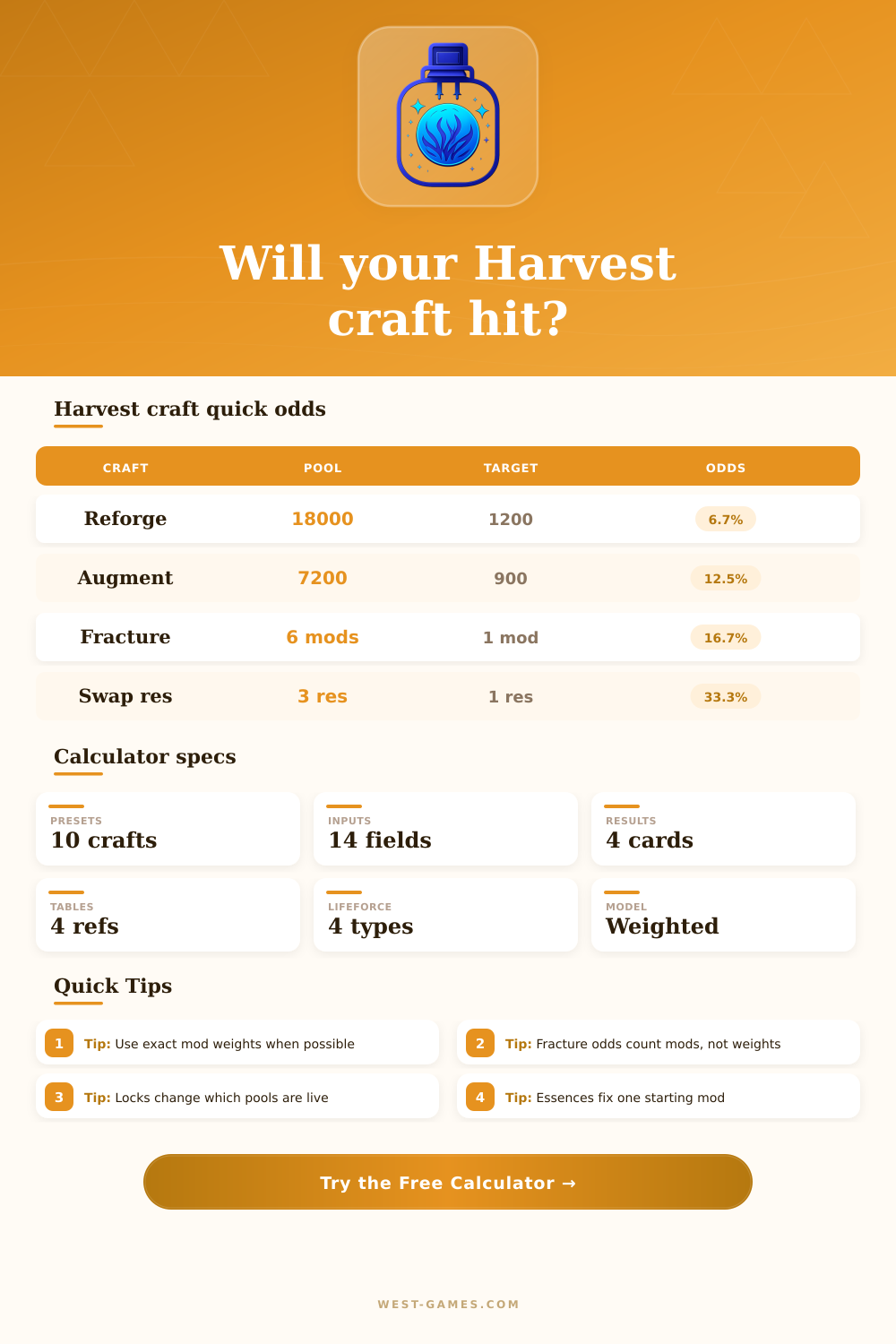
🌿 PoE Harvest Crafting Calculator
Model lifeforce color, craft type, mod pool weighting, target tags, reforge and augment assumptions, fracture odds, essence starts, probability to hit, and expected attempts.
| Lifeforce | Visual cue | Typical role | Calculator use |
|---|---|---|---|
| Wild | Purple crop family | Elemental, socket, and common station crafts | Cost label and preset grouping |
| Vivid | Yellow crop family | Caster, life, currency, and utility crafts | Weighted tag scenarios |
| Primal | Blue crop family | Cold, speed, defence, and specialist crafts | Weighted tag scenarios |
| Sacred | Boss-tier lifeforce | High-end craft assumptions such as fracture planning | Count-based fracture model |
Craft availability and exact costs can change by league. Enter the station cost you want to use rather than relying on a fixed table.
| Action | Main probability | Extra adjustment | Best input to verify |
|---|---|---|---|
| Reforge with tag | Target weight / target-tag weight | Open slot and lock pressure | Exact tag pool after item level |
| Reforge more likely | Target weight / total pool | Same-type multiplier estimate | How many current matching tags exist |
| Augment then remove | Target weight / tag pool | Chance the removal hurts the plan | Open affix and protected side |
| Remove non-target add target | Target weight / tag pool | Non-target removal availability | Filled prefix or suffix groups |
| Fracture | Target mod count / eligible mod count | No weighting after item is rolled | Number of eligible live mods |
The calculator uses simplified independent attempts for expected value. Real crafting sessions can branch after near-misses or bricked outcomes.
| Pool piece | Example weight | What changes it | Why it matters |
|---|---|---|---|
| Total eligible pool | 18,000 | Base, item level, influence, affix state | Controls broad reforge odds |
| Target tag pool | 7,200 | Tag family and cannot-roll blockers | Controls guaranteed-tag odds |
| Exact target set | 1,200 | Tier tolerance and acceptable mods | Controls success definition |
| Blocked portion | 20% | Bench blocks and filled sides | Can improve or invalidate the plan |
If multiple tiers count as success, add their weights together before entering the target modifier weight.
| Starting state | Harvest behavior to model | Input to watch | Planning note |
|---|---|---|---|
| Essence-started base | Essence mod is already present before Harvest | Current prefixes and suffixes | Good for forcing one mod before reforging |
| Protected suffixes | Reforge keeping suffixes protects that side | Open prefix slots | Target must be able to land on the open side |
| Fractured base | Locked mod stays through later rerolls | Already fractured warning | Do not model another fracture on it |
| Influenced or synthesised | Some fracture assumptions become invalid | Item state dropdown | Use warning text before committing |
The calculator separates starting-item assumptions from current live mod counts so you can model essence into Harvest or Harvest into fracture.
| Metric | Formula | Inputs | Interpretation |
|---|---|---|---|
| Adjusted pool | Pool x (1 - blocker coverage) | Total pool and blocker percentage | Approximate live weight after blocks |
| Target craft chance | Target weight / relevant pool | Target weight, tag pool, craft action | Chance a single craft creates the target |
| Expected attempts | 1 / chance | Chance per attempt | Average crafts to hit once |
| Budget chance | 1 - (1 - chance)^attempts | Chance and attempts | Chance to hit within the plan |
| Confidence attempts | log(1 - confidence) / log(1 - chance) | Chance and confidence target | Attempts for a chosen confidence level |
For reforge actions, this is a probability planning model. It does not enumerate every prefix/suffix fill pattern or hidden mod group conflict.
Path of Exile’s harvest system is gardening meets gambling. You plant some seeds, let them grow, then pray that the game blesses you with something good instead of more copies of what you already have. This is the selling point, making high-stakes crafting feel like a slower, more deliberate process, not one where you’re furiously using curse scrolls. But there’s still a chasm between “hoping” to get something and actualy getting it.
Once you grasp probability, pools, and weights, that chasm shrinks. When your odds plummet and you don’t know why, plug in your assumptions and let the calculator do its thing.
Understand the Math to Craft Better
Lifeforce colors, and the actions they unlock, is at the core of the mechanic. Each has its own action, from basic reforging to intricate fracture locking. Via wild, vivid, primal, sacred. Most player are familiar with wild’s elemental damage and vitality’s life stats. Few have realized how these picks interact with base type and item level.
There’s some math involved beyond color choice. What items does the game consider eligible to roll on this particular piece of gear? What does it consider eligible? How much is my total eligible pool weight? That’s the denominator of your chance. And if you didn’t account for low item level caps or blocked mods, then that denominator might be too large and make your perceived success rate appear greater then it truly is.
That’s what most folks are missing: they’re calculating under ideal conditions, when they’re actualy crafting in messier reality. That’s a wrinkle in the way most people think about weight-based systems.
After fracturing, it doesn’t matter what hidden weights is attached to an item anymore; it matters only flat counts. Each modifier has 3 prefixes and 3 suffixes for a total of 6. So now, depending on whether you’re trying to get a specific prefix (or suffix) as opposed to any other random prefix (suffix), your chances are completely dependent on whatever you currently have vs. What you desire. The math changes again, and the calculator internally switches over to account for that change. From that point, it goes from a weighted probability system to a count-based system. This prevents you from applying weight logic to fractures, which would lead to wrong expectations if you don’t understand how the switch works.
Now if you know that happens, then you can’t just try to force a higher tiered mod to attach when another item you also want fill the same slot. One way to reduce some of this randomness is with Essence starts. Locking in a single ideal modifier first gives you an edge over the wild card. You have fewer items to worry about but now you pay more up front.
By changing number of protected sides (and fixed mods) you can model this into the tool. It will show you if the insurance of getting an essence start is worth the cost, relative to just rolling the dice on a free reforge. For some items, it’s actualy cheaper to pay for guaranteed security than take raw chance. For others, you’re overpaying for peace of mind you aren’t actualy lacking in item state. That’s where theory becomes budgeting.
On a given attempt there’s only a six percent chance to make it. You probably need to make 10 tries before one succeeds. What if you run out of lifeforce? How many times will it take, at least on average, for this thing to succeed? And how much do you have left over for other things?
That’s what the calculator does: It tells you the expected number of attempts required for some amount of confidence. It’ll help you decide if it’s worth continuing down the crafting path, or selling now and saving up for something else with more bang-for-buck. It’ll turn a fuzzy sense of risk into a solid number you know how to budget for.
Path of Exile’s craft system is as much about managing your disappointment as it is scoring your wins. You’re going to brick your base. You’re going to lose your stuff. Often times what separates a disaster from a profitable session of crafting isn’t just luck. It’s preparation. You must understand the inputs, understand the math, and see your crops not as a slot machine but as a business operation where you plant based off purpose rather than hope.
That completely alters how you approach the game.