🚀 ARC Raiders Talent Calculator
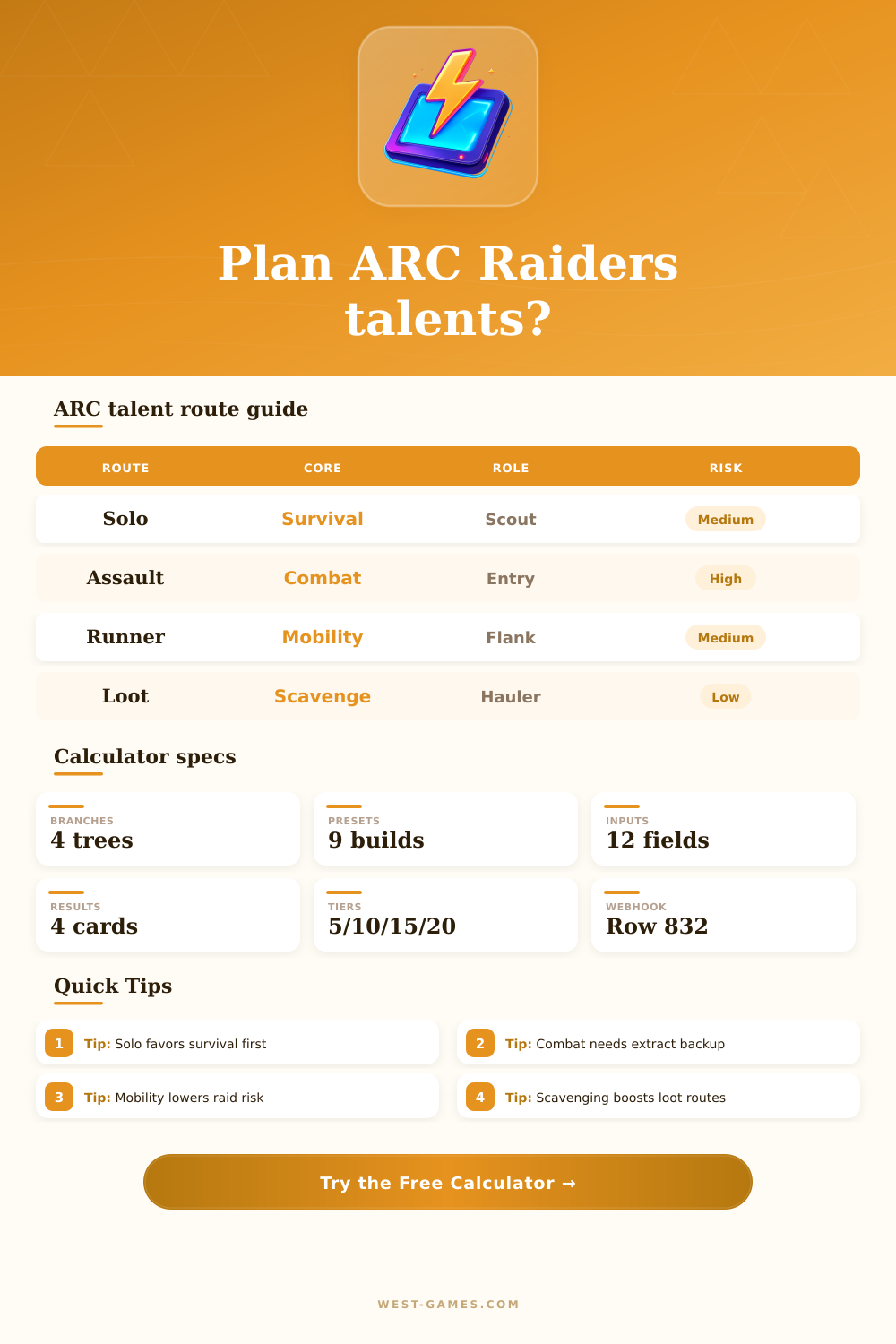
Plan survival, combat, mobility, and scavenging branches with squad role weighting, extraction risk, perk tiers, loadout synergy, and solo versus squad priorities.
| Role | Survival | Combat | Mobility | Scavenging |
|---|---|---|---|---|
| Scout | 18% | 24% | 34% | 24% |
| Assault | 20% | 42% | 22% | 16% |
| Runner | 18% | 18% | 42% | 22% |
| Support | 32% | 20% | 20% | 28% |
| Hauler | 28% | 16% | 18% | 38% |
The calculator blends these role weights with queue style, objective, loadout, armor, and extraction risk.
| Branch points | Tier label | Planning use | Common tradeoff |
|---|---|---|---|
| 5+ | Starter | Basic quality perks | Still shallow |
| 10+ | Core | First build identity | Few flex points |
| 15+ | Advanced | Main route online | Secondary branch lags |
| 20+ | Elite | High commitment | Role becomes narrow |
| 25+ | Capstone | Deep specialist route | Weak backup tools |
Use the target unlock tier input to see whether your main branch reaches the row you want.
| Loadout | Best branch | Secondary | Risk note |
|---|---|---|---|
| Light SMG | Mobility | Combat | Fragile trades |
| Marksman | Combat | Mobility | Needs spacing |
| Heavy LMG | Combat | Survival | Slow exits |
| Scrapper | Scavenging | Survival | Bag pressure |
| Stealth scanner | Mobility | Scavenging | Avoid duels |
Synergy is not a tier list. It only checks whether the chosen talents support the kit you want to bring.
| Preset | Branch focus | Queue | Objective |
|---|---|---|---|
| Solo Rat Extractor | Survival + mobility | Solo | Extract streak |
| Squad Entry Fighter | Combat + survival | Squad | PvP pressure |
| Loot Hauler Route | Scavenging + survival | Duo | Loot value |
| Mobile Flanker | Mobility + combat | Squad | Flank fights |
| Support Medic | Survival + scavenging | Squad | Team stability |
Load a preset, then overwrite branch points and context fields to match your actual raid plan.
Then you get into that sweet spot, see the ARC patrol coming, and realize your shield battery have run out. Oh no! But it’s not your bad luck. Your build architecture failed. Players approach their talent trees as if they’re cosmetics: Pick what looks good, pick what deals massive raw damage. What they neglect is that extract games are less about killing things, and more about managing risk.
Often, the key to getting that rare scrap instead of losing your whole team is choosing mobility over firepower early on. It weighs that balance out for you based off your play style against other factors. For example, it doesn’t ask you to calculate whether adding more armor will slow down your sprint recovery time. It also won’t ask if you’d rather put a bunch of points into Scavenging so you can loot everything but risk dying in the middle of a firefight. You tell it what you want and it figures it out from there.
How to Choose Your Skills
Want to run solo? The calculator prioritizes mobility and survival over teamwork, since you can’t rely on someone else reviving you. Every misstep becomes your responsibility alone. That’s a huge deal for folks who aren’t running with stranger. That all shifts when playing with a squad. Combat perks and heavy armor that cost an agility penalty become affordable if you have three other teammates covering the angles.
Weighting of branches are presented in reference tables within the interface, which show the shift different than which roles each player chooses. A hauler depend on efficient scavenging to get the most out of their loot runs; the scout requires mobility to get into flanking position. Optimize too many stats, and you end up with something that’s good at nothing. The system clues you in as to which trade-offs you’re willing to make for your role, and which will be fatal.
Players tend to overanalyze loadouts in terms of numerical values. For example, if your talent build emphasizes speed and light armor, bringing a beefy machine gun doesn’t makes much sense. You’ll be sitting ducks. You won’t take advantage of the weapon’s constant fire, and your overall movement will suffer. To address this issue, the calculator overlays your talent distribution against your kit type. So, if you pick up stealth scanner kit but allocate all your points toward aggressive combat traits, the tool informs you that there’s a mismatch between your risk posture and your loadout. In other words, it prompts you to reconsider if you’re actualy playing the game you think you are.
Many underestimate the importance of perk tiers. Yes, base-tier of each unlocks a basic sense of identity on your character, but it rarely provide enough depth for endgame content. For something to make a real impact, I like to progress down the elite and advanced branches in at least one main tree. To do this, the UI displays exactly where you sit relative to your total budget of points and the relevant tier boundaries, so you’ll always be aware of what’s just around the corner when it comes to unlocking important gameplay modifiers. Nothing worse than finding out too late that an extra two points would of unlocked some critical survival ability, and planning helps avoid all that regret.
And this isn’t about building the “perfect” build. There is no such thing as a perfect build when playing in a chaotic environment like extraction. It’s about understanding your play style and having a coherent plan for your character. You should be able to look back and say, “Oh I died there because I wasn’t wearing enough shields.” Or maybe, “I was too slow here because I have 30 pounds of armor on.” Understanding these cause-and-effect relationship are what make learning from failures so important.
Define your goal first. Let the calculator balance the branches. Then test the theory out in practice. You’ll find that being prepared matters much more then being quick on your feet.