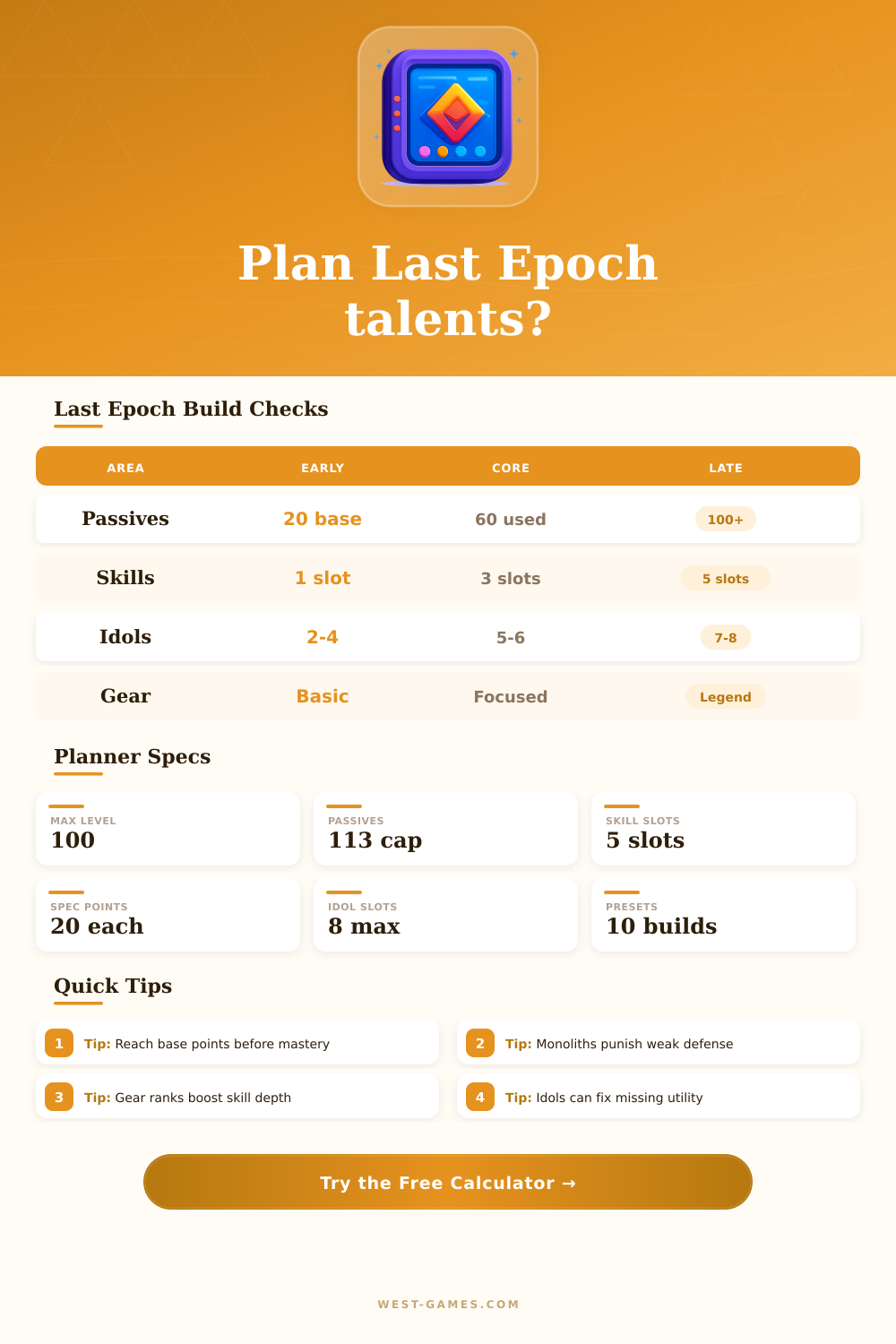
⚔ Epoch Talent Calculator
Plan Last Epoch passives, class mastery depth, specialized skill ranks, idol support, and leveling versus monolith readiness.
| Class | Masteries | Passive lean | Support note |
|---|---|---|---|
| Sentinel | Paladin, Forge Guard, Void Knight | Defense / melee | Armor, block, void, fire, minions |
| Mage | Sorcerer, Spellblade, Runemaster | Offense / ward | Spell scaling, ward, elemental tags |
| Acolyte | Lich, Necromancer, Warlock | Damage / sustain | Minions, curses, necrotic, ward |
| Rogue | Bladedancer, Marksman, Falconer | Crit / ailment | Dodge, glancing blow, bleed, falcon |
| Primalist | Beastmaster, Shaman, Druid | Hybrid / endurance | Companions, totems, forms, health |
The calculator uses these broad class identities to nudge offense, defense, utility, and support scoring.
| Checkpoint | Typical target | Calculator signal | Planning use |
|---|---|---|---|
| Base class start | 0-19 base | Early build | Campaign and identity setup |
| Mastery unlock | 20 base | Unlock ready | Commit to mastery direction |
| Core mastery | 25-39 mastery | Core online | Main mechanics are active |
| Deep mastery | 40-54 mastery | Deep nodes | Late scaling and synergy |
| Endgame depth | 55+ mastery | Capstone depth | Highly focused monolith plan |
Exact node access depends on the chosen tree, but these checkpoints make the passive budget easier to audit.
| Level band | Expected slots | Base point goal | Calculator note |
|---|---|---|---|
| Early campaign | 1-2 | 5-12 per skill | Prioritize the main clear skill |
| Mid campaign | 3 | 12-16 per skill | Add movement or defense utility |
| Late campaign | 4 | 16-19 per skill | Support loops begin to matter |
| Monolith entry | 5 | 18-20 per skill | Full five-skill plan comes online |
| Empowered push | 5 + gear | 20 + ranks | Gear ranks refine specific nodes |
The skill pool result combines specialized slots, average skill points, and total +skill ranks from gear.
| Support | Low weight | Strong weight | Best used for |
|---|---|---|---|
| Idol slots | 0-3 active | 6-8 active | Fixing resists, damage tags, sustain |
| Gear affixes | Basic rares | Exalted / sealed | Multipliers, health, ward, cooldown |
| Uniques | One-off effect | Build-around | Converting tags or enabling loops |
| +skill ranks | 0-2 ranks | 5+ ranks | Reaching expensive specialization nodes |
| Legendary potential | Minor bonus | Major synergy | Stacking unique effect plus affixes |
Support weighting is intentionally separate from passive points so you can test whether gear is carrying the build.
| Metric | Formula idea | Main inputs | Interpretation |
|---|---|---|---|
| Available passives | level - 1 + quest passives, capped | Level, quest points | Planning budget for passive allocation |
| Offense score | offense nodes + mastery + spec + gear | Offense, spec points, support | How hard the plan scales damage |
| Defense score | defense nodes + base + idols + content | Defense, idols, corruption | How well the plan absorbs monolith pressure |
| Utility score | utility nodes + slots + idols + bias | Utility, skill slots, idol support | Movement, uptime, mana, cooldown, and control |
| Build fit | weighted offense, defense, utility, budget | Content weights and sliders | Overall planner score for your selected goal |
This is a build-planning model, not a live character import. Adjust fields to match the exact nodes, idols, and affixes on your character.
Last Epochs game is about spending hours creating your character. It is also about upgrading gear and finding the ideal combination of items and passive tree.
You run into a Monolith of Fate and you find out youve got all this damage but no defense at all. The screen goes black. What happened? Usually it wasnt what you were doing with the skill. The math behind how you assigned your talents failed to account for the heavy demands of endgame content. Builds fracture under close inspection when their passives is planned in a vacuum away from idols and other gear.
How to Balance Your Character in Last Epoch
But the problem ultimatey comes down to scarcity: theres only so much room in the point grid. Youve got nodes representing your base class, mastery specialization, offense, defense, and utility. Theyre all fighting for room on a grid that fills up fast. By dumping every point into damage because it makes you feel good during early campaigns, youll run face-first into a brick wall once enemies begins returning fire in amounts more than what your health can soak up.
Thats where the calculator up top comes into play. It does the heavy lifting by juggling those priorities. It also allows you to preview how shifting your focus affect your overall viability without wasting hours grinding out gear that wont fit your real passive budget.
Next, evaluate your mastery depth. Your class identity open up after hitting 20 base points, but you are still raw. Dig deeper to find true multipliers. You will also find some serious survivability mechanics in the mastery tree. This is where many player make their initial error. Rather than committing to a core loop, they split their points between offense and defense. Often a focused build with modest stats outperform a jack-of-all-trades that does everything poorly.
Monoliths and leveling require different things from the player, and the tool helps you see this by weighing your inputs to match. The truth is that gear can allow you to skip certain nodes on your tree. Having special idols with skill ranks allows for skipping some nodes on the tree. Thats the secret efficiency of high-end builds: you dont only get gear but purchase freedom on your passive grid. Those freed up points flow into either utility or defense and turn your glass cannon into an end-game candidate.
Idols specifically shines through this. Some carefully chosen idol gives you damage bonuses or resistances that would normally require a long trek through the skill tree, all at the cost of valuable connections.
So what do you really play? Do you prioritize pushing Empowered Monoliths? Do you focus on leveling? Do you just go full-out offense? Offense is king in the early game where speed of clearing is a bottleneck. Or do you focus on survival? Survival is the bottleneck in high-end endgame. If you arent going to survive, how much damage you deal dont matter.
You can tweak weights between monolith readiness vs leveling, and get an honest score that reflects your real goals, as opposed to some sort of theoretical max. What happens is that youll end up distributing passives according to the environment youre facing.
Dont ignore usefulness. Utility like mobility, mana regen and cooldown reduction can be an after-thought but theyre what makes your rotation feel smooth or not. You can have a very high-skill build with slow, frustrating gameplay because it cannot keep its skills active enough. Also dont forget about your overall number of skill specializations available. Are you putting enough points in to hit the breakpoints of utility nodes to even benefit from them? Otherwise youre swinging slower and getting nothing out of it.
But ultimately, a solid Last Epoch build is one whose balance of defense, offense, and utility come together like an equation. You want enough of each so you can stay alive, dish out damage in pack clears, and keep things moving smoothly.
How do various classes skew toward those goals? Those are laid out in the reference tables on the page, but what you wind up with will be determined by your own personal playstyle and gear set. Experiment with various allocations using the tool. Play around with idol slots. Shift points from damage to health until you have a score representing a character that isnt merely powerful on paper but robust to boot. You should of crafted with intent, and youll find the echoes reward you for it.